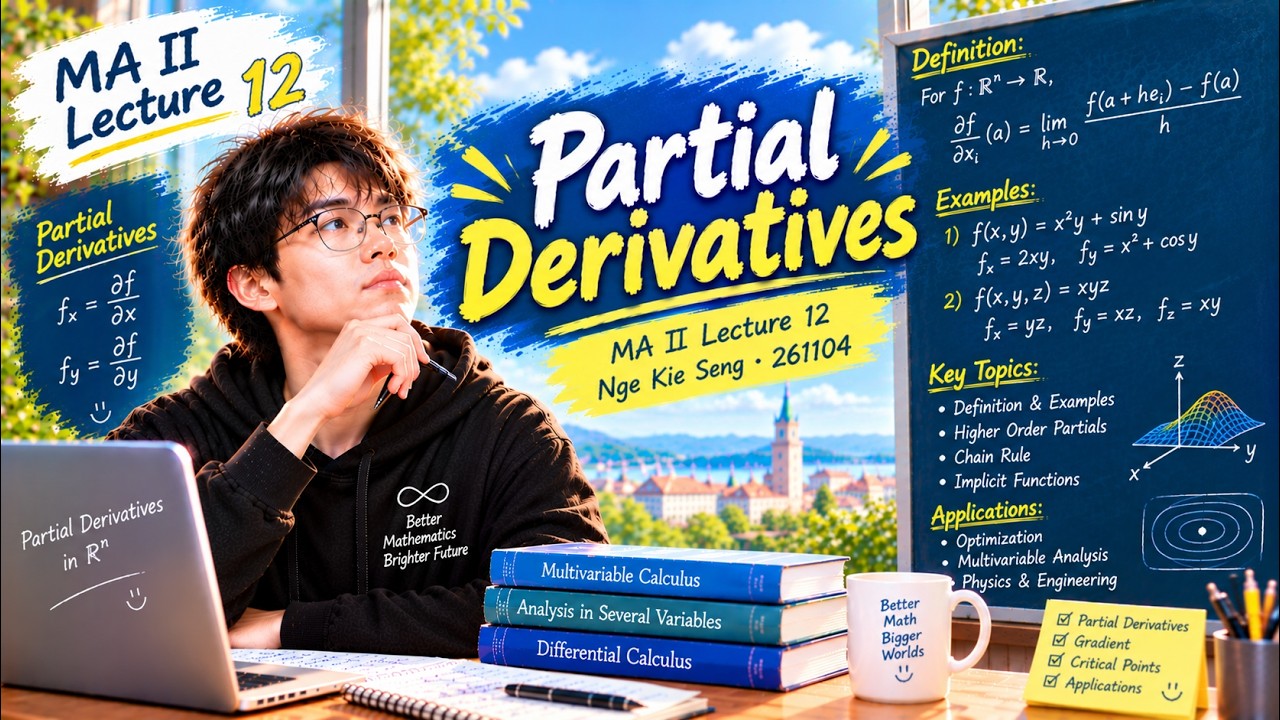
Partial Derivatives | MA II Lecture 12 | Nge Kie Seng 261104
Title history
- Partial Derivatives | MA II Lecture 12 | Nge Kie Seng 261104 — observed on 20261109-0802 UTC (YouTube)
Keywords
Summary
165 words
Critical Evaluation
Value of the Information & Strength of the Argument
The lecture provides substantial value by guiding students from foundational definitions to a subtle theorem in multivariable calculus. The instructor carefully justifies each step, particularly the use of the sequential definition of limits and the need for continuous differentiability. The proof of Clairaut’s theorem is well-structured, using the mean value theorem in a didactic manner to exchange the order of partial derivatives. The argumentation is solid and pedagogically effective, with logical progression and clear connections to prior material. However, the lecture is not original in content, and its value lies in the exposition rather than new knowledge.
Scientific Rigor, Source Quality, Title Accuracy
The scientific rigor is high in terms of mathematical correctness: definitions and proofs follow standard analysis textbooks. No external sources are cited, which is typical for a lecture, but it limits verifiability. The title precisely matches the content, as the lecture focuses exclusively on partial derivatives. The lecture’s internal consistency is good, and the instructor openly discusses conventions, such as the order of subscripts, to avoid ambiguity. The absence of citations is not a major flaw given the educational context, though a viewer seeking rigorous references would need to consult standard texts.
204 words
Title / Content Match
The title accurately reflects the content: the lecture indeed focuses on partial derivatives and related concepts such as continuity and mixed partials.
Quality & Reliability
7/10
The lecture provides a rigorous and detailed treatment of partial derivatives, including proofs and counterexamples. However, no external sources are cited, and the transcription is imperfect (with several unclear passages). The mathematical content is standard and appears accurate, but a critical viewer would seek additional references for verification.
Key Moments
Markers derived by PSI from the transcript: the creator did not define chapters.
- Recall of limit points and continuity from previous lectures.
- Discussion of the sequential definition of limits and its equivalence to epsilon-delta.
- Introduction of the partial derivative definition with respect to a single variable.
- Counterexample showing that partial derivatives do not imply continuity.
- Definition of continuous differentiability and second-order partial derivatives.
- Statement and proof of Clairaut's theorem (symmetry of mixed partials).
Contribution & Novelties
This lecture offers a clear and methodical approach to a standard topic. Its original contribution lies in the pedagogical structure: it explicitly motivates the need for continuous differentiability by showing the failure of continuity from mere partial derivative existence, and it provides a rigorous proof of Clairaut’s theorem using the mean value theorem. The lecture also emphasizes the importance of open sets and the sequential definition of limits, which are often glossed over in introductory courses. For further exploration, consider the following references:
Pour aller plus loin :
- Partial derivative — This Wikipedia page gives a comprehensive overview of partial derivatives, including definitions, notation, and examples.
- Symmetry of second derivatives — This page details Clairaut’s theorem and the conditions under which mixed partial derivatives commute.
- Mean value theorem — A fundamental theorem in calculus used in the proof presented in the lecture.
142 words
Radar Profile
The radar profile shows strong scores in quantity of information, quality of information, and technical level, reflecting a dense and mathematically demanding lecture. The reliability score is slightly lower due to the lack of cited references, but the content aligns with standard mathematical knowledge. This profile is typical for an advanced instructional video.