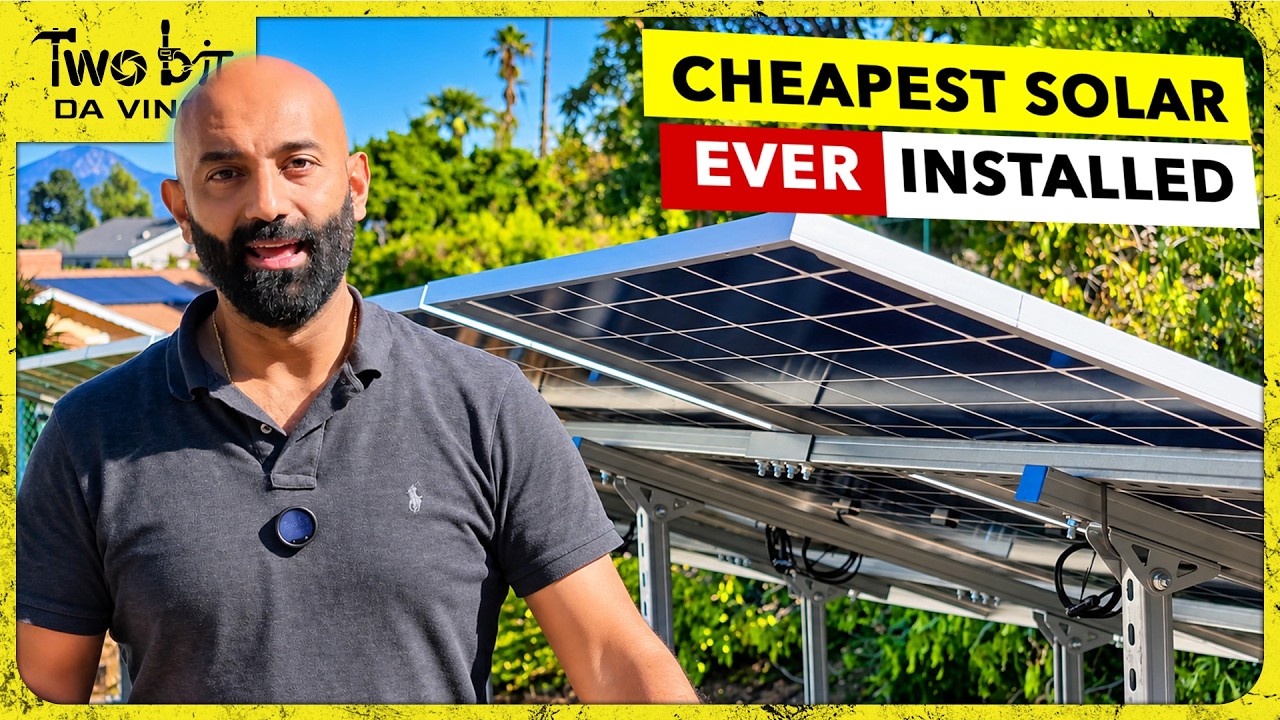
The Cheapest Way to Go Solar in 2026
Title history
- The Cheapest Way to Go Solar in 2026 — observed on 20261031-2305 UTC (YouTube)
Keywords
Summary
121 words
Critical Evaluation
Value of the Information & Strength of the Argument
VALUE OF INFORMATION: The video offers tangible value by providing real-world cost data, installation procedures, and performance metrics. It breaks down the cost of solar panels ($0.65/W), racking, concrete, and wiring, and compares it to traditional installer quotes. The demonstration of adding 5 kWh of storage in 5 minutes and the stress test to 10 kW illustrate practical capabilities. STRENGTH OF ARGUMENT: The argument that solar+storage is now the most cost-effective approach under NEM 3.0 is supported by a bill analysis for Carl’s home, showing a $2,300 annual saving and a 5-6 year payback. However, the argument is somewhat one-sided due to the sponsorship and the omission of labor costs, which the host acknowledges but leaves to the viewer to estimate. The case is persuasive but not fully balanced.
Scientific Rigor, Source Quality, Title Accuracy
SCIENTIFIC RIGOR: The video relies on empirical observations from a single installation and specific utility data, but lacks peer-reviewed sources or systematic comparisons. The cost estimates are transparent but conditional on DIY labor. QUALITY OF SOURCES: The primary source is EcoFlow’s product information and pricing, supplemented by the host’s own measurements and a utility bill forecast. No academic or industry studies are cited. TITLE ADEQUACY: The title accurately reflects the content: it shows a method to achieve a complete solar+storage system for approximately the cost of solar alone, without overpromising. The video delivers on this claim within the described constraints.
244 words
Title / Content Match
The title is apt: the video presents a cost-effective solar+storage solution with a specific price point, aligning with the promise of the 'cheapest way'.
Quality & Reliability
7/10
The video provides concrete cost figures and installation details, but its sponsorship by EcoFlow may bias the recommendations. The analysis is based on the host's experience and a single installation, lacking broader statistical evidence.
Chapters
Cited Sources
- EcoFlow TITAN Series — Product page for the EcoFlow Titan system installed in the video.
- EcoFlow TITAN Early Bird Offer — Special pricing and promotion mentioned for the Titan, including installation discounts.
- Ground Mount Racking Link — Amazon link to the ground mount racking system used in the installation.
- Two Bit da Vinci website - How EcoFlow Solved Going Solar in 2026 — Companion page with additional information on the video and perhaps further details.
External References
Contribution & Novelties
This video contributes a hands-on, real-world demonstration of a plug-and-play solar+battery system at a claimed cost of approximately $0.65 per watt for panels and a total system cost comparable to traditional solar-only installations. It uniquely highlights the ease of expansion and the importance of future-proofing given Jevons paradox. The presentation of a 5-6 year payback under NEM 3.0, despite the loss of tax credits, is a valuable data point for homeowners.
Pour aller plus loin :
- Net metering — Explains the mechanism that affects solar economics, as referenced in the NEM 3.0 discussion.
- Jevons paradox — The economic concept used to justify oversizing the system for future increased energy use.
- Solar power in California — Provides context on the regulatory and market environment mentioned in the video.
127 words
Radar Profile
The radar profile shows a balanced distribution with high scores in information quantity and quality, moderate technical depth, and slightly lower reliability due to the sponsored nature. This suggests the video is informative and detailed but may have a promotional bias.
💬 Among the 30 comments analyzed, the tone is balanced: viewers appreciate the detailed cost breakdown and practical demonstration, but many express concerns about the omitted labor costs and the apparent sponsorship, while some share their own DIY experiences and cost comparisons.