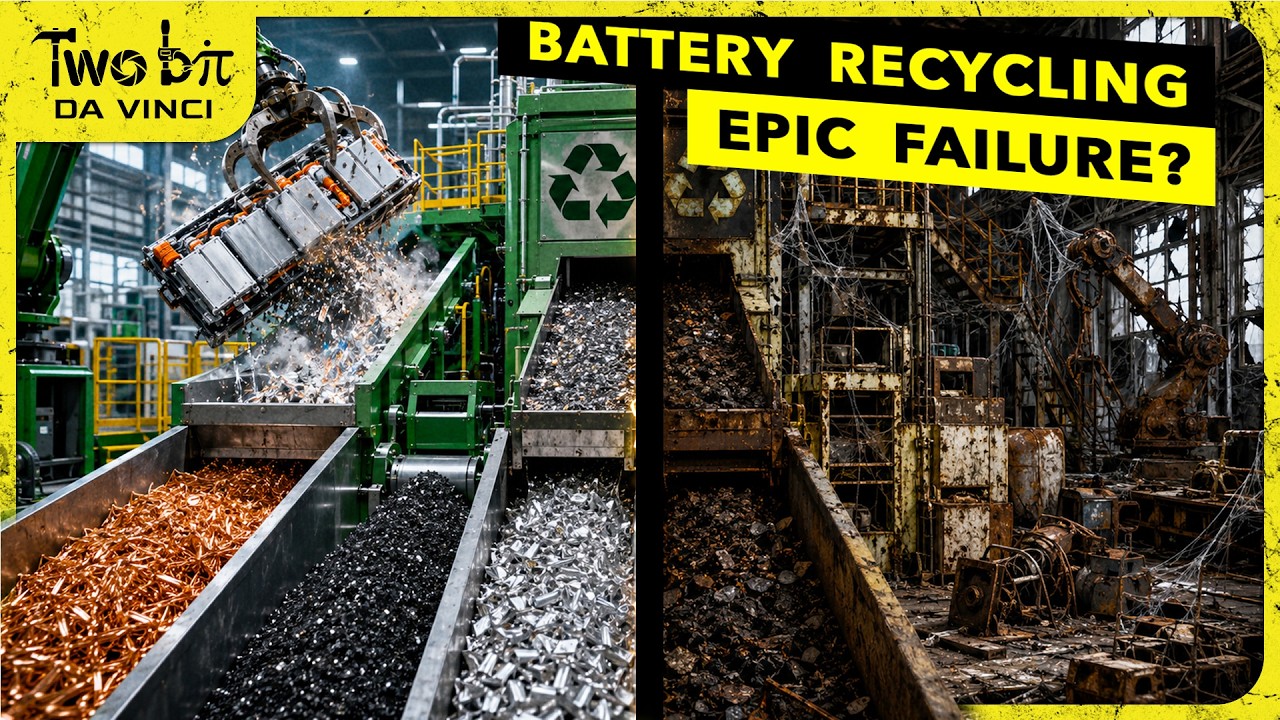
Battery Recycling Has Been an Epic Failure - What Happened?
Title history
- Battery Recycling Has Been an Epic Failure - What Happened? — observed on 20261101-0045 UTC (YouTube)
Keywords
Summary
148 words
Critical Evaluation
Value of the Information & Strength of the Argument
The video provides valuable information by synthesizing numerous real-world case studies, financial figures, and technical details. It effectively argues that recycling failures stem from a combination of chemistry shifts, economic volatility, and strategic missteps. The argumentation is solid, presenting a logical sequence: the economic incentive disappears with LFP, the technical bottleneck is in refining, and the feedstock assumptions were wrong. The use of specific examples (Ascend, Li-Cycle, Northvolt) and contrasting success in China strengthens the case. However, the presenter’s bias is evident, and some claims lack direct citation, but overall the reasoning is coherent and supports the thesis.
Scientific Rigor, Source Quality, Title Accuracy
The video demonstrates reasonable scientific rigor by referencing industry data and reports (Benchmark Minerals, Fraunhofer, ADAC, Recurrent) without providing explicit links. The sources mentioned are credible, but the lack of direct URLs reduces verifiability. The title is appropriate and matches the content, focusing on the failure narrative. The video does not overstate its conclusions and acknowledges nuances, such as the positive American Battery Technology example. The presence of a sponsor segment (Fitnexa) is noted but does not detract from the core analysis. Overall, the scientific quality is good for a popular-tech channel, though not peer-reviewed.
208 words
Title / Content Match
The title accurately reflects the content, which explains why battery recycling has failed economically and technically.
Quality & Reliability
7/10
The video cites specific data from industry sources like Benchmark Minerals, NPR, Fraunhofer, and ADAC, and provides detailed financials from company filings. However, it relies heavily on news reports and presenter interpretation, with some potential bias from the sponsor segment.
Chapters
- The Recycling Paradox
- LFP vs. NMC
- Recycling's Shifting Forecast
- Battery Chemistry Explained
- Fitnexa Somnipods 3
- Black Mass & Pyrometallurgy
- Hydrometallurgy & Direct Recycling
- Ascend Elements' Downfall
- The Refinery Bottleneck
- Lycycle's Single Point Failure
- Industry Giants Hesitate
- Commodity Price Volatility
- Batteries Last Longer
- Manufacturing Scrap Dries Up
- Why China Succeeds
- American Battery Technology
- Outro
External References
Contribution & Novelties
The video’s original contribution is its synthesis of recent bankruptcies and market shifts in the battery recycling industry, linking chemistry changes (LFP vs NMC) to economic viability. It also highlights the role of manufacturing scrap and battery longevity, offering a multi-factor explanation for the failure. The comparison with China’s regulatory and integrated model provides actionable insights.
Pour aller plus loin :
- Battery recycling - Wikipedia — Overview of recycling processes and challenges.
- Lithium iron phosphate - Wikipedia — Chemistry and cost implications for recycling.
- Hydrometallurgy - Wikipedia — Technical details of acid-based recovery methods.
- Direct recycling (battery) - Wikipedia — Potential future approach for cathode rejuvenation.
106 words
Radar Profile
The profile shows high information quantity (8/10) and moderate technical depth (7/10), with good quality and reliability. This suggests a content-rich video with balanced technical explanations, suitable for an informed audience.
💬 positif: Sur les 30 commentaires analysés, les avis sont majoritairement positifs, saluant la profondeur de l'analyse et ajoutant des nuances pertinentes.