Lecture 7 on Topic 6: Glass Shaping
Title history
- Lecture 7 on Topic 6: Glass Shaping — observed on 20261114-0310 UTC (YouTube)
Keywords
Summary
149 words
Critical Evaluation
Value of the Information & Strength of the Argument
The lecture provides valuable insights into the physics governing glass shaping, particularly the stability of cane drawing. The argumentation is solid: the instructor builds a case from the Stokes equation to explain why necking is mitigated by temperature-dependent viscosity. He uses scaling analysis, Stefan-Boltzmann’s law, and a numerical simulation to support the hypothesis. The reasoning is logical, and the connection between theoretical models and practical observations is clearly established. The inclusion of the Virtual Glass software demonstrates how cutting-edge tools can replace empirical guessing. The lecture stands out for its depth of explanation and rigorous quantitative approach, making it highly informative for students and professionals alike.
Scientific Rigor, Source Quality, Title Accuracy
The lecture is part of MIT’s OpenCourseWare program, ensuring high academic standards. The instructor, Juejun Hu, is a professor at MIT, lending credibility to the content. The sources referenced, such as the course website and Virtual Glass, are legitimate and verifiable. The title ‘Lecture 7 on Topic 6: Glass Shaping’ accurately reflects the main subject, though it understates the emphasis on the physics of viscosity and heat transfer. The content is well-structured, with clear explanations and demonstrations. Overall, the editorial quality is excellent, with no noticeable bias or inaccuracies in the presented material.
214 words
Title / Content Match
The title accurately reflects the lecture's focus on glass shaping processes, though the lecture also covers related physics and heat transfer principles.
Quality & Reliability
9/10
Content from MIT OpenCourseWare, presented by a qualified instructor, with clear explanations and rigorous scientific content.
Key Moments
Markers derived by PSI from the transcript: the creator did not define chapters.
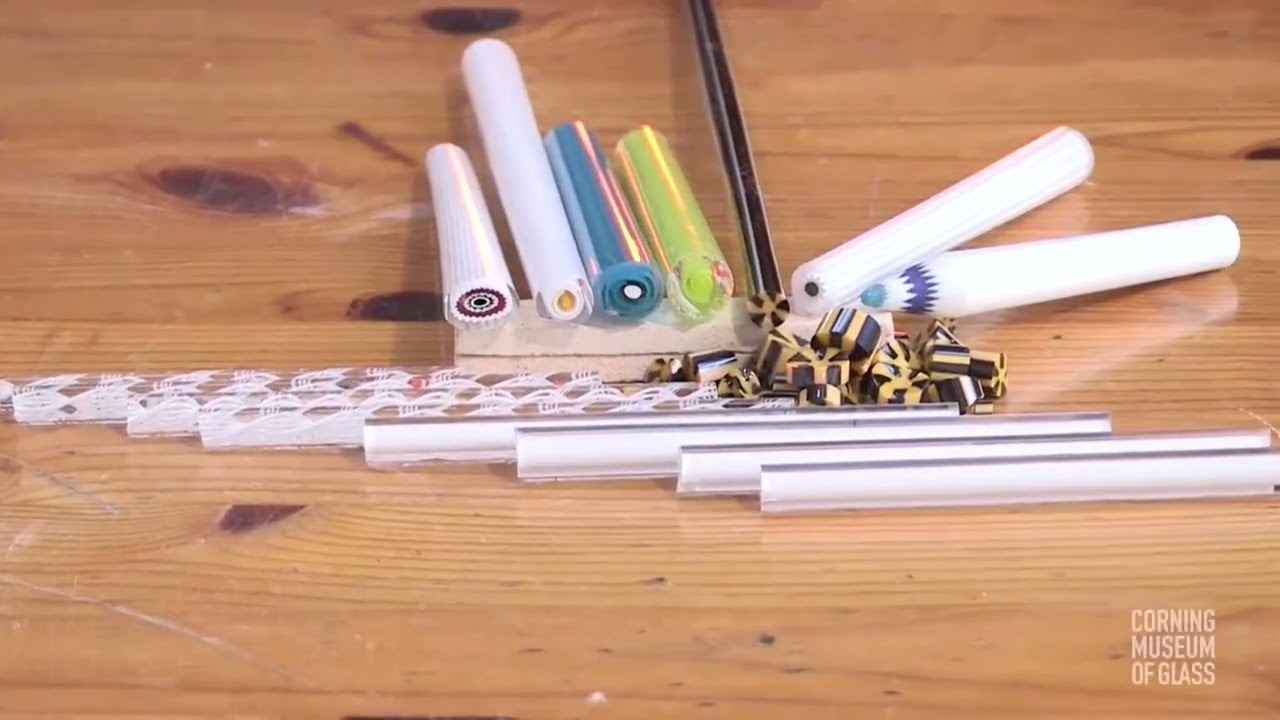
- Introduction to cane working and historical context in Venice and Murano.
- Explanation of cane creation steps and the Virtual Glass software.
- Video demonstration of millefiori making and pattern embedding.
- Analysis of why cane doesn't break during drawing, introducing scale invariance and necking.
- Heat dissipation mechanisms and derivation of Stefan-Boltzmann radiative cooling, followed by model results.
Cited Sources
- MIT OCW 3.071 Amorphous Materials Course Page — Complete course resource including lecture notes and materials.
- YouTube Playlist for the Course — Playlist of all lectures in the series.
- MIT OpenCourseWare Main Site — General access to MIT course content.
External References
Contribution & Novelties
The lecture uniquely integrates classical glassworking techniques with modern computational simulation (Virtual Glass), offering a novel pedagogical approach. It explains the stability of cane drawing through quantitative analysis, showing how radiative heat transfer and temperature-dependent viscosity prevent necking. This bridges empirical craftsmanship and materials science.
Pour aller plus loin :
- Stefan–Boltzmann law — Fundamental for understanding radiative heat transfer in hot glass.
- Viscosity — Core concept for glass flow behavior.
- Glass transition — Relates to temperature dependence of viscosity.
- Newtonian fluid — Basis for the linear stress-strain rate assumption used in the model.
93 words
Radar Profile
The radar profile shows strong scores in quality, fiabilité, and technical level, with slightly lower but still high quantity of information. This indicates a trusted, detailed, and research-backed lecture, well-suited for advanced learners.