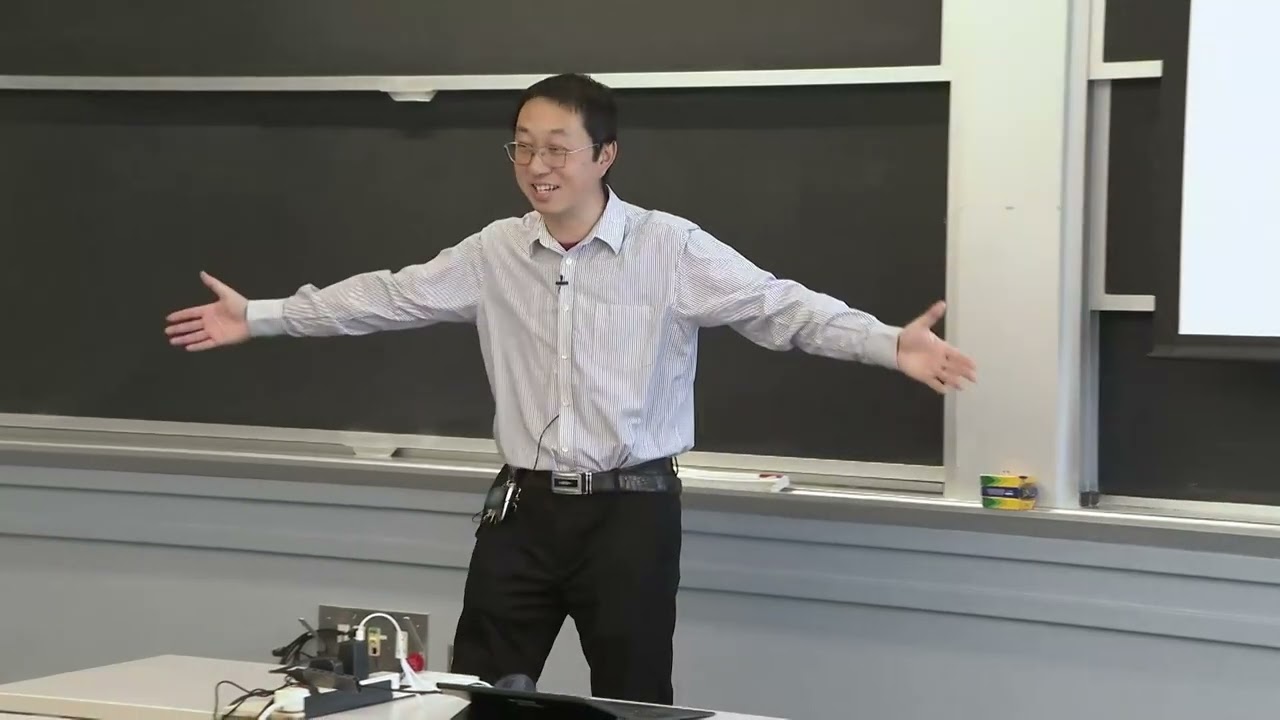
Lecture 8 on Topic 7: Viscoelasticity and Relaxation
Title history
- Lecture 8 on Topic 7: Viscoelasticity and Relaxation — observed on 20261114-0310 UTC (YouTube)
Keywords
Summary
161 words
Critical Evaluation
Value of the Information & Strength of the Argument
The lecture provides a well-structured and rigorous development of viscoelasticity theory, starting from fundamental definitions and building up to complex models. The argumentation is logical, with clear derivations of key equations (e.g., exponential stress decay) and proper justification for each assumption. The connection between microscopic relaxation mechanisms and phenomenological model elements is explicitly made, enhancing conceptual understanding. The inclusion of the Deborah number and its biblical origin adds cultural context, while the discussion of the glass transition puzzle situates the topic within broader scientific challenges. The argumentation is solid, with each step clearly motivated and mathematically sound.
Scientific Rigor, Source Quality, Title Accuracy
The lecture is scientifically rigorous, with precise definitions and derivations. Sources are primarily internal to the course (previous lectures) and standard textbook knowledge, but external references include Science’s 125th anniversary list and a quote from physicist David Weitz, adding credibility. The title accurately reflects the content, as the entire lecture is dedicated to viscoelasticity and relaxation. No external sources are cited explicitly beyond the course materials, but the content is consistent with established physics. The description provides links to MIT OpenCourseWare resources, which serve as authoritative backing for the educational content.
203 words
Title / Content Match
Le titre correspond exactement au contenu : la leçon traite de la viscoélasticité et de la relaxation dans le contexte des matériaux amorphes.
Quality & Reliability
9/10
The lecture is delivered by an MIT instructor, well-structured, with rigorous mathematical derivations and citations to scientific literature. The content is accurate and pedagogically sound, though no external verification beyond the course context.
Key Moments
Markers derived by PSI from the transcript: the creator did not define chapters.
- Introduction to the lecture topic and why viscoelasticity and relaxation are treated together.
- Discussion of the glass transition as a defining feature and citation of Science's 125th anniversary question.
- Explanation of why relaxation is only significant in the glass transition regime, introducing the Deborah number.
- Introduction of complex shear modulus separating storage and loss moduli.
- Derivation of Maxwell element response under constant stress and constant strain.
- Derivation of exponential stress relaxation and the relaxation time tau.
- Presentation of loss tangent and its frequency dependence.
- Introduction of Voigt-Kelvin element and strain relaxation behavior.
- Generalized Maxwell model and the sum of exponentials leading to stretched exponential function.
- Illustration of elastic, viscous, and viscoelastic responses, and examples of materials exhibiting viscoelasticity.
Cited Sources
- MIT OpenCourseWare course 3.071 — Page officielle du cours, référencée dans la description.
- YouTube Playlist — Playlist de la série de cours.
- OCW Terms — Conditions d'utilisation de MIT OCW.
- OCW Support — Lien de soutien à MIT OCW.
- OCW Main — Site principal du programme.
- OCW Comments Policy — Politique de commentaires de la chaîne.
Contribution & Novelties
The lecture provides an integrated treatment of viscoelasticity and relaxation, emphasizing their shared mathematical foundations, which is an uncommon organizational approach in glass science literature. It derives the stretched exponential function from a generalized Maxwell model, linking multiple relaxation mechanisms to observable behavior, and clearly establishes the equivalence between phenomenological models and microscopic structural relaxation. The pedagogical clarity in connecting the Deborah number, complex modulus, and relaxation kinetics is a valuable contribution to learners.
Pour aller plus loin :
- Viscoelasticity — Overview of viscoelastic behavior and models.
- Deborah number — Dimensionless number defining material response timescales.
- Stretched exponential function — Mathematical form used for relaxation distributions.
- Glass transition — Fundamental phenomena underlying the lecture’s context.
115 words
Radar Profile
Le profil radar présente des scores très élevés et équilibrés dans toutes les dimensions, reflétant une leçon académique complète, techniquement rigoureuse et fiable. La quantité et la qualité de l'information sont maximales, avec un niveau technique avancé et une fiabilité globale sans faille.