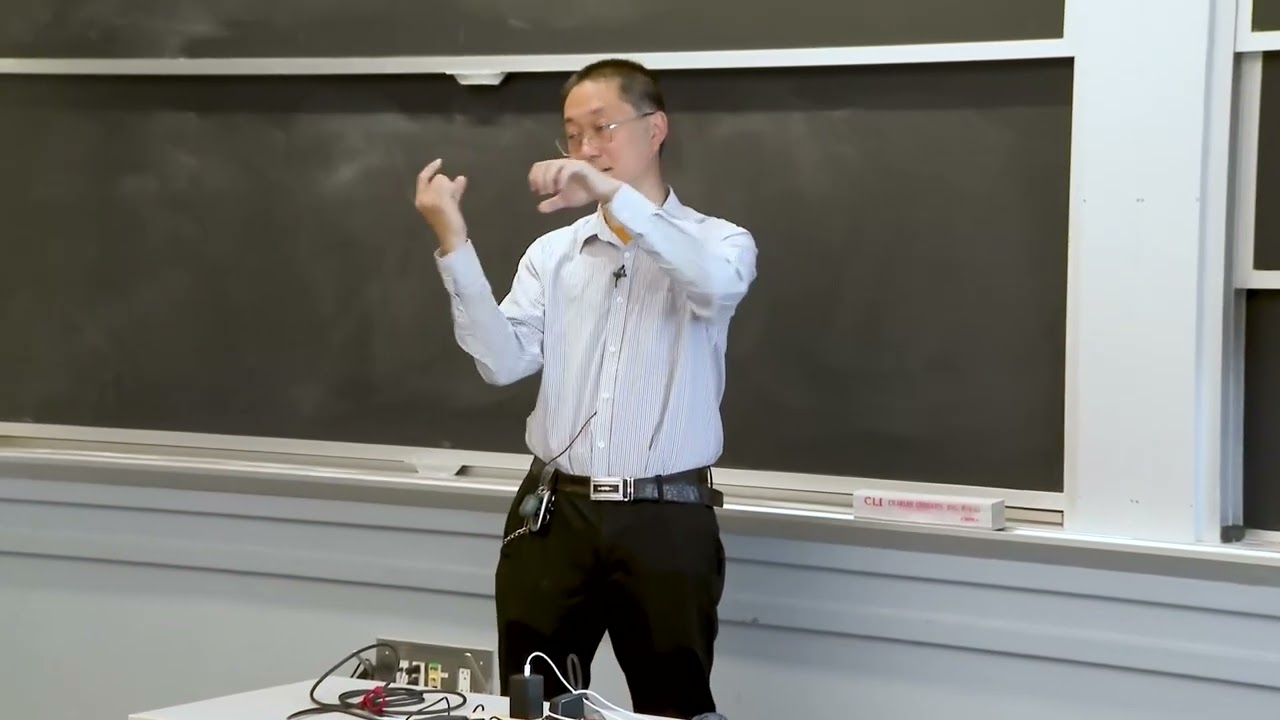
Lecture 21 on Topic 14: Optical Fibers and Waveguides
Title history
- Lecture 21 on Topic 14: Optical Fibers and Waveguides — observed on 20261114-0306 UTC (YouTube)
Keywords
Summary
218 words
Critical Evaluation
Value of the Information & Strength of the Argument
The information presented is highly valuable for understanding the design and fabrication of optical waveguides, particularly the roles of material choice and manufacturing processes. The argumentation is solid: the instructor builds a coherent narrative from the broad motivation of integrated photonics to specific loss mechanisms and fabrication techniques. He uses quantitative models, such as the scattering loss equation and the equipartition theorem for surface roughness, to support his claims. The comparisons between optical fibers and planar waveguides are clearly explained with physical reasoning, making the material accessible yet technically rigorous. The lecture successfully bridges fundamental concepts (total internal reflection, Rayleigh scattering) with practical engineering considerations (deposition rates, lithographic precision).
Scientific Rigor, Source Quality, Title Accuracy
Scientific rigor is high: the lecture is part of an MIT course, the instructor is an expert in the field, and the content includes equations and references to historical work (e.g., Stewart Miller’s 1969 paper). While no formal citations are given during the lecture, the course page and related links are provided for further study. The title precisely matches the content, covering both optical fibers and waveguides. The lack of YouTube comments (only 8 views and 0 likes) does not allow an analysis of public reception, but the lecture’s quality is evident from its structure and depth.
221 words
Title / Content Match
The title accurately reflects the content, covering both optical fibers and waveguides in a structured lecture.
Quality & Reliability
9/10
Lecture by a recognized professor at MIT, structured and rigorous, with equations and historical context. The content is authoritative and technically detailed, though it relies on the instructor's expertise rather than external citations.
Key Moments
Markers derived by PSI from the transcript: the creator did not define chapters.
- Introduction to integrated photonics and analogy with electronic integrated circuits.
- Moore's law and scaling of hard drives, motivating similar exponential growth for optics.
- Comparison of traditional discrete optics lab vs. photonic integrated circuits.
- History: Stewart Miller's 1969 proposal of integrated optics on a glass plate.
- Waveguide structure: substrate, cladding, core; materials and advantages of amorphous materials.
- Loss comparison between optical fibers (0.2 dB/km) and on-chip waveguides (dB/cm), and reasons for high waveguide loss.
- Surface roughness scattering mechanisms in fibers and planar waveguides; surface capillary waves.
- Fabrication of planar waveguides: lithography, deposition, and etching; role of amorphous materials.
- Ion exchange method for glass waveguides: silver-sodium exchange and field-assisted burial.
Cited Sources
- MIT OCW Course Page: 3.071 Amorphous Materials, Spring 2025 — Course homepage with full materials and syllabus.
- MIT OCW Terms of Use — License and usage terms for OCW content.
- MIT OCW Comments Policy — Guidelines for comments on OCW media.
- Support MIT OpenCourseWare — Donation link supporting OCW.
- MIT OpenCourseWare Main Site — General OCW portal.
- YouTube Playlist for 3.071 — Full playlist of course lectures.
Contribution & Novelties
The lecture offers a clear presentation of how amorphous materials, particularly glass, are central to modern integrated photonics. It uniquely highlights the interplay between surface roughness, index contrast, and loss in both fibers and planar waveguides, and details fabrication methods such as ion exchange that exploit the processability of glass. The discussion of surface capillary waves and their contribution to scattering in microstructured fibers is particularly insightful.
Pour aller plus loin :
- Total internal reflection — Fundamental principle underlying light confinement in waveguides.
- Photonic integrated circuit — Overview of integration concepts and applications.
- Optical fiber — General background on fibers and loss mechanisms.
- Modified chemical vapor deposition (MCVD) — Preform fabrication technique for optical fibers.
115 words
Radar Profile
The radar profile shows uniformly high scores across quantity, quality, technical level, and reliability, indicating a dense, well-structured, and authoritative technical lecture that excels in all evaluated dimensions.