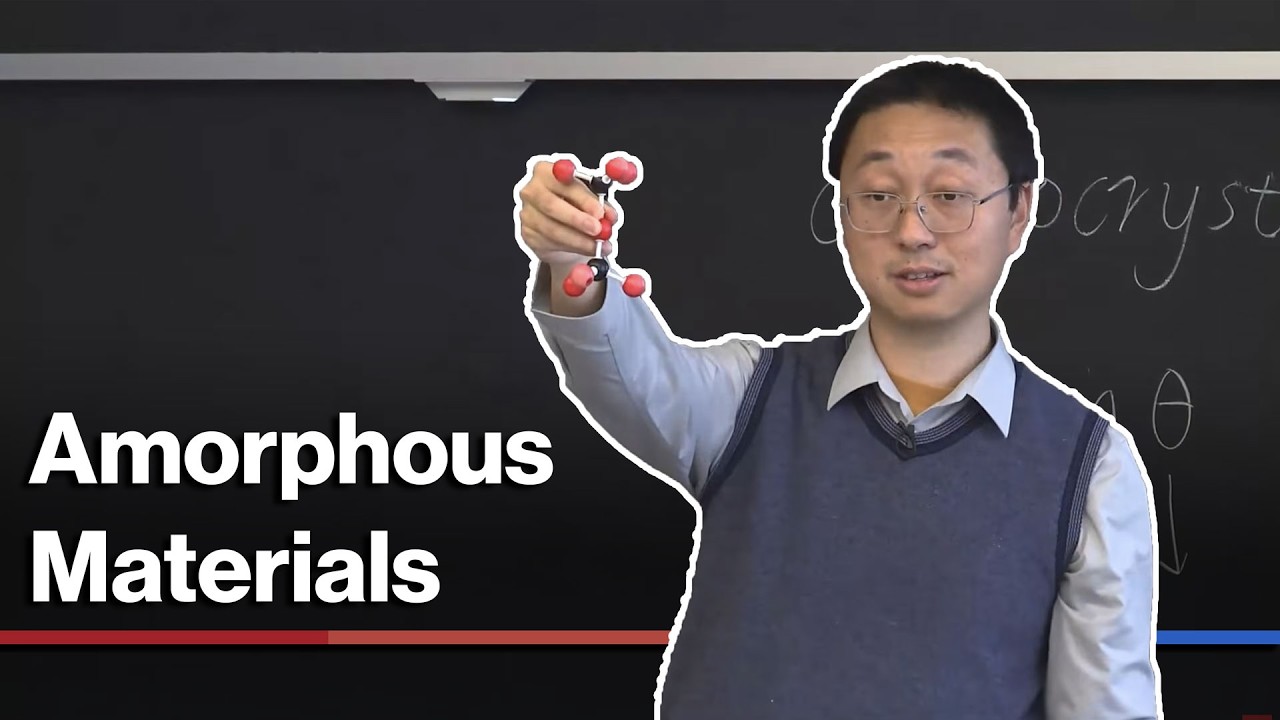
Lecture 1 on Topic 1: Fundamentals of the Amorphous State
Title history
- Lecture 1 on Topic 1: Fundamentals of the Amorphous State — observed on 20261114-0303 UTC (YouTube)
Keywords
Summary
113 words
Critical Evaluation
Value of the Information & Strength of the Argument
The lecture provides a comprehensive introduction to amorphous materials, blending qualitative descriptions with references to advanced topics like glass transition and ion-exchange strengthening. The argumentation is clear and well-supported by demonstrations (e.g., Prince Rupert’s drop) and industry examples. The interactive components engage students in thinking about properties. However, the scientific depth is introductory, suitable for a first lecture, and the argumentation is mostly expository rather than critical. The inclusion of a Corning video adds a practical perspective but is promotional in nature.
Scientific Rigor, Source Quality, Title Accuracy
The scientific rigor is high: the instructor is a MIT professor with expertise in optics and materials. Sources include standard textbooks and the MIT OCW platform. The title accurately reflects the content, focusing on fundamentals. The video is an educational resource, not a formal publication, but the information aligns with established science. No conflicting sources are presented.
154 words
Title / Content Match
The title accurately reflects the lecture's scope: it covers fundamentals of the amorphous state, including definition, structure, and formation, as described in the video.
Quality & Reliability
9/10
The content is presented by MIT professor Juejun Hu, based on established textbook knowledge and structured pedagogical material. The lecture references credible sources, including standard texts and MIT OpenCourseWare resources. A Corning promotional video is clearly identified and not presented as independent research. No advertising or sponsored content beyond that.
Key Moments
Markers derived by PSI from the transcript: the creator did not define chapters.
- Course introduction and overview
- Discussion of reference texts and course structure
- Explanation of pick-your-own-topic lectures with examples
- Transition to fundamentals: definition of amorphous materials
- Interactive discussion of glass properties (brittle, transparent, etc.)
- Corning video: Glass Age and flexible glass
- Prince Rupert's drop demonstration and explanation
- Return to scientific definition and structure of glasses
Cited Sources
- MIT OCW 3.071 Amorphous Materials Course Page — Course homepage with materials and syllabus
- YouTube Playlist — Full lecture playlist for the course
- MIT OpenCourseWare — Main platform hosting educational resources
- Support OCW — Donation page for MIT OpenCourseWare
- OCW Terms — License and terms of use for OCW content
- OCW Comments Policy — Guidelines for comments on OCW social media
Concurring Sources
- Amorphous solid - Wikipedia — Provides background on amorphous solids and their properties.
- Glass transition - Wikipedia — Supports the lecture's reference to glass transition phenomena.
Contribution & Novelties
The lecture offers a clear pedagogical introduction to amorphous materials, highlighting the distinction between amorphous solids and glasses. It goes beyond typical definitions by including practical examples and project ideas.
Pour aller plus loin :
- Amorphous solid — Foundational concept of amorphous materials.
- Glass transition — Key thermal behavior discussed in the lecture.
- Random network theory — Structural model for oxide glasses, mentioned implicitly.
- Prince Rupert’s drop — Stress phenomenon demonstrated in the video.
74 words
Radar Profile
The radar profile shows a strong emphasis on information quantity and reliability, with slightly lower technical depth, reflecting an introductory but credible lecture.