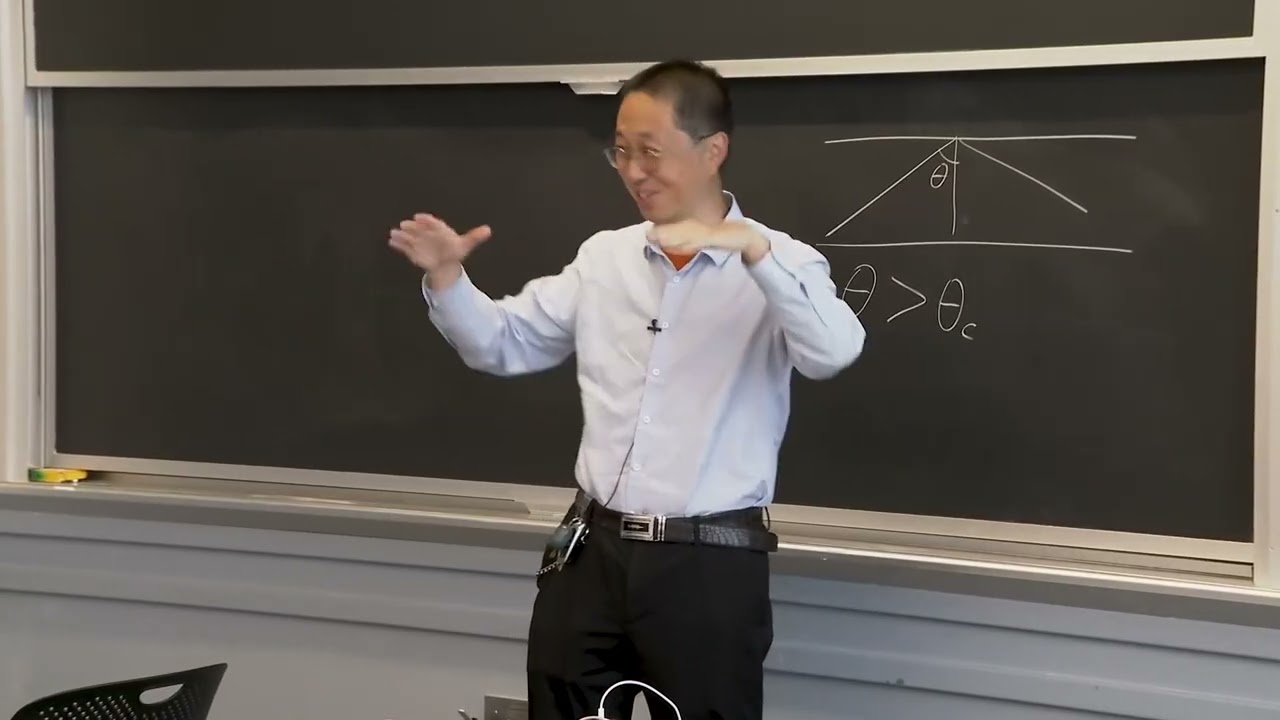
Lecture 22 on Topic 15: Characterizing the Amorphous State
Title history
- Lecture 22 on Topic 15: Characterizing the Amorphous State — observed on 20261114-0303 UTC (YouTube)
Keywords
Summary
186 words
Critical Evaluation
Value of the Information & Strength of the Argument
The lecture provides substantial educational value by bridging fundamental physics of scattering with practical characterization strategies. The instructor systematically builds the derivation of the structure factor from first principles, justifying each approximation and clarifying assumptions. Argumentation is solid; claims are supported by equations, published literature (e.g., the OFC paper on ultralow-loss fiber), and real experimental demonstrations. The discussion on measurement pitfalls for thin-film losses is particularly insightful, emphasizing the pitfalls of using normal-incidence absorption data to infer waveguide performance. The problem set segment reinforces problem-solving skills and critical evaluation of materials selection. The lecture maintains a rigorous, evidence-based approach throughout, making it highly valuable for advanced undergraduate or graduate students in materials science.
Scientific Rigor, Source Quality, Title Accuracy
The lecture adheres to high scientific rigor, referencing peer-reviewed work (e.g., the record-low loss fiber) and deriving equations step by step. The sources cited are appropriate and credible: the instructor references the OFC conference paper and mentions that many ideas come from standard textbooks, though no specific external web links are provided. The title ‘Characterizing the Amorphous State’ accurately captures the core focus, but the lecture also covers optical properties and a problem set, which are somewhat outside that title; however, they serve as contextual reinforcement. No comments are available for analysis, so no public feedback trends can be inferred.
228 words
Title / Content Match
The title accurately reflects the central topic, though the lecture also covers optical properties and a problem set review as contextual material.
Quality & Reliability
9/10
The lecture is delivered by a MIT professor as part of an open courseware series. The content is technically accurate, grounded in established materials science principles, and includes derivations and experimental demonstrations. The production is academic and peer-validated through MIT's institutional reputation.
Key Moments
Markers derived by PSI from the transcript: the creator did not define chapters.
- Introduction to lecture plan: optical properties wrap-up, pset, and characterization methods.
- Discussion of high-index glasses for augmented reality, including requirements like high transmission, low birefringence.
- Moving on to problem set solutions, starting with bimetallic strip strain calculations.
- Discussion of ultra-low-loss glass design, referencing ZBLAN and record-low silica fiber (0.14 dB/km).
- Transition to diffraction techniques; introduction to X-ray diffraction and comparison of crystalline vs amorphous patterns.
- Live demonstration of diffraction using a helical spring and laser pointer, mimicking DNA X-ray pattern.
- Derivation of structure factor for amorphous materials and explanation of pair distribution function.
Cited Sources
- MIT OpenCourseWare 3.071 Amorphous Materials — Course homepage for the full lecture series and materials.
- YouTube Playlist for 3.071 — Complete playlist of lectures for this course.
- MIT OCW Support — Donation/support page for MIT OpenCourseWare.
- MIT OpenCourseWare Main Site — General OCW portal for accessing free course materials.
- MIT OCW Terms — Terms of use for OCW content.
- MIT OCW Comments Policy — Guidelines for commenting on OCW videos.
Contribution & Novelties
This lecture offers a clear, graduate-level explanation of how to quantitatively describe amorphous structures using diffraction data, bridging conceptual understanding with mathematical formalism. The derivation of the structure factor from first principles and the introduction of pair distribution functions provide a rigorous framework rarely covered in introductory materials courses. The practical emphasis on measurement limitations for thin-film absorption is a valuable contribution, highlighting pitfalls that even experienced researchers may overlook. The lecture reinforces the importance of combining multiple characterization techniques and critically evaluating reported properties.
Pour aller plus loin :
- Pair distribution function — Relevant to the use of PDF in analyzing amorphous structures.
- Fictive temperature — A key concept referenced in minimizing Rayleigh scattering.
- Structure factor — Central to the derivation presented in the lecture.
- X-ray crystallography — Provides background on diffraction and structure determination.
- Silica optical fiber — Context for the low-loss fiber discussion.
146 words
Radar Profile
The profile shows high scores across all dimensions, with particularly strong quantite_information and fiabilite_globale, indicating a dense and trustworthy educational resource. The slightly lower niveau_technique reflects that it is accessible for graduate-level learners but not overly technical for a broader audience.