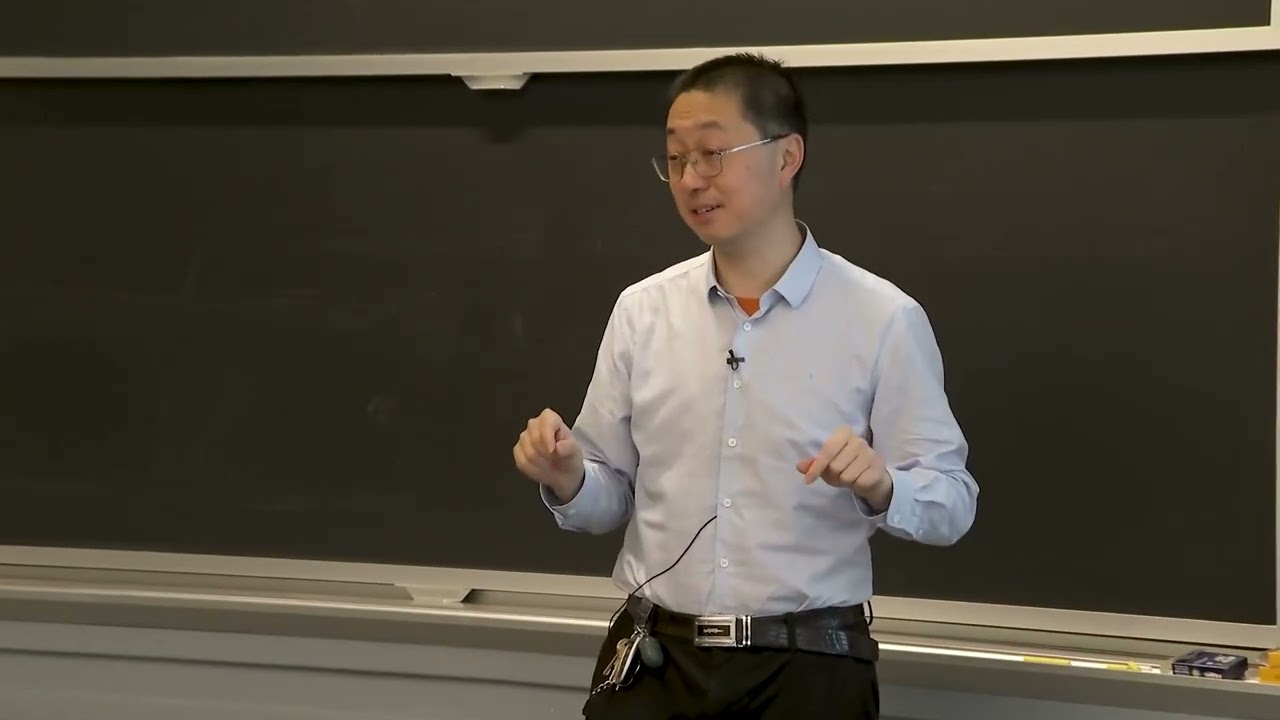
Lecture 10 on Topic 8: Mechanical Properties
Title history
- Lecture 10 on Topic 8: Mechanical Properties — observed on 20261114-0303 UTC (YouTube)
Keywords
Summary
160 words
Critical Evaluation
Value of the Information & Strength of the Argument
The lecture provides substantial value by bridging theoretical concepts with practical problem-solving. It walks through detailed derivations, such as the volume relaxation equation, and offers concrete examples like glass batching calculations and the isostatic condition in 2D. The argumentation is solid: the instructor justifies claims with quantitative analyses (e.g., computing heat diffusion length for GST films) and references established theories like Tool’s theory and fictive temperature. The presentation is logically structured, moving from specific problem set solutions to broader theory, and the instructor emphasizes how simplifications (fictive temperature) provide predictive power despite being approximations. The content is well-supported by physics and materials science principles.
Scientific Rigor, Source Quality, Title Accuracy
The scientific rigor is high, as expected from MIT OpenCourseWare. The instructor, Juejun Hu, is an expert in the field. The lecture is based on standard course material and specific literature (e.g., crystallization time of GST measured as ~15 ns). Sources are referenced indirectly; the description provides links to the course page and OCW resources, but no direct citation URLs are mentioned in the transcript. The title ‘Lecture 10 on Topic 8: Mechanical Properties’ is exactly accurate—it is a course lecture on that topic. No user comments were provided for analysis.
210 words
Title / Content Match
The title accurately reflects the content: a lecture on mechanical properties of amorphous materials.
Quality & Reliability
8/10
Lecture by expert instructor, MIT OCW, based on established course material, but without extensive referencing in the transcript itself.
Key Moments
Markers derived by PSI from the transcript: the creator did not define chapters.
- Start of lecture; review of problem set on coordination number and glass stability.
- Discussion on glass batching; lab-scale glass production and composition calculations.
- Examples of Zachariasen's rules applied to barium oxide and sodium oxide structures.
- 2D rigidity percolation threshold and isostatic condition for polymer chains.
- Phase-change materials limitation for tunable bulk lenses due to fast crystallization kinetics.
- Comparison of effective cooling rates in vacuum deposition vs. other glass preparation methods.
- Introduction to Tool's theory; fictive temperature as a structural parameter.
- Derivation of volume relaxation equation and its physical significance.
Cited Sources
- MIT 3.071 Amorphous Materials, Spring 2025 course page — Full course materials and lecture notes.
- YouTube Playlist for the course — All lectures of the course.
- MIT OpenCourseWare main site — Access to OCW resources.
- OCW Terms of Use — License information.
Concurring Sources
- Fictive temperature — Defines the fictive temperature concept used in the lecture.
- Structural relaxation — Explains the relaxation processes discussed.
External References
Contribution & Novelties
The lecture offers a coherent teaching approach to mechanical properties of glasses, blending theoretical foundations (fictive temperature, Tool’s theory) with practical engineering considerations (batching, phase-change limits). It highlights a common misconception in GST-based device design, providing quantitative thermal diffusivity calculations that show why bulk switching fails—a cautionary note valuable for researchers. The use of fictive temperature as a unifying concept is an effective pedagogical simplification.
Pour aller plus loin :
- Fictive temperature — Key concept in glass science, central to the lecture.
- Structural relaxation — Time-dependent response of glass structure, directly related to Tool’s theory.
- Weibull distribution — Used in fracture statistics for brittle materials, mentioned in the course description.
110 words
Radar Profile
The profile shows strong scores across information quantity, quality, technical level, and reliability, indicating a comprehensive and authoritative lecture. The slight dip in technical level relative to quantity and quality suggests it is advanced but accessible with background knowledge.