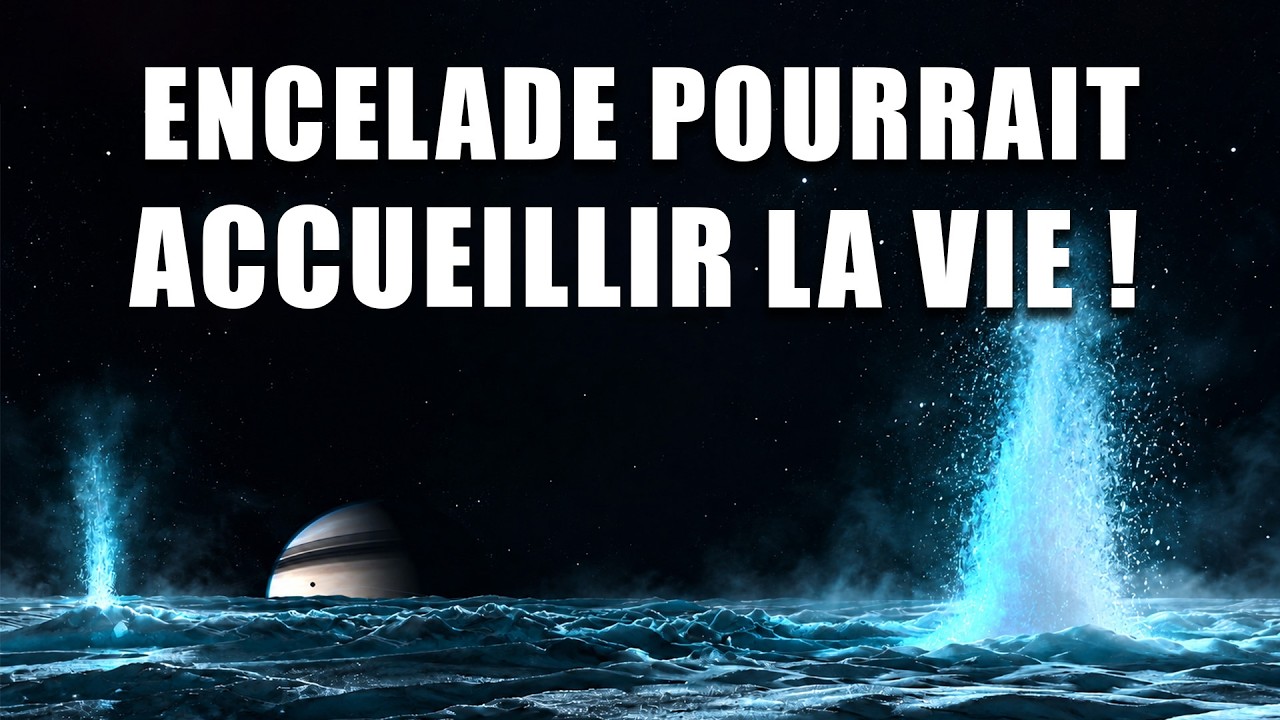
ENCELADE : deux études relancent la recherche de VIE EXTRATERRESTRE ! DNDE
ENCELADUS: two studies relaunch the search for EXTRATERRESTRIAL LIFE! DNDE
Keywords
Summary
179 words
Critical Evaluation
Value of the Information & Strength of the Argument
VALUE OF INFORMATION & SOLIDITY OF ARGUMENTATION.
The video provides substantial added value by synthesizing recent scientific findings and making them accessible to a general audience. It explains complex concepts such as carbonate-bicarbonate equilibrium, carbon fixation pathways, and the physicochemical concentration mechanisms in ice grains with clarity. The argumentation is rigorous: the presenter explicitly states the limitations of laboratory simulations and does not claim that Enceladus is inhabited. The reasoning is based on credible sources and logical connections, acknowledging uncertainties (e.g., pH estimates, lack of direct evidence). The discussion of Italy-NASA and European fragmentation is nuanced, weighing geopolitical and industrial benefits against risks, and is based on concrete agreements and statements. The coverage of Google and China programs includes technical caveats (cooling, radiation, cost) and does not overstate readiness. The AstroForge segment also critically assesses the economic viability of asteroid mining. Overall, the information is accurate, well-argued, and appropriately qualified.
Scientific Rigor, Source Quality, Title Accuracy
SCIENTIFIC RIGOR, SOURCE QUALITY, TITLE-CONTENT ALIGNMENT.
The video demonstrates strong scientific rigor by citing peer-reviewed studies (in Science Advances) and official announcements. The sources listed in the description are reputable: NASA, ESA, Italian Ministry of Enterprises and Made in Italy, Google Research, CAS Space, and AstroForge. The presenter clearly distinguishes between hypotheses and confirmed findings, and includes cautionary statements when interpreting results. The title focuses on Enceladus, which is indeed the opening and longest segment, but the video also covers other news; this slight mismatch is acceptable as the title is not misleading. The content adheres to the standards of science communication, with appropriate references and a balanced tone.
274 words
Title / Content Match
The title highlights the Enceladus studies, which are the main segment, but the video also covers other space news. The title is somewhat accurate but does not reflect the full scope of content.
Quality & Reliability
8/10
The video presents a well-structured summary of recent space exploration news, focusing on two peer-reviewed studies about Enceladus and also covering geopolitical, technological, and commercial developments. It consistently references official sources and scientific publications, maintains a cautious tone when interpreting results, and clearly distinguishes established facts from speculative implications.
Key Moments
Markers derived by PSI from the transcript: the creator did not define chapters.
- Introduction to Enceladus and the significance of the two new studies.
- First study: microorganism growth in simulated Enceladus ocean conditions.
- Second study: chemical concentration in ejected ice grains.
- Italy-NASA agreement for lunar habitat and astronaut missions.
- Google's Suncatcher project and China's Supercomputing-1 mission.
- AstroForge's Autonomy One mission and its implications.
- Conclusion and wrap-up.
Cited Sources
- Study on microbial growth in Enceladus-like conditions — First study cited for showing that Methanococcus okinawensis can grow in simulated Enceladus ocean.
- Study on ice grain composition from Enceladus — Second study that explains concentration of substances in ice grains ejected from Enceladus.
- Italy-NASA agreement on lunar habitat — Official Italian government announcement of the agreement on lunar habitat modules.
- Italy to spend over $5 billion to send two astronauts to the Moon — News article detailing Italy's investment and astronaut missions.
- Google Project Sundial: facts — Google blog post about the Suncatcher project for orbital AI computing.
- CAS Space article on Supercomputing-1 — Chinese company CAS Space's announcement of the Supercomputing-1 satellite.
- AstroForge introduces Autonomy One — AstroForge's official announcement of the autonomous mission.
Contribution & Novelties
The video offers a concise yet comprehensive update on several frontier space topics. Its main original contribution is the synthesis of two recent studies on Enceladus, demonstrating both the potential habitability of its ocean and a novel mechanism for concentrating biosignatures in ejected ice grains, which could inform future detection strategies. It also contextualizes these findings within the broader landscape of space exploration, including Europe’s evolving role in Artemis, the emergence of orbital AI computing, and the push toward autonomous spacecraft.
Pour aller plus loin :
- Enceladus - Wikipedia — Overview of Enceladus, its ocean, and plumes.
- Methanogenesis - Wikipedia — The metabolic pathway studied in the first experiment.
- Hydrothermal vent - Wikipedia — Relevant to the energy source on Enceladus’ ocean floor.
123 words
Radar Profile
The radar profile shows high values in information quantity and quality, a moderate technical level, and high overall reliability, indicating a well-rounded science news video that educates without oversimplifying.