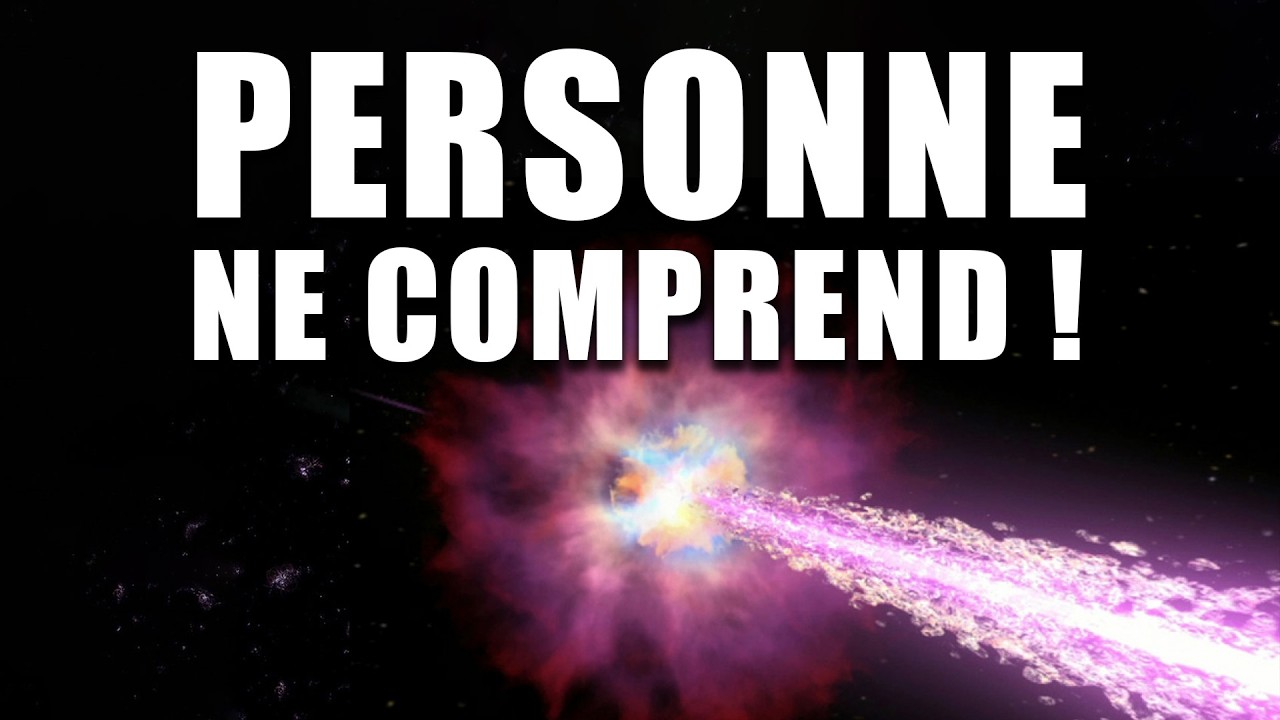
10 ans après, ces deux explosions cosmiques restent inexplicables ! DNDE
The Gamma Mystery
Title history
- 10 ans après, ces deux explosions cosmiques restent inexplicables ! DNDE — observed on 20261027-1751 UTC (YouTube)
Keywords
Summary
137 words
Critical Evaluation
Value of the Information & Strength of the Argument
The value of the information is high for space enthusiasts, as it synthesizes recent scientific and programmatic developments. The argumentation is clear and well-structured, particularly in explaining the GRB classification dilemma and the technical complexities of lunar landing architectures. The presenter presents multiple hypotheses and acknowledges uncertainties, avoiding overstatement. The NASA section includes concrete details about the new competition and the fuel transfer challenge, while the China section highlights key milestones. The reasoning is logical and supported by references to official sources, though some speculation remains about timelines.
Scientific Rigor, Source Quality, Title Accuracy
The video references a peer-reviewed study in Nature Astronomy (link provided) for the GRB mystery, NASA’s official page for the Artemis changes, and the Chinese Manned Space Agency website for the lunar program. These are reliable primary sources. The title adequately reflects the main story, though it slightly overshadows the lesser news items. The explanation of technical concepts is accurate, and the presenter distinguishes between confirmed facts and informed estimates. The visual content includes credited imagery from NASA, SpaceX, etc., enhancing credibility. No obvious discrepancies between the claims and the cited sources were noted.
197 words
Title / Content Match
The title accurately highlights the central mystery of the double gamma-ray burst, though the video also covers NASA and China lunar program updates, which are not reflected in the title.
Quality & Reliability
8/10
The video cites recent scientific sources and official space agency announcements, providing a balanced overview. The presenter clearly distinguishes facts from speculation, and the referenced paper in Nature Astronomy is reputable.
Key Moments
Markers derived by PSI from the transcript: the creator did not define chapters.
- Introduction to the mysterious double gamma-ray burst detected in 2016.
- Explanation of the two GRB families (short and long) and the anomaly of GRB 160425A.
- Summary of the new study's findings and remaining questions about the burst.
- Overview of NASA's Artemis program changes, including competition between SpaceX and Blue Origin.
- Chinese lunar program updates and comparison with US approach.
- Concluding remarks on the race to the Moon.
Cited Sources
- Nature Astronomy study on GRB 160425A — The scientific paper analyzing the double gamma-ray burst.
- NASA Artemis lander development page — Official NASA announcement about the new Artemis 4 strategy.
- China Manned Space Agency (CMSE) — Official source for Chinese lunar program developments.
- Podcast on Spotify — Link to the DNDE podcast version.
Concurring Sources
- NASA Artemis page — Confirms the new competition between SpaceX and Blue Origin.
- Nature Astronomy paper — Peer-reviewed analysis of GRB 160425A, consistent with the video's description.
Contribution & Novelties
This video brings together the latest updates on a decade-old astronomical mystery and the evolving Artemis program. The main novelty is the presentation of the recent Nature Astronomy study that deepens the enigma of GRB 160425A, offering a clear explanation of why the two bursts likely stem from a single, unknown physical process. Additionally, it provides an accessible breakdown of the new NASA architecture, including a frank discussion of the number of Starship refueling launches, and contrasts it with China’s simpler two-launch approach.
Pour aller plus loin :
- Gamma-ray burst — Essential background on the two classes and their origins.
- Kilonova — Related phenomenon to merging neutron stars, which the short GRB might represent.
- Artemis program — Overview of NASA’s lunar program and its evolving architecture.
- Long March 10 — Details on China’s crewed lunar rocket.
- Swift Gamma-Ray Burst Mission — The satellite that detected the burst, now nearing end of life.
152 words
Radar Profile
The profile shows balanced strengths across information quantity, quality, technical level, and reliability, with slightly lower quantity reflecting the limited scope (three topics). The dominance in reliability and quality indicates a trustworthy, well-sourced content.