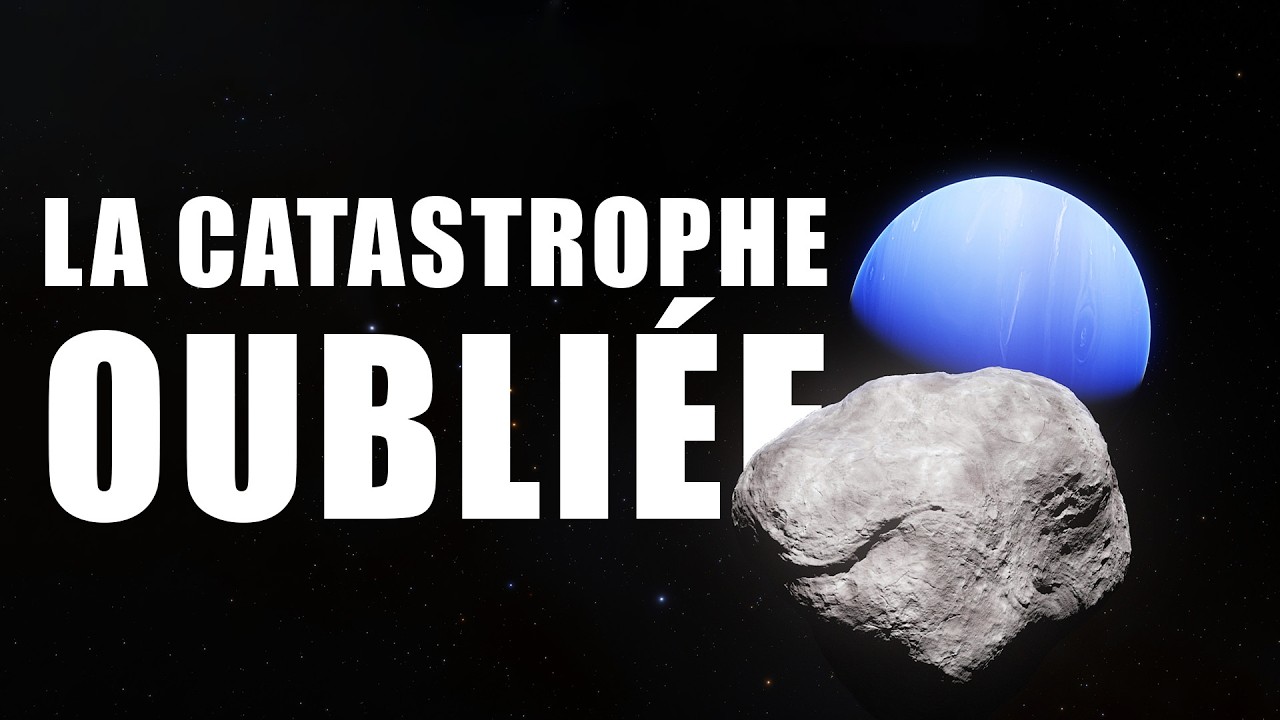
La catastrophe des lunes de Neptune, un mystère toujours entier !
Neptune's Moons File
Title history
- La catastrophe des lunes de Neptune, un mystère toujours entier ! — observed on 20261108-1752 UTC (YouTube)
Keywords
Summary
150 words
Critical Evaluation
Value of the Information & Strength of the Argument
The video provides a solid synthesis of current research on Neptune’s moon system, weaving together orbital dynamics, spectroscopy, and simulation results. It clearly explains the scientific evidence and the logical reasoning behind the proposed catastrophic scenario, while honestly acknowledging uncertainties and gaps in the data. The argumentation is structured, moving from observations to hypotheses to implications, with a balanced presentation of alternative ideas (e.g., Nereid’s origin). It effectively conveys the value of the James Webb Telescope contributions without overstating them, making a compelling case for future exploration.
Scientific Rigor, Source Quality, Title Accuracy
The video relies on credible sources, including peer-reviewed arXiv papers, a PubMed article, and a national academies report, all listed in the description. The sources are used appropriately to support specific claims. The title is accurate in capturing the central theme of a catastrophic event affecting Neptune’s moons. The content is methodologically rigorous, distinguishing between established facts and hypotheses, and the presenter refrains from overstatements. The overall presentation aligns with the title, delivering a comprehensive overview of the mystery without sensationalizing it.
184 words
Title / Content Match
The title accurately reflects the content: it focuses on the violent history of Neptune's moons and the ongoing mystery surrounding their origins.
Quality & Reliability
8/10
The video is based on peer-reviewed research (arXiv, PubMed, NASA) and presents recent JWST findings with clear explanations of the scientific method. It avoids speculation and clearly labels unresolved questions.
Key Moments
Markers derived by PSI from the transcript: the creator did not define chapters.
- Introduction to Neptune's moon system and its apparent regularity
- Presentation of Triton's retrograde orbit as an anomaly
- Nereid's eccentric orbit and its puzzling characteristics
- Description of inner moons (Proteus, Larissa, Galatea) and their apparent order
- Hypothesis of Triton's capture and its disruptive effects on existing moons
- Introduction of James Webb's spectroscopic observations of the moons
- Details of phyllosilicate findings on inner moons and rings, suggesting destruction of larger bodies
- Discussion of future missions, including NASA's ice giant priorities and Chinese concepts
- Conclusion summarizing the evidence and remaining mysteries
Cited Sources
- arXiv: The catastrophic origin of Neptune's moons (2606.02818) — Cited as a reference for the scenario of Triton capture and moon destruction
- arXiv: Nereid's orbit and origin (2607.27481) — Relevant to the analysis of Nereid's composition and orbital evolution
- PubMed: Neptune's moon system (16688170) — References on Triton and inner moons, possibly earlier observational studies
- arXiv: Phyllosilicates on Neptune's moons (astro-ph/0505235) — Studies on surface compositions and the presence of hydrated minerals
- PMC: Ice giant exploration priorities (PMC6476549) — Discusses NASA's decadal survey and priorities for Uranus and Neptune missions
- National Academies: Planetary science decadal survey (26522) — Official report ranking ice giant exploration as a top priority
Concurring Sources
- arXiv: The catastrophic origin of Neptune's moons (2606.02818) — Supports the capture and destruction scenario.
- PubMed: Neptune's moon system (16688170) — Earlier observations consistent with the irregular system.
Dissenting Sources
- arXiv: Nereid's orbit and origin (2607.27481) — May present an alternative origin for Nereid (captured vs. survivor), though the video argues for the survivor scenario based on spectra.
Contribution & Novelties
The video synthesizes recent JWST findings and combines them with orbital simulations to support the catastrophic capture scenario for Triton. It brings to light the phyllosilicate detections that link inner moons to larger, water-altered parent bodies, offering a plausible reconstruction of the system’s violent past. This adds a new layer of evidence to older orbital arguments, strengthening the case for a major disruption event.
Pour aller plus loin :
- Triton (moon) on Wikipedia — Overview of Triton’s properties and the capture hypothesis.
- James Webb Space Telescope — Context on the telescope used for the spectral observations.
- Neptune’s moons on Wikipedia — General information on the satellite system.
- Phyllosilicates — Explanation of these minerals and their significance in aqueous alteration.
119 words
Radar Profile
The radar profile shows balanced scores across quality, quantity, and technical level, with a slight dip in technical depth due to the popularization nature. Reliability is high, supported by peer-reviewed sources. Overall, the video is a solid and trustworthy source for understanding current research on Neptune's moons.