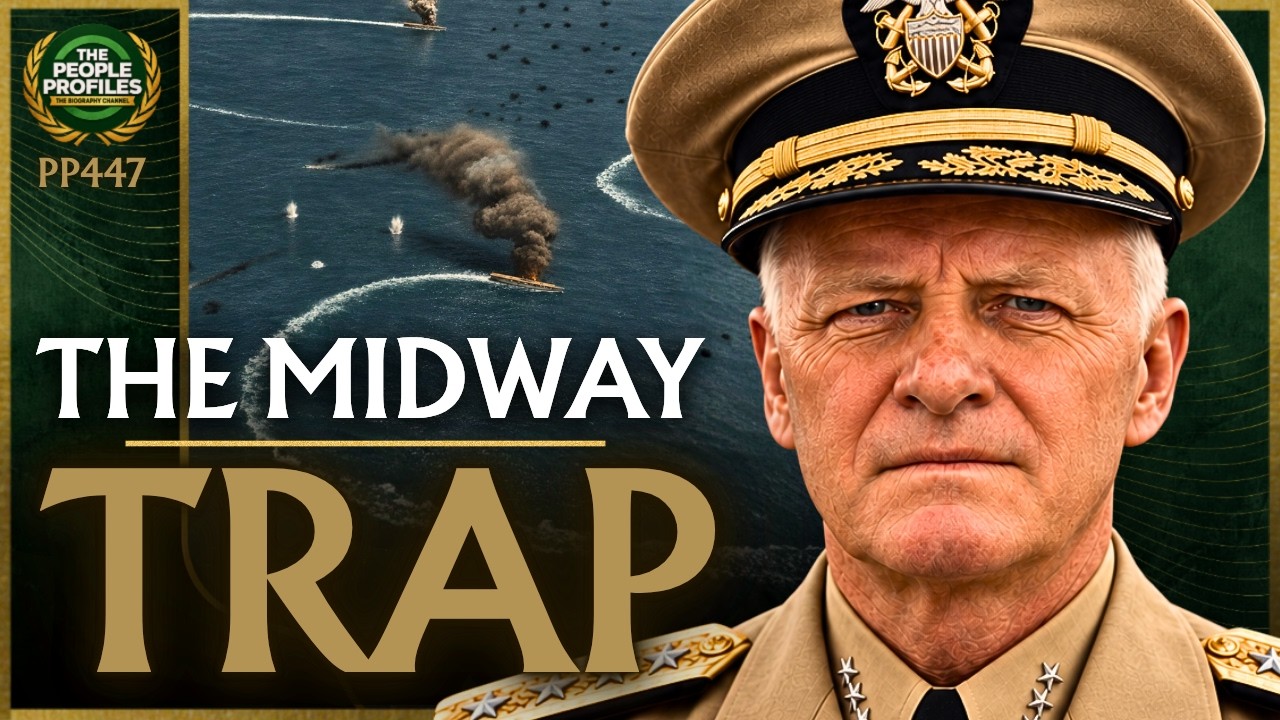
Chester Nimitz - The Trap That Won the Battle of Midway Documentary
Keywords
Summary
255 words
Critical Evaluation
Value of the Information & Strength of the Argument
The informational value is high for a general-audience biography: rather than a list of battles, the programme builds a portrait through the technical and institutional choices that shaped Nimitz’s career. The diesel conversion of early submarines, the logistics of underway refuelling learned in the North Atlantic in 1917-18, the shortening of the Naval Academy course in 1939, and the habit of testing propositions against three practical questions are all substantive elements that explain command competence rather than merely asserting it. The strongest analytical passage concerns his refusal of the Pacific Fleet command in early 1941 and the consequent fact that he was not compromised by Pearl Harbor; the programme draws an explicit causal line and lets the viewer weigh it. The Midway sequence is well reconstructed as a chain of inference: an intercepted designator, a testable hypothesis, a controlled deception, a confirming intercept. The treatment of his distance from the fighting, his physical symptoms of stress, his deafness and his evening routine adds psychological texture without psychologising. The argument is nevertheless almost entirely sequential and expository: there is no engagement with competing interpretations, no assessment of how far Midway’s outcome depended on Japanese tactical decisions rather than on Nimitz’s intelligence coup, and no exploration of the strategic disagreements with King or MacArthur beyond a single mention of being overruled on the Marianas. Causality is asserted rather than argued whenever the narrative needs to move forward, and the closing framing of Nimitz as a ‘forgotten hero’ is a rhetorical device restated several times rather than demonstrated.
Scientific Rigor, Source Quality, Title Accuracy
Scientific rigour rests entirely on the internal coherence of the script. No historian, archive, memoir, dispatch or official history is named at any point, and the description contains no bibliography — only the channel’s own playlists, companion videos and funding links. Archive footage and images are declared as sourced from free or commercially licensed media libraries, which addresses copyright but says nothing about evidentiary provenance. Individual details are of uneven traceability: the Mainzer Adelsverein settlement, the 1908 Batangas Harbour court-martial, the 1916 finger injury and the Port Moresby intercept are of the kind found in standard biographies such as E. B. Potter’s authorised life, but the programme never signals which claims rest on documentary record and which on anecdote. Numbers are used sparingly and plausibly — seventh of 114 midshipmen, over 3,000 casualties at Tarawa, four carriers lost at Midway — without sourcing. On title adequacy, the Midway ’trap’ is genuine content but functions as one act of a much longer life story, so the title’s promise of a single decisive mechanism is only partly honoured; this mismatch is real but does not undermine the substance of the documentary. One organisational note: the transcript supplied for this evaluation stops during the Marianas campaign, so the final portion announced in the description — the surrender on USS Missouri, the Chief of Naval Operations years, his death in 1966 and the carrier that bears his name — could not be assessed here.
510 words
Title / Content Match
The title promises a focused account of the intelligence trap at Midway, but that episode occupies only a short segment of a broad 48-minute life-and-career biography, so the framing oversells the specificity of the content. The subject is accurate (Nimitz, Midway, Pacific command) but the emphasis is misleading.
Quality & Reliability
7/10
The narrative is dense, chronologically coherent and largely consistent with the established historiography of Nimitz and the Pacific War: the Texas German background, the 1905 Naval Academy graduation, the Decatur grounding, the diesel and submarine expertise, the Maumee refuelling experiments, the December 1941 appointment, the 'AF is short of water' confirmation and the Midway ambush, Guadalcanal and the relief of Ghormley all match standard accounts. Reliability is capped, however, by the complete absence of on-screen citations, archival references or named historians; everything rests on an unseen script and generic archive footage, so the viewer cannot trace any individual claim. A handful of colourful details (the finger injury, the pistol range after Savo Island, the three questions on the office wall) are the kind of anecdote that circulates without clear attribution.
Key Moments
Markers derived by PSI from the transcript: the creator did not define chapters.
- Opening on 4 June 1942: codebreakers in a Pearl Harbor basement feeding Nimitz reports from Midway, framing the film around signals intelligence.
- Birth in Fredericksburg, Texas, 1885; the grandfather Karl Heinrich/Charles Henry, the Mainzer Adelsverein and the Steamboat Hotel.
- The 1900 encounter with two West Point officers at the family hotel, the letter to Congressman Slayden, and entry to the Naval Academy.
- Midshipman cruise on the battleship Ohio to observe the Russo-Japanese War and the Tokyo meeting with Admiral Tōgō Heihachirō.
- Command of the Decatur, the 1908 Batangas Harbour grounding and court-martial, then the transfer to the experimental submarine division.
- The First World War: chief engineer on the oiler Maumee and the pioneering practice of replenishing ships at sea, later applied in the Pacific.
- 7 December 1941: the radio broadcast interrupted, and his appointment nine days later to succeed Kimmel as Commander-in-Chief, Pacific Fleet.
- The intelligence sequence: the 'AF' designator, the false water-shortage broadcast from Midway, and the confirming Japanese intercept.
- 4 June 1942: Fletcher's task force waiting for the Japanese, four carriers lost, and Nimitz's 'about midway to our objective' communique.
- Portrait of Nimitz at his desk in Pearl Harbor, the three questions on the office wall, and the Guadalcanal command change from Ghormley to Halsey.
- 1943 turnaround, the Fifth Fleet, the cost of Tarawa and the concrete pillbox replicas built in Hawaii to calibrate bombardment.
Cited Sources
- Admiral Yamamoto – Deadly Gamble at Pearl Harbor (People Profiles companion documentary) — Linked in the description as the next recommended episode from the same channel; presented as a companion portrait, not as an evidential source for any claim made in this film.
- Douglas MacArthur – The American Shogun (People Profiles companion documentary) — Linked in the description; covers the commander repeatedly contrasted with Nimitz in the narration, again as channel content rather than documentation.
- Military Leaders playlist (People Profiles) — Description link situating the episode in the channel's series on military commanders; no evidentiary function.
- Leaders of World War Two playlist (People Profiles) — Description link to the channel's Second World War biographical series; no evidentiary function.
- American Icons playlist (People Profiles) — Description link to the channel's broader American biography series; no evidentiary function.
Concurring Sources
- Wikipedia – Chester W. Nimitz — Encyclopaedic overview corroborating the chronology used in the film: Texas birth, 1905 graduation, submarine and diesel expertise, December 1941 appointment, Midway, and later Chief of Naval Operations.
- Wikipedia – Battle of Midway — Supports the intelligence narrative, including the role of Station Hypo, the contested 'AF' identification and the four Japanese carriers lost on 4 June 1942.
- Wikipedia – Guadalcanal campaign — Corroborates the August 1942 landings, the Savo Island cruiser losses and the replacement of Ghormley by Halsey.
- E. B. Potter, Nimitz (Naval Institute Press, 1976) — The authorised biography, based on Nimitz's own papers and interviews; the standard reference for most of the personal and career detail retold here, though never named in the film.
- Jonathan Parshall & Anthony Tully, Shattered Sword: The Untold Story of the Battle of Midway (2005) — Japanese-sourced reconstruction confirming the intelligence picture while emphasising the weight of Japanese tactical decisions on 4 June 1942.
Dissenting Sources
- Historiographical emphasis in Shattered Sword and subsequent Midway scholarship — The film states that the codebreakers' work 'ensured' the destruction of four Japanese carriers. Specialists attribute the outcome to a combination of intelligence, Japanese command decisions and timing; intelligence was necessary but not sufficient, and the film never qualifies the causal claim.
- Critical assessments of the 'forgotten hero' framing — The repeated claim that Nimitz is forgotten, unlike MacArthur or Eisenhower, is a rhetorical framing rather than a documented finding; his standing in naval historiography and the naming of a carrier class suggest a more nuanced picture of his post-war reputation.
- Accounts of the 'AF is short of water' deception — The story is widely retold but its exact mechanics and the extent to which it was a deliberate ruse versus an incidental confirmation vary between accounts; the film presents a single clean version without noting the variation in the record.
External References
Contribution & Novelties
The distinctive contribution is not new evidence but synthesis: the film connects Nimitz’s pre-war technical career — submarine diesel propulsion, logistics, the 1917 refuelling experiments — directly to the command style he applied in 1942-45, and it spends unusual time on the unglamorous mechanics of leadership, including his daily timetable at Pearl Harbor, his physical symptoms of stress and the three questions he required officers to answer. The Guadalcanal command change and the Tarawa pillbox replicas are treated as decision-making case studies rather than battle anecdote, and the framing deliberately counters the MacArthur- and Patton-centred popular memory of the Pacific War. What it does not offer is any archival novelty, any oral history, or any engagement with academic debate.
Pour aller plus loin :
- Chester W. Nimitz — Baseline chronology and command record against which the film’s claims can be checked.
- Battle of Midway — Covers the intelligence picture, the ‘AF’ episode and the debate over what actually decided the battle.
- Guadalcanal campaign — Context for the Savo Island losses and the Ghormley-Halsey command change.
- Nimitz-class aircraft carrier — The naming legacy the film uses as its opening hook.
- USS Missouri (BB-63) — The surrender deck of 2 September 1945, where Nimitz signed for the United States.
- E. B. Potter, Nimitz (Naval Institute Press, 1976) — The authorised biography; the evidentiary backbone the documentary never cites.
- Jonathan Parshall & Anthony Tully, Shattered Sword (2005) — The standard Japanese-side reconstruction of Midway, useful for testing the film’s causal claims.
248 words
Radar Profile
The profile is strongly skewed toward information density and reliability, with a solid factual spine and a well-paced narrative structure. Technical depth is deliberately modest, reflecting an accessible biographical register rather than operational or strategic analysis. The relative weakness is documentation and interpretive ambition: the content scores well on what it reports, less well on how far it interrogates or sources it.