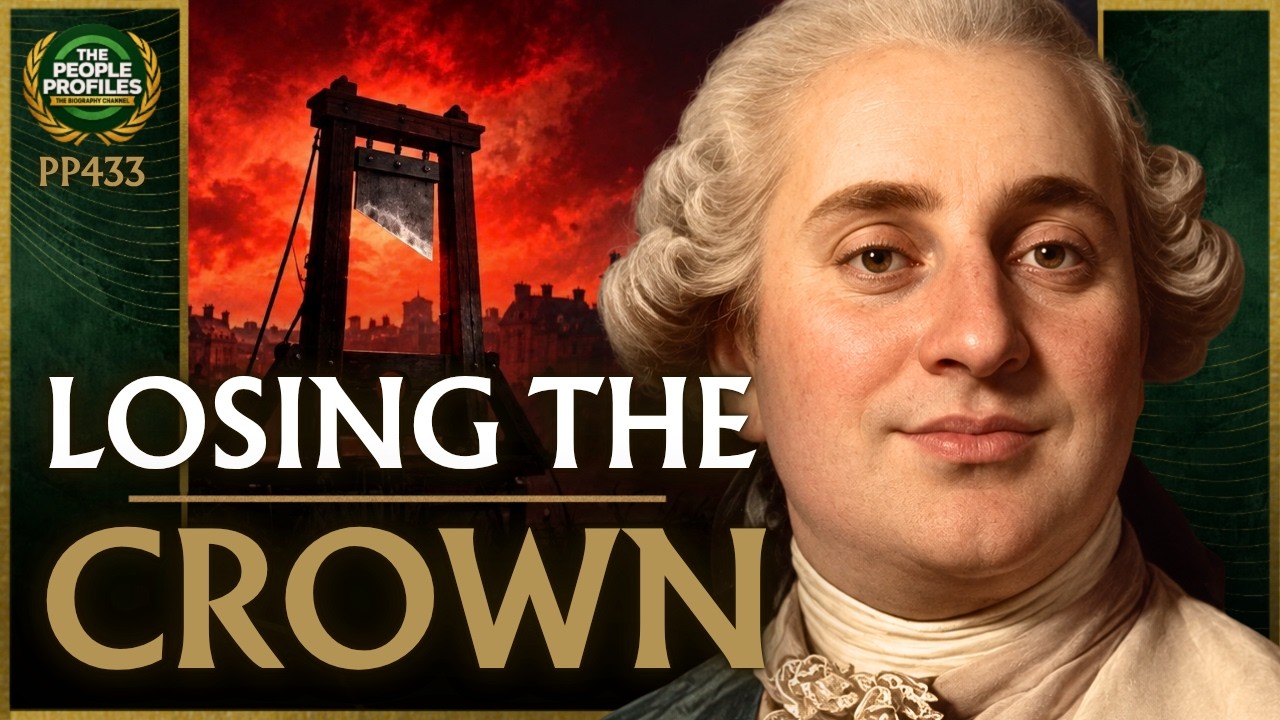
Louis XVI - The King Who Lost His Crown and Head documentary
Keywords
Summary
143 words
Critical Evaluation
Value of the Information & Strength of the Argument
The video offers substantial value in its detailed narrative of Louis XVI’s life, presenting a balanced view that counters common stereotypes. It argues that Louis was not a simpleton but an intelligent, albeit reserved, monarch who engaged with Enlightenment thinkers and understood financial matters. The argumentation is supported by specific examples, such as his support for the American rebels and his efforts to reform France’s finances. The documentary also emphasizes the impact of external factors like the Laki volcano and the Diamond Necklace Affair, illustrating the complexity of the crisis. The reasoning is coherent and well-structured, moving chronologically while weaving in contextual elements like the political system of absolutism and the rivalry with Britain.
Scientific Rigor, Source Quality, Title Accuracy
The production claims rigorous sourcing, with scripts written by qualified historians and verified for plagiarism via AI detection. However, no specific scholarly sources are cited in the video or description; only links to the channel’s playlists and Spotify are provided. The content aligns with mainstream historical interpretations, but the lack of explicit citations limits verifiability. The title accurately reflects the focus on Louis XVI’s demise, though the transcript provided covers only up to 1789; the video likely extends to his trial and execution. The channel’s reputation for historically grounded content supports overall reliability.
222 words
Title / Content Match
The title accurately reflects the focus on Louis XVI's reign and his eventual downfall, although the provided transcript covers only up to the Women's March, not his execution. This does not significantly detract from the title's relevance.
Quality & Reliability
8/10
The video is produced by a channel that claims scripts are written by qualified historians and checked for plagiarism with AI detection, scoring 0% on Grammarly. The content is factually dense and aligns with established historical narratives.
Key Moments
Markers derived by PSI from the transcript: the creator did not define chapters.
- Introduction: the storming of the Bastille and Louis XVI's journal entry 'rien'.
- Birth and early life of Louis Auguste, his education, and his emergence as heir to the throne.
- Marriage to Marie Antoinette and the Franco-Austrian alliance.
- Accession to the throne at age 19, the coronation, and early reforms.
- French involvement in the American Revolutionary War and its financial consequences.
- The Diamond Necklace Affair and the worsening financial and political crisis.
- Summoning of the Estates General, Tennis Court Oath, and the storming of the Bastille.
- The Women's March on Versailles and Louis's interaction with the crowd.
Cited Sources
- The People Profiles on Spotify — Official Spotify channel for listening to episodes.
- Related videos playlist 1 — Playlist of related historical biographies.
- Related videos playlist 2 — Playlist of additional historical content.
- Related videos playlist 3 — Another playlist of related videos.
Contribution & Novelties
The video provides a comprehensive and accessible overview of Louis XVI’s reign, synthesizing well-known events into a coherent narrative that corrects oversimplified perceptions. It emphasizes the complex interplay of personal character, political structures, and external factors like volcanic climate impacts. The documentary’s strength lies in its narrative flow and its attempt to present a balanced portrait.
Pour aller plus loin :
- French Revolution — The broader historical context in which Louis XVI’s rule ended.
- Estates General (France) — The parliamentary body central to the unfolding of 1789.
- Diamond Necklace Affair — The scandal that damaged the monarchy’s reputation.
- Laki — The volcanic eruption whose climatic effects exacerbated France’s crisis.
109 words
Radar Profile
The radar profile shows high scores in quantity and reliability of information, with a moderate technical level appropriate for a general audience. The quality of information is strong, though slightly lower than quantity due to the absence of explicit scholarly citations. The overall profile indicates a well-researched, informative documentary.