Virus Genomics 2026 keynote | Marion Koopmans, Erasmus University Medical Centre, The Netherlands
Title history
- Virus Genomics 2026 keynote | Marion Koopmans, Erasmus University Medical Centre, The Netherlands — observed on 20261117-1524 UTC (YouTube)
Keywords
Summary
169 words
Critical Evaluation
Value of the Information & Strength of the Argument
The value of the information is high: Koopmans offers original insights from two complex, real-world outbreak investigations, demonstrating how multidisciplinary evidence (clinical, genomic, environmental) can reconstruct transmission events and even identify missing links. Her argumentation is solid, grounded in specific examples, and she frankly addresses limitations, such as unresolved questions in the SARS-CoV-2 origins. She makes a strong case for expanding surveillance beyond human case detection to include animal and environmental components, and for using predictive modeling to allocate resources more effectively. The lecture is well-structured and evidence-driven, though some claims rely on unpublished data, which slightly weakens immediate verification.
Scientific Rigor, Source Quality, Title Accuracy
Koopmans consistently cites peer-reviewed literature (e.g., a 2018 New England Journal of Medicine study on person-to-person hantavirus transmission) and official reports (WHO mission on SARS-CoV-2 origins). She distinguishes between published and unpublished findings, maintaining transparency. The title accurately reflects the content, focusing on virus genomics and surveillance at the human-animal interface. The lecture is delivered to a specialist audience, and the technical depth is appropriate. No comments are provided, so no public reception analysis is possible.
191 words
Title / Content Match
The title accurately reflects the content, as the keynote focuses on viral genomics and surveillance at the human-animal interface, exactly as advertised.
Quality & Reliability
8/10
The speaker is a world-leading expert in zoonotic infections and pandemic preparedness. She presents detailed outbreak investigations with strong methodological rigor, including genomic and environmental evidence. However, some data are unpublished or from ongoing work, and the SARS-CoV-2 origins debate remains unresolved, which slightly limits definitive conclusiveness.
Key Moments
Markers derived by PSI from the transcript: the creator did not define chapters.
- Introduction and rationale for studying the human-animal interface.
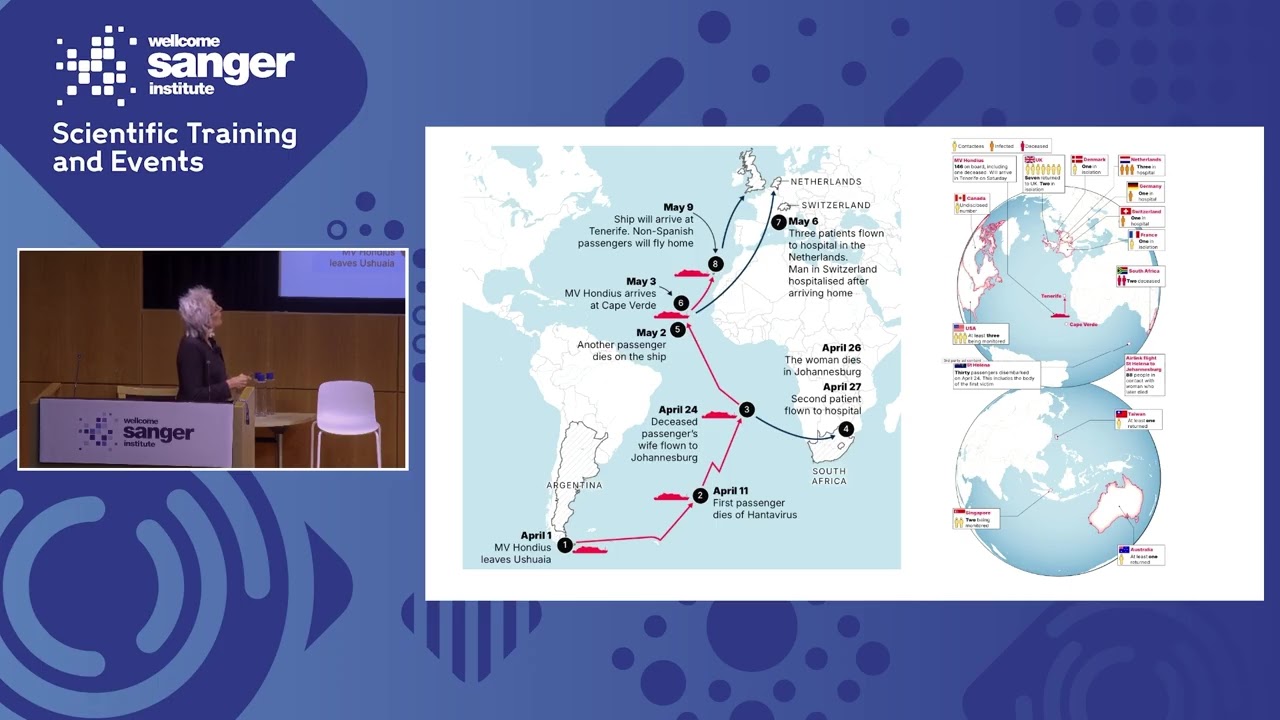
- Overview of the hantavirus outbreak on the expedition ship.
- Detailed genomic and environmental sampling analysis of the ship.
- SARS-CoV-2 origins investigation and WHO mission to Wuhan.
- Predictive tools for early detection and hotspot mapping.
- Conclusions and call for proactive pandemic preparedness.
Cited Sources
- NEJM 2018: Person-to-person transmission of Andes virus — Cited as a documented case of person-to-person transmission for hantavirus, informing the cruise ship investigation.
- WHO report on the origins of SARS-CoV-2 — Koopmans participated in the WHO mission; the report includes maps and analysis of the Huanan market.
- Spatial analysis by Mike Worobey's group — Reanalysis of market data showing the market as an epicenter, mentioned in the talk.
Concurring Sources
- NEJM 2018 study on Andes virus person-to-person transmission — Supports the possibility of secondary transmission seen on the cruise ship.
- Worobey et al. spatial analysis — Concurs with the market as an epicenter of early COVID-19 cases.
Dissenting Sources
- Alternative origin theories for SARS-CoV-2 — Some analyses suggest a different origin scenario, such as early circulation elsewhere or a laboratory-related spillover, which Koopmans acknowledges as unsettled.
Contribution & Novelties
Koopmans provides a compelling demonstration of how deep, integrated outbreak investigations can uncover transmission routes and hidden reservoirs, using cutting-edge genomics and environmental sampling. She challenges the field to shift from reactive response to predictive surveillance, offering practical examples of hotspot mapping at a national level. Her emphasis on the human-animal interface and the need for upstream interventions is a significant contribution to pandemic preparedness thinking.
Pour aller plus loin :
- One Health — Framework for interdisciplinary collaboration between human, animal, and environmental health.
- Metagenomics — Direct genetic analysis of environmental samples, key to identifying pathogens and animal DNA.
- Zoonosis — Diseases transmitted from animals to humans, central to the talk’s focus.
112 words
Radar Profile
The radar profile shows high scores in quantity of information and fiabilité, reflecting the technical depth and evidence-based approach. The medium niveau_technique indicates the talk is accessible to a scientific audience but not to laypeople. The overall balance emphasizes rigorous, data-rich content.