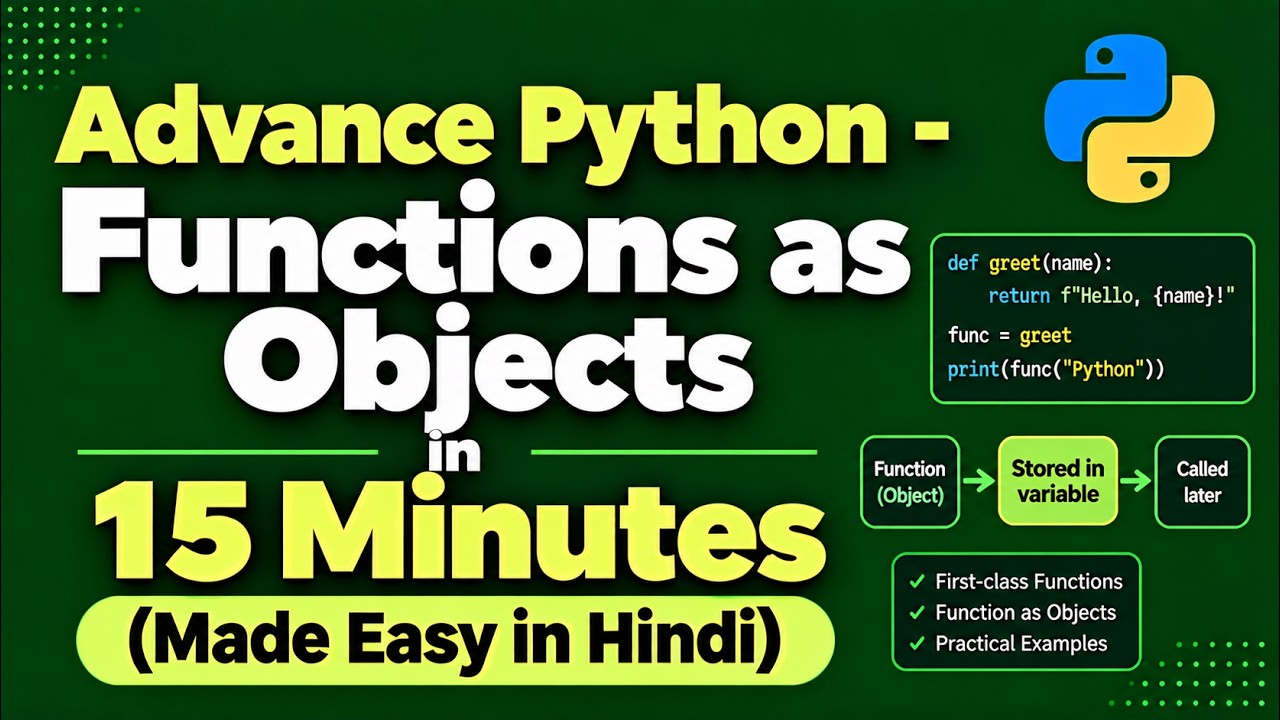
Using Python Functions as Objects - Syntax and Usage
Keywords
Summary
157 words
Critical Evaluation
Value of the Information & Strength of the Argument
The video provides clear and practical demonstrations of function-as-object usage. It builds arguments through incremental examples, each showing code and its output. The pedagogical approach is effective for learners, as it progresses from simple assignment to more complex patterns like passing functions and returning nested functions. The explanations are thorough, though delivered in Hindi, which may limit accessibility for non-Hindi speakers. The argumentation is solid, with no logical errors detected. The value lies in its didactic clarity and the variety of use cases presented, which help consolidate the concept.
Scientific Rigor, Source Quality, Title Accuracy
The video does not cite external sources or references, relying solely on the instructor’s explanation. However, the content aligns with standard Python behavior and is technically accurate. The title ‘Using Python Functions as Objects - Syntax and Usage’ accurately reflects the content, which covers both syntax and usage examples. Despite the English title, the narration is in Hindi, which could be noted but does not affect the technical accuracy. The lack of citations is a minor weakness, but the fundamental nature of the topic reduces the need for external references. Overall, the rigor is acceptable for a tutorial.
202 words
Title / Content Match
The title accurately reflects the content, covering both syntax and usage of Python functions as first-class objects.
Quality & Reliability
7/10
The tutorial is technically accurate and clear, though it lacks external references and is presented in Hindi, which limits accessibility to a broader audience.
Key Moments
Markers derived by PSI from the transcript: the creator did not define chapters.
- Introduction to first-class objects and the session's goal
- Example: assigning a function to a variable and calling it indirectly
- Storing functions in a list and invoking them by index
- Conditional definition of functions based on a test variable
- Storing functions and arguments in tuples and iterating with a for loop
- Passing a function as an argument to another function
- Returning a nested function, demonstrating closures
- Summary and conclusion
Concurring Sources
- Python Documentation - Defining Functions — Official Python tutorial that explains function definition and usage, corroborating the video's explanations.
- First-class function - Wikipedia — Article on first-class functions, the concept illustrated in the video.
- Closure (computer programming) - Wikipedia — Explains closures, which the video demonstrates with a nested function returning from an outer function.
Contribution & Novelties
The video’s contribution is its pedagogical approach to demonstrating Python’s first-class functions, using a sequence of simple examples that build complexity. It emphasizes practical usage, from variable assignment to closures, making the abstract concept tangible.
Pour aller plus loin :
- Python Documentation - Defining Functions — Official guide on function definition and usage.
- First-class function - Wikipedia — Overview of the concept at the heart of this video.
- Closure (computer programming) - Wikipedia — Explanation of closures, illustrated in the nested function example.
83 words
Radar Profile
The profile shows high scores in quality of information and technical level, balanced by moderate quantitative information and reliability. This indicates a focused, well-explained tutorial with minimal external sources.