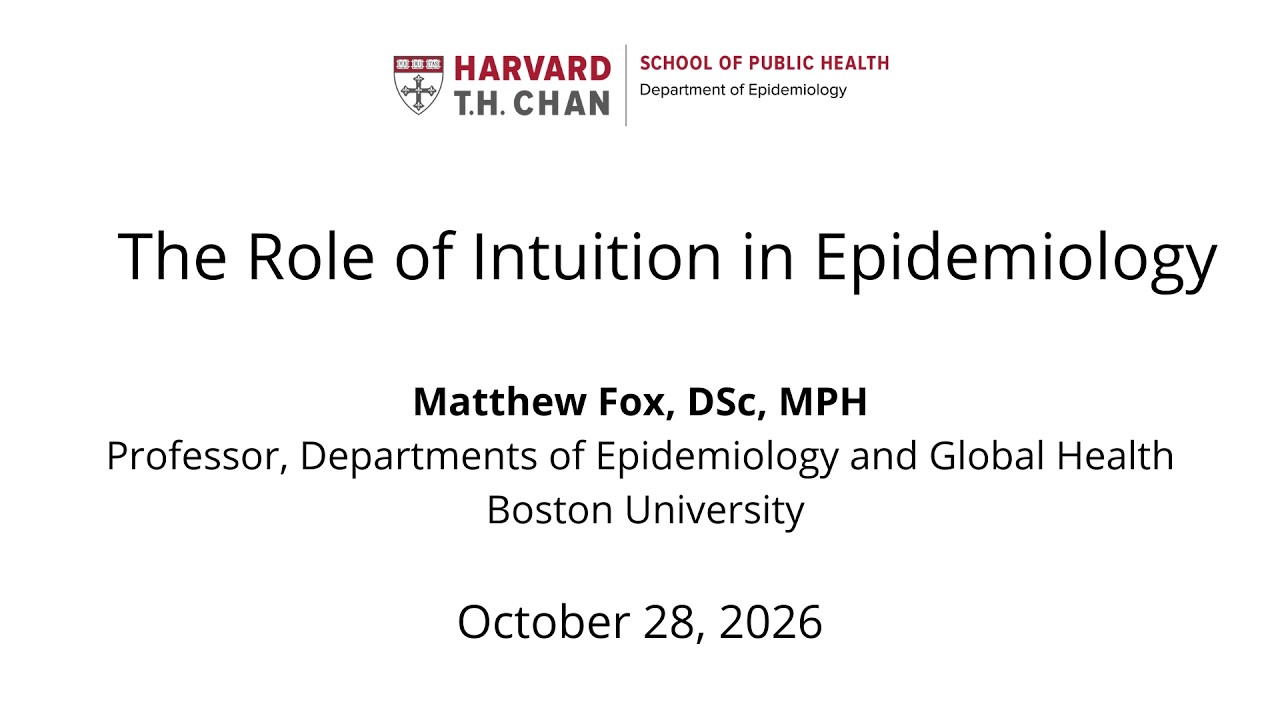
Matthew Fox Seminar, October 28, 2026
Title history
- Matthew Fox Seminar, October 28, 2026 — observed on 20261113-2203 UTC (YouTube)
Keywords
Summary
155 words
Critical Evaluation
Value of the Information & Strength of the Argument
The talk provides valuable insight into the psychological underpinnings of scientific inference, a topic often overlooked in technical training. Fox builds a compelling argument by combining established theories (Kahneman) with concrete examples from epidemiologic literature and everyday decision-making. He effectively demonstrates how intuition can both aid and mislead, and he systematically addresses potential objections, such as the justification for scrutinizing industry-funded studies while acknowledging personal incentives. The argumentation is logical and accessible, though it remains an overview rather than an in-depth methodological critique.
Scientific Rigor, Source Quality, Title Accuracy
Fox references key works in cognitive psychology and epidemiology, including Lash’s paper on heuristic thinking and Greenland’s call for cognitive science in methodology. He also mentions specific studies (e.g., the corn oil trial, the cloud/nerds study, and a preprint on visualization aesthetics) with appropriate caveats. The sources are relevant and credible, though not exhaustively cited. The title is accurate for a seminar but does not convey the specific content; it does not mislead. The presentation adheres to scientific norms by clearly flagging limitations and uncertainties.
183 words
Title / Content Match
The title is generic and reflects the seminar format accurately; it indicates the speaker and date but does not hint at the specific topic, which is acceptable for a departmental seminar.
Quality & Reliability
7/10
The seminar offers a well-structured, expert-led overview of intuitive reasoning in epidemiology, drawing on established literature (Kahneman, Lash, Greenland) and concrete examples. While not presenting original research, the arguments are coherent and grounded in referenced studies. Some claims (e.g., cloud study) are presented with appropriate caveats about their preliminary nature.
Key Moments
Markers derived by PSI from the transcript: the creator did not define chapters.
- Introduction of Matthew Fox by Bert Hofman
- Speaker thanks and outlines scope of talk on intuition in epidemiology
- Discussion of Kahneman's system 1 and system 2 thinking
- Potato dehydration problem illustrating poor intuition with proportions
- Introduction to heuristics and cognitive biases, citing Lash and Greenland
- SUV example demonstrating salience bias (tyranny of the anecdote)
- Discussion of industry-funded corn oil study and conflicts of interest
- Clouds make nerds look good study on incidental factors in admissions decisions
- Visualization aesthetics and trust in science (preprint), with Washington Post examples
- Peer reviewer scenario and the role of intuition in accepting/rejecting papers
- Case study of smoking during pregnancy and breast cancer, illustrating causality assessment
Cited Sources
- Epidemiology Degree Program Overview — Linked in video description, relevant to Harvard Chan School programs.
- Thinking, Fast and Slow — Book by Daniel Kahneman, central to the talk's framework on dual-process theory.
- Heuristic thinking and inference from observational epidemiology — Paper by Timothy Lash, cited as inspiration for the talk.
- The need for cognitive science in methodology — Paper by Sander Greenland, co-cited with Lash.
- Innes & Byers (2002) study on smoking during pregnancy and breast cancer — Original study discussed as example for causality assessment.
- Corn oil improves plasma lipoprotein lipid profile compared with extra-virgin olive oil consumption — Study published in Journal of Clinical Lipidology, funded by Mazola/ACH/PepsiCo, used to illustrate conflict of interest.
Concurring Sources
- Thinking, Fast and Slow — Provides the theoretical basis for intuition and heuristics discussed in the talk.
- Cognitive bias modification — Related to training intuition and feedback, complementing Fox's discussion.
Contribution & Novelties
The talk offers a refreshing perspective on epidemiology by foregrounding the psychological mechanisms behind scientific inference. It synthesizes existing cognitive psychology literature and applies it specifically to epidemiologic practice, highlighting underappreciated biases like salience and aesthetic influence on trust. The notion of ‘uncalibrated intuition’ and the lack of feedback loops in our field is a novel framing that could motivate further methodological research.
Pour aller plus loin :
- Daniel Kahneman’s work on dual-process theory — Foundational for understanding system 1/system 2.
- Cognitive bias — Overview of systematic patterns of deviation from norm or rationality.
- Heuristics in judgment and decision-making — Key reference for heuristics and biases.
- Publication bias — Related to how incentives may distort evidence base, connecting to Fox’s discussion of funder influence.
124 words
Radar Profile
The radar profile shows strong scores in information quantity and technical level, with somewhat lower but still solid quality and reliability. This reflects a well-informed seminar that synthesizes multiple sources rather than presenting original data, and relies on reputable but not always peer-reviewed references (e.g., a preprint). The profile suits an educational talk meant for a specialized audience.