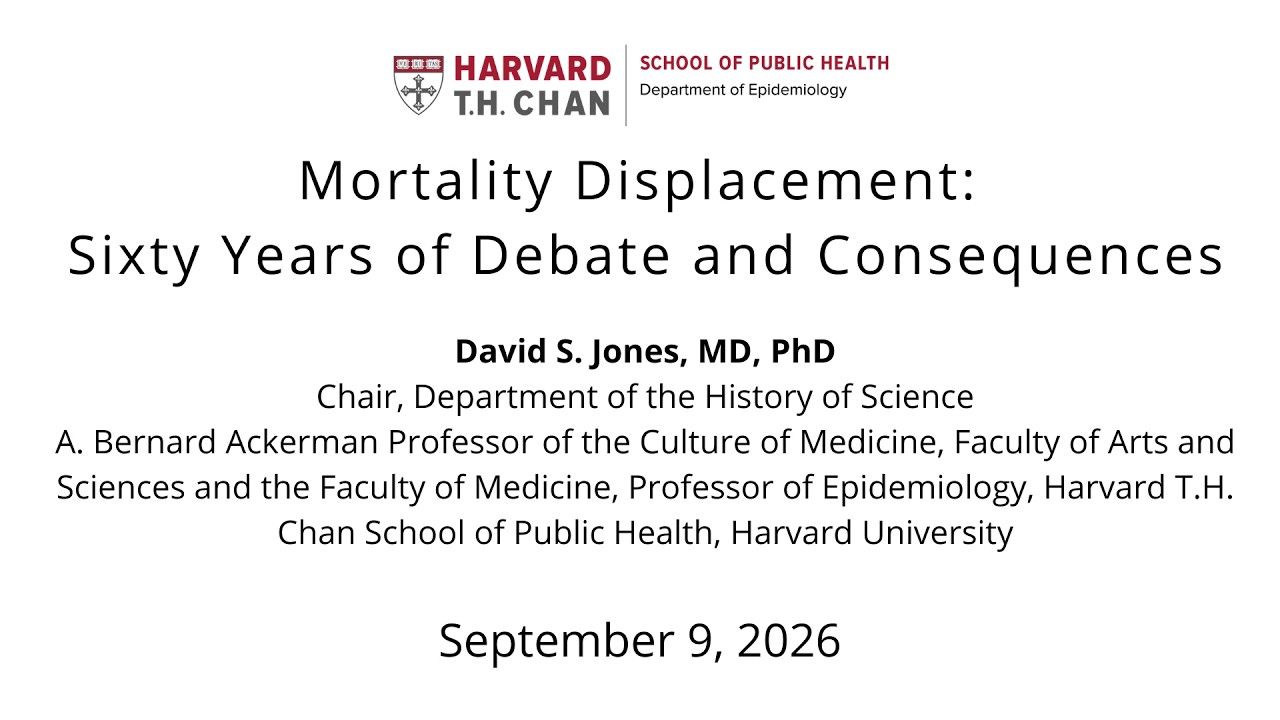
David Jones Seminar, September 9, 2026
Keywords
Summary
163 words
Critical Evaluation
Value of the Information & Strength of the Argument
The talk provides substantial value by offering a thorough historical review of mortality displacement, synthesizing decades of literature across influenza, air pollution, and heat wave research. Jones meticulously documents the evolution of the concept, including its first occurrences in the literature and the lack of clear evidence supporting it. The argumentation is well-structured, building from specific historical cases to broader methodological and policy implications. He critiques the misuse of the concept by industry-affiliated researchers and highlights the difficulty of distinguishing legitimate scientific inquiry from regulatory obstruction. The presentation is balanced, acknowledging genuine statistical challenges while exposing weaknesses in many claims of mortality displacement. Overall, the argument is compelling and grounded in careful historical research.
Scientific Rigor, Source Quality, Title Accuracy
The seminar demonstrates high scientific rigor, with Jones citing numerous historical studies and reports, including work from the Public Health Service, the EPA, and key epidemiological papers. He is careful to note when sources are missing or contradictory, such as the unpublished EPA analysis cited by Kalkstein. The presentation benefits from the speaker’s access to colleagues like Joel Schwartz and Francesca Dominici, adding insider perspective. The title accurately reflects the content, focusing on the 60-year debate and its consequences. No public comments were provided for analysis, so the public reception is not assessed.
222 words
Title / Content Match
The title accurately describes the seminar's focus on mortality displacement and its historical debate.
Quality & Reliability
9/10
Highly reliable seminar from a Harvard professor, based on extensive historical research and clear critical analysis, with authoritative institution backing.
Key Moments
Markers derived by PSI from the transcript: the creator did not define chapters.
- Introduction and overview of the topic of mortality displacement.
- Discussion of the LA wildfires and the debate over whether deaths were displaced.
- Historical origins of the concept in influenza epidemiology, with examples from the 1918 pandemic and later studies.
- Examination of the London smog of 1952 and British air pollution research.
- Analysis of heat wave mortality and early mentions of harvesting effects.
- Revival of the concept in the 1990s with the PM2.5 regulation debates.
- Role of industry critics and the Health Effects Institute in the controversy.
- Statistical challenges and the question of quantifying premature deaths.
Cited Sources
- Epidemiology Degree Program Overview — Description link; provides information about epidemiology degrees at Harvard Chan School.
Contribution & Novelties
This seminar offers a comprehensive and critical historical synthesis of the concept of mortality displacement, tracing its origins, evolution, and controversial applications in environmental epidemiology. It highlights the influence of industry funding on scientific debates and the persistent challenge of distinguishing legitimate scientific concerns from regulatory obstruction. The talk also underscores the disconnect between intuitive claims of harvesting effects and the lack of robust empirical evidence.
Pour aller plus loin :
- Environmental epidemiology — Relevant for understanding the broader context of studying environmental health impacts.
- Time series analysis — The statistical method central to many studies of pollution and mortality.
- Particulates (PM2.5) — The air pollutant at the heart of the regulatory debates discussed.
- Heat wave — A key environmental stressor in the mortality displacement literature.
126 words
Radar Profile
The radar profile shows high scores across information quantity, quality, and reliability, with a slightly lower technical level reflecting the accessible presentation. This indicates a well-researched and authoritative talk that provides deep insights while remaining generally comprehensible to an informed audience.