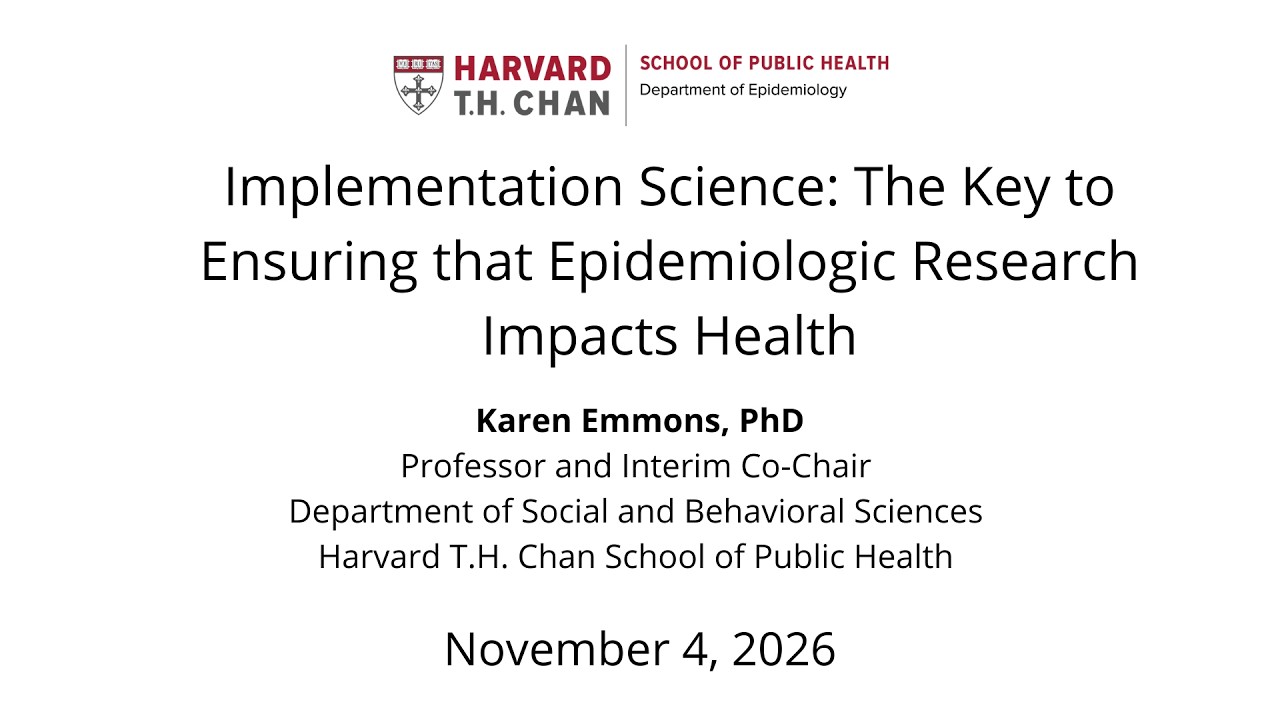
Karen Emmons Seminar, November 4, 2026
Title history
- Karen Emmons Seminar, November 4, 2026 — observed on 20261113-2201 UTC (YouTube)
Keywords
Summary
195 words
Critical Evaluation
Value of the Information & Strength of the Argument
The talk provides valuable insights into the need for implementation science, effectively bridging the gap between research and practice. Emmons’ argument is compelling, built on numerical evidence (14% adoption in 17 years vs. 80% in 3 years) and a vivid personal anecdote of a failed dissemination effort that underscores the necessity of proactive strategies. She addresses potential skepticism from epidemiologists by framing implementation science as an extension of their work, not a replacement. The logical flow—from definition to components to relevance—makes the case accessible and persuasive, although the presentation is more of an overview than a deep technical treatise.
Scientific Rigor, Source Quality, Title Accuracy
The talk maintains scientific rigor in its conceptual framework and terminology, and Emmons references key resources like the CFIR and a recent paper on implementation science and epidemiology, though specific citations are not provided on screen. The title is perfectly aligned with the content, as it is a recorded seminar presentation. The description includes a link to the department’s degree program overview, which serves as a legitimate supplementary resource. No specific external sources are directly cited beyond this link, but the speaker’s authority and the institutional context uphold the credibility.
204 words
Title / Content Match
The title accurately reflects the content: a seminar by Professor Karen Emmons recorded on November 4, 2026.
Quality & Reliability
8/10
The talk is delivered by a professor at Harvard with deep expertise in implementation science; it is informative and grounded in personal research experience, but relies primarily on oral presentation without detailed citations to peer-reviewed sources.
Key Moments
Markers derived by PSI from the transcript: the creator did not define chapters.
- Definition of implementation science and the 'research to practice' gap
- Discussion of research pipeline and adoption rates (14% in 17 years vs. 80% in 3 years)
- Personal example: smoking cessation intervention for childhood cancer survivors and its failure in real-world practice
- Overview of implementation science models and frameworks, including CFIR and process models
- Hybrid effectiveness-implementation designs and implementation outcomes (acceptability, adoption, fidelity, etc.)
- Conclusion emphasizing the importance of implementation science for epidemiology and population health
Cited Sources
- Harvard Chan School of Public Health - Epidemiology Degree Program Overview — Provided in the video description as a resource for degree programs; relevant to the seminar's academic setting.
Contribution & Novelties
This seminar offers a concise yet substantive introduction to implementation science specifically tailored for epidemiologists, emphasizing that evidence is only useful when applied. The speaker’s firsthand account of a failed dissemination attempt vividly illustrates the perils of passive knowledge transfer and the value of structured implementation approaches. The talk also introduces key frameworks and hybrid designs that can help epidemiologists integrate implementation considerations into their research from the start.
Pour aller plus loin :
- Implementation science — Overview of the field, definitions, and history.
- CFIR guide — The Consolidated Framework for Implementation Research, a comprehensive tool for assessing context.
- Knowledge translation — Related concept focusing on closing the gap between knowledge and practice.
113 words
Radar Profile
The profile shows high scores in information quality and reliability, with moderate quantity and technical levels. This reflects an expert seminar that offers credible, well-structured content, though it is not exhaustive in detail and assumes some prior knowledge of public health.