Byung Chul Han | PSICOPOLÍTICA | Estudios culturales en Epistemología crítica
Byung-Chul Han | PSYCHOPOLITICS | Cultural Studies in Critical Epistemology
Title history
- Byung Chul Han | PSICOPOLÍTICA | Estudios culturales en Epistemología crítica — observed on 20261101-0204 UTC (YouTube)
Keywords
Summary
214 words
Critical Evaluation
Value of the Information & Strength of the Argument
The video offers a valuable and accessible exposition of Han’s key arguments, connecting them to contemporary digital culture and self-help trends. The argumentation is coherent and grounded in the primary text, with the presenter systematically building on Foucault’s theoretical framework. The use of concrete examples (e.g., social media algorithms, self-optimization images) effectively illustrates abstract philosophical ideas. However, the analysis is largely expository and does not critically engage with potential objections or alternative interpretations. The presenter’s personal reflections, while engaging, occasionally sidetrack the core argument. Nonetheless, the overall reasoning is solid and faithful to Han’s original work, making it a useful educational resource for understanding psychopolitics and the critique of neoliberalism.
Scientific Rigor, Source Quality, Title Accuracy
The video demonstrates a good grasp of the source material, referencing Han’s ‘Psychopolitics’ and ‘The Burnout Society’, as well as Foucault’s concepts of biopolitics and the panopticon. The title matches the content, which is explicitly about Han’s psychopolitics in a critical epistemology context. The presentation lacks explicit sourcing for external claims, but it clearly derives from Han’s published texts, and the references to Foucault are standard. The absence of a description or links in the video metadata reduces the ability to verify specific sources, but the internal consistency and accurate conceptual representation lend credibility. The speaker does not falsify or distort the ideas, though the personal digressions dilute the rigor. Overall, the source quality is acceptable for an introductory educational discussion, though it would benefit from direct citations to page numbers or external references.
259 words
Title / Content Match
The title accurately mirrors the content: a critical epistemology-focused analysis of Han's Psychopolitics.
Quality & Reliability
7/10
The video presents a well-structured and faithful summary of Byung Chul Han's 'Psychopolitics', accurately referencing Foucault's concepts. However, the analysis is subjective and interspersed with personal interpretations and anecdotes, lacking external verification or contrasting views.
Key Moments
Markers derived by PSI from the transcript: the creator did not define chapters.
- Introduction to Byung Chul Han and his philosophical work.
- Discussion of Foucault's biopolitics and the shift from physical to psychic production.
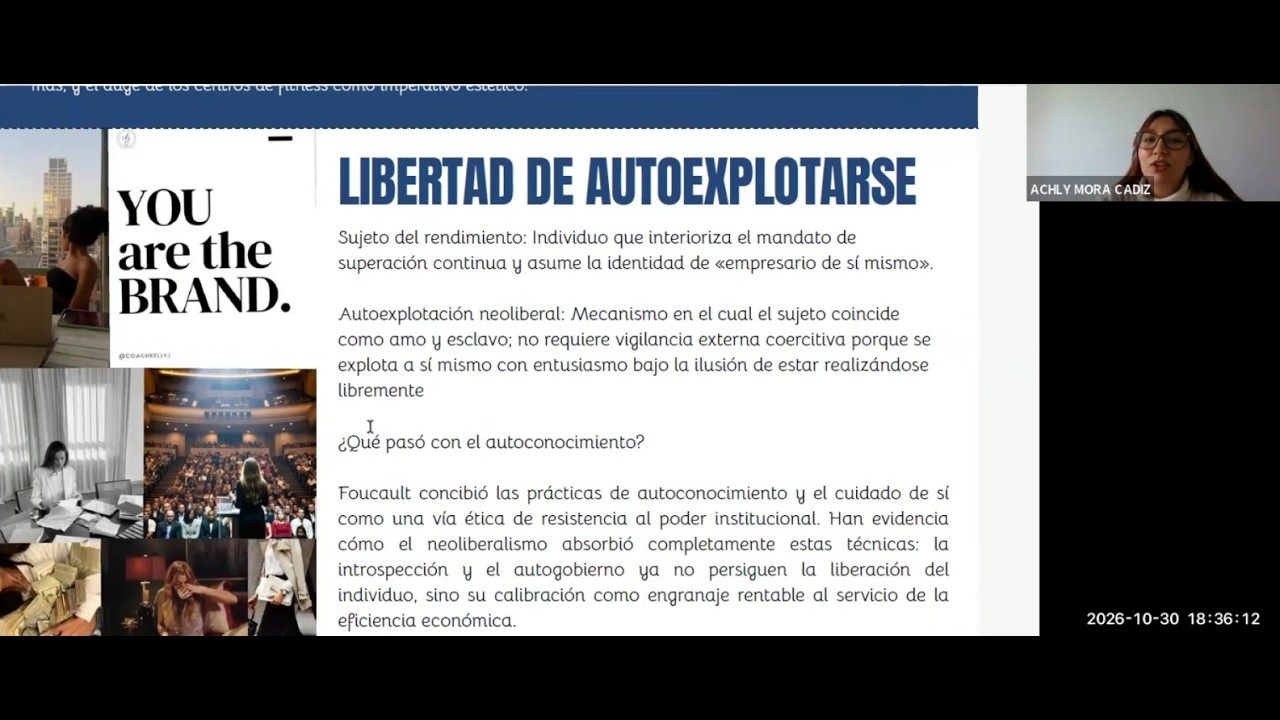
- Explanation of self-exploitation and the 'entrepreneur of oneself' concept.
- Critique of positive thinking and toxic positivity as a new form of oppression.
- Analysis of Big Data, the digital panopticon, and dataism.
- Examination of the quantified self movement and loss of narrative identity.
Cited Sources
- Byung-Chul Han — Author of 'Psychopolitics', the book under review.
- Psychopolitics: Neoliberalism and New Technologies of Power — The primary text discussed in the video, published in 2014.
- The Burnout Society — Another book by Han mentioned in the introduction.
- Michel Foucault — Philosopher whose concepts of biopolitics and panopticon are referenced.
Concurring Sources
- Byung-Chul Han - official works — Han's philosophical positions as summarized in the video align with his published works.
Contribution & Novelties
The video contributes by offering a didactic and contemporary interpretation of Han’s psychopolitics, bridging the text with real-world examples from social media, self-help culture, and everyday digital surveillance. It effectively synthesizes complex philosophical ideas into accessible language, making Han’s critique of neoliberalism and the digital panopticon relatable to a general audience. The personal anecdotes and visual references (e.g., Pinterest images) ground the abstract concepts, though this also introduces a subjective layer that a formal academic analysis might avoid. The video’s novelty lies in its pedagogical approach, highlighting the relevance of Han’s ideas to current lifestyle trends and mental health discourse.
Pour aller plus loin :
- Biopolitics on Wikipedia — Provides background on Foucault’s concept that underpins Han’s analysis.
- Panopticon on Wikipedia — Explains Jeremy Bentham’s prison design and its digital extension, crucial for understanding Han’s digital panopticon.
- Quantified Self on Wikipedia — Relevant movement of self-measurement that Han criticizes.
- Dataism on Wikipedia — Discusses the ideology of data-centric worldviews, a key term in Han’s critique.
165 words
Radar Profile
The radar profile shows a moderate level across all dimensions, with the strongest score in technical depth (8) reflecting the philosophical complexity, while information quality and reliability score slightly lower (7) due to the subjective and expository nature. The overall balance suggests a solid but not exceptional educational content.