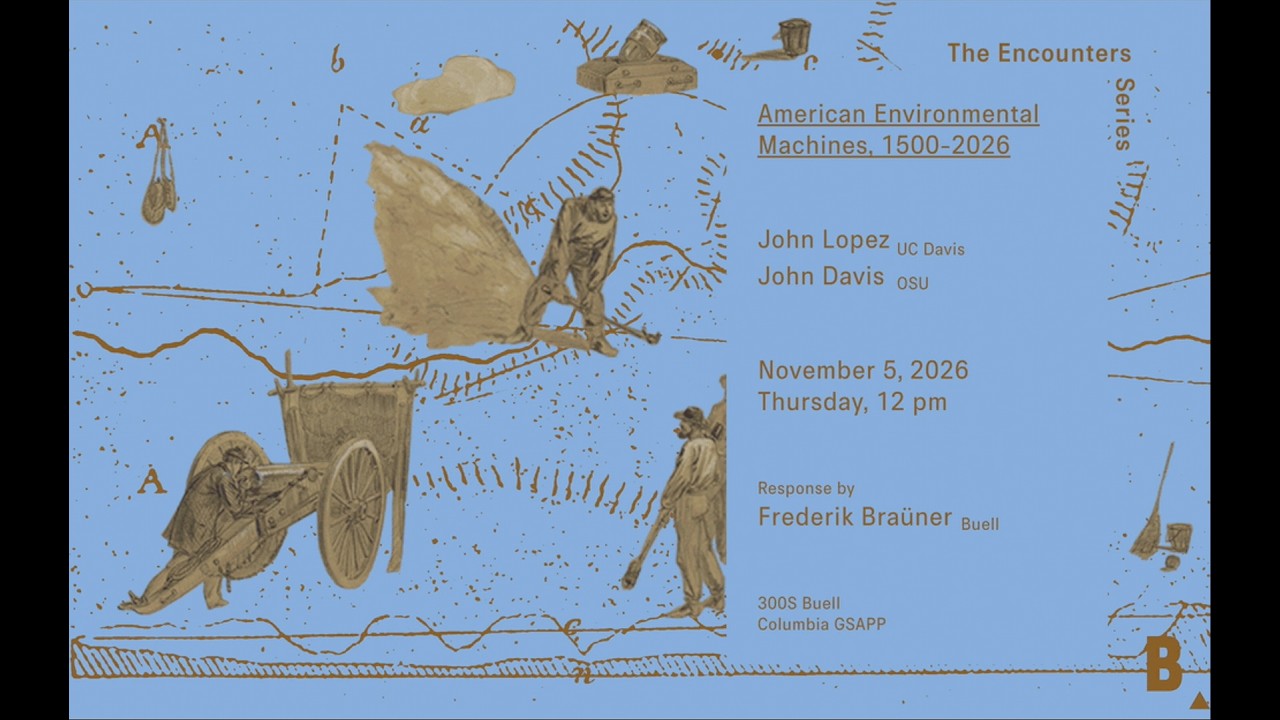
Encounters Series: American Environmental Machines, 1500-2026
Title history
- Encounters Series: American Environmental Machines, 1500-2026 — observed on 20261117-0331 UTC (YouTube)
Keywords
Summary
167 words
Critical Evaluation
Value of the Information & Strength of the Argument
The value of the information lies in its detailed, archival-based historical reconstructions. López effectively demonstrates how the choice between drainage (desagüe) and a machine-based hydraulic system reflected cultural and political preferences rather than purely technical necessity, and he persuasively links this historical decision to contemporary problems like land subsidence and climate-induced flooding. Davis’s analysis of the Savannah River is similarly rich, showing how engineering projects are deeply embedded in questions of serfdom, privilege, and political domination, particularly in the context of Reconstruction. The argumentation is robust, drawing on specific documents, maps, engravings, and engineering data, and it carefully delineates cause and effect across temporal scales.
Scientific Rigor, Source Quality, Title Accuracy
The rigor is high; both speakers are scholars at leading institutions (UC Davis, OSU) and their work reflects extensive archival research. John López’s book ‘The Aquatic Metropolis’ is already published, and Davis’s ‘Reconstructors’ is forthcoming, indicating a solid academic foundation. The sources cited are internal to the lecture (e.g., Jacques Besson’s 1578 treatise, maps, and historical records) and the title adequately captures the content, which is precise and coherent. No external links were provided in the description, so verification relies on the academic credentials and the internal consistency of the narrative.
211 words
Title / Content Match
The title accurately reflects the lecture's theme, bridging historical case studies to discuss environmental engineering and machines in American history.
Quality & Reliability
8/10
The talk features two established academic historians presenting original research. John López's work on Mexican hydraulic history and John Davis's on the Savannah River are supported by archival references and published materials. The rigor is high, with conceptually sound arguments, though the scope is necessarily limited by the lecture format.
Key Moments
Markers derived by PSI from the transcript: the creator did not define chapters.
- Introduction by Lucía Allais and context of the Encounters Series.
- John López describes Tenochtitlan and the Spanish colonial desagüe project.
- Analysis of Adriaen Leeghwater's hydraulic machines (dredgers, cranes, windmills).
- Rejection of Leeghwater's plan and the warning about subsidence.
- John Davis introduces the Savannah River experiment and the Corps of Engineers.
- Discussion of the post-Civil War modernization of the Savannah River and its socio-political implications.
- Frederik Braüner's response and concluding remarks.
Cited Sources
- The Aquatic Metropolis (book by John López) — Mentioned as published work on Mexico City's flooding history.
- Reconstructors: Land, Work and Engineering after the Civil War (book by John Davis) — Mentioned as upcoming book on engineering and environment in the US South.
- Theatrum Instrumentorum et Machinarum by Jacques Besson (1578) — Cited as a treatise containing engravings of machines like the dredger.
Contribution & Novelties
The lecture provides an original interdisciplinary contribution by connecting distant historical contexts (Mexico City and the US South) under the conceptual umbrella of ’environmental machines.’ It challenges dominant narratives by highlighting the deliberate political rejection of engineers’ warnings and the long-term detrimental effects of drainage projects. The comparative methodology yields fresh perspectives on how nations interact with nature through technology.
Pour aller plus loin :
- Desagüe — Historical drainage project of Mexico Valley, central to López’s argument.
- Land subsidence — Phenomenon explained by López, critically linked to groundwater withdrawal.
- United States Army Corps of Engineers — Key federal agency in Davis’s narrative of river engineering.
- Archimedes’ screw — Hydraulic machine type mentioned in López’s discussion of Dutch windmills.
118 words
Radar Profile
The radar shows a well-balanced profile with high scores in information quantity and quality, reflecting the depth of academic detail. The technical level is moderate, requiring some background in history or engineering, while reliability is solid due to the speakers' credentials and archival grounding.