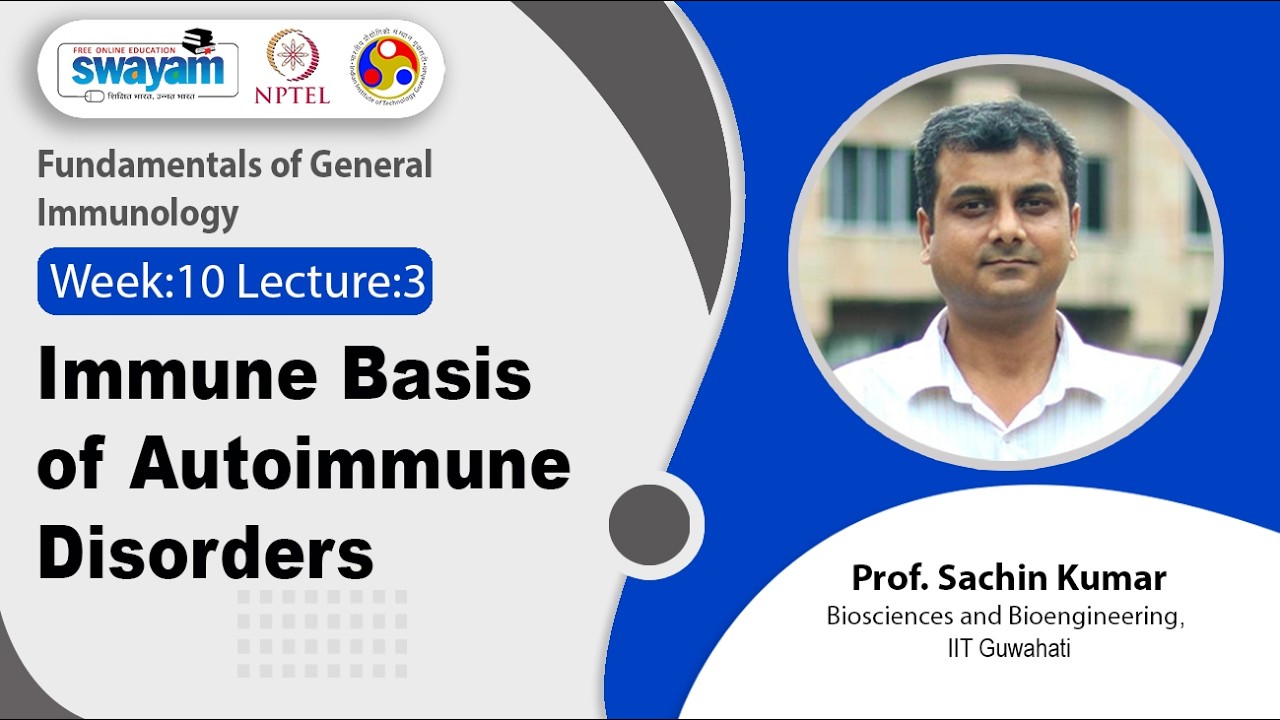
Lec 42: Immune Basis of Autoimmune Disorders
Keywords
Summary
140 words
Critical Evaluation
Value of the Information & Strength of the Argument
The lecture provides substantial educational value by systematically explaining the immune mechanisms underlying autoimmune diseases. It connects fundamental concepts such as immune tolerance, hypersensitivity, and immune complex pathology, offering a coherent framework. The argumentation is logical: it starts with defining chronic/systemic diseases, then introduces autoimmunity as a breach of tolerance, and proceeds to dissect specific examples. The instructor uses clear analogies (e.g., incubation period, acute vs. chronic) and detailed molecular explanations (e.g., citrullination, ACPA) to solidify understanding. The discussion of immune tolerance checkpoints is particularly valuable, as it highlights potential therapeutic targets. The presentation is well-structured and consistent with established immunology knowledge.
Scientific Rigor, Source Quality, Title Accuracy
The scientific rigor is high, as the content aligns with standard immunology textbooks and peer-reviewed knowledge. The presenter is a professor at IIT Guwahati, and the lecture is part of an official NPTEL course, lending credibility. The description provides links to the course page and playlist, serving as primary sources. However, the video itself does not cite external research papers, and the reliance on prior course material is expected. The title ‘Immune Basis of Autoimmune Disorders’ precisely matches the lecture’s scope. Notably, no viewer comments or interactions are available for analysis, so audience reception cannot be assessed.
214 words
Title / Content Match
The title accurately reflects the lecture's focus on the immune mechanisms underlying autoimmune diseases.
Quality & Reliability
8/10
Lecture by a professor from IIT Guwahati, part of a structured NPTEL course, covering well-established immunology concepts with clear explanations.
Key Moments
Markers derived by PSI from the transcript: the creator did not define chapters.
- Introduction to chronic and systemic diseases; distinction between acute and chronic conditions.
- Definition of autoimmunity and overview of autoimmune disorders like rheumatoid arthritis, lupus, and type 1 diabetes.
- Discussion of immune tolerance: central and peripheral tolerance, clonal deletion, regulatory T cells.
- Detailed immunology of rheumatoid arthritis: citrullinated proteins, ACPA antibodies, immune complexes, role of osteoclasts and neutrophils.
- Systemic lupus erythematosus: butterfly rash, kidney involvement, multisystem effects.
Cited Sources
- NPTEL Course Page: noc26_bt52 — Official course page for 'Fundamentals of General Immunology'
- Playlist: Fundamentals of General Immunology — Video playlist containing this lecture
Contribution & Novelties
This lecture contributes to educational content by providing a structured overview of the immune basis of autoimmune disorders, suitable for students. It synthesizes concepts from immunology, such as tolerance and hypersensitivity, into a clinical context. The discussion of immune tolerance checkpoints offers a practical angle for future therapeutic strategies.
Pour aller plus loin :
- Central tolerance — Key mechanism of immune self-tolerance in thymus and bone marrow.
- Regulatory T cell — Critical for peripheral tolerance and prevention of autoimmunity.
- Anti-citrullinated protein antibody — Biomarker and pathogenic factor in rheumatoid arthritis.
- Systemic lupus erythematosus — Overview of the systemic autoimmune disease discussed.
101 words
Radar Profile
The profile shows high scores in fiability and information quantity, with slightly lower technical level indicating a lecture suitable for advanced students. The balance between quality and technical depth suggests a solid educational resource.