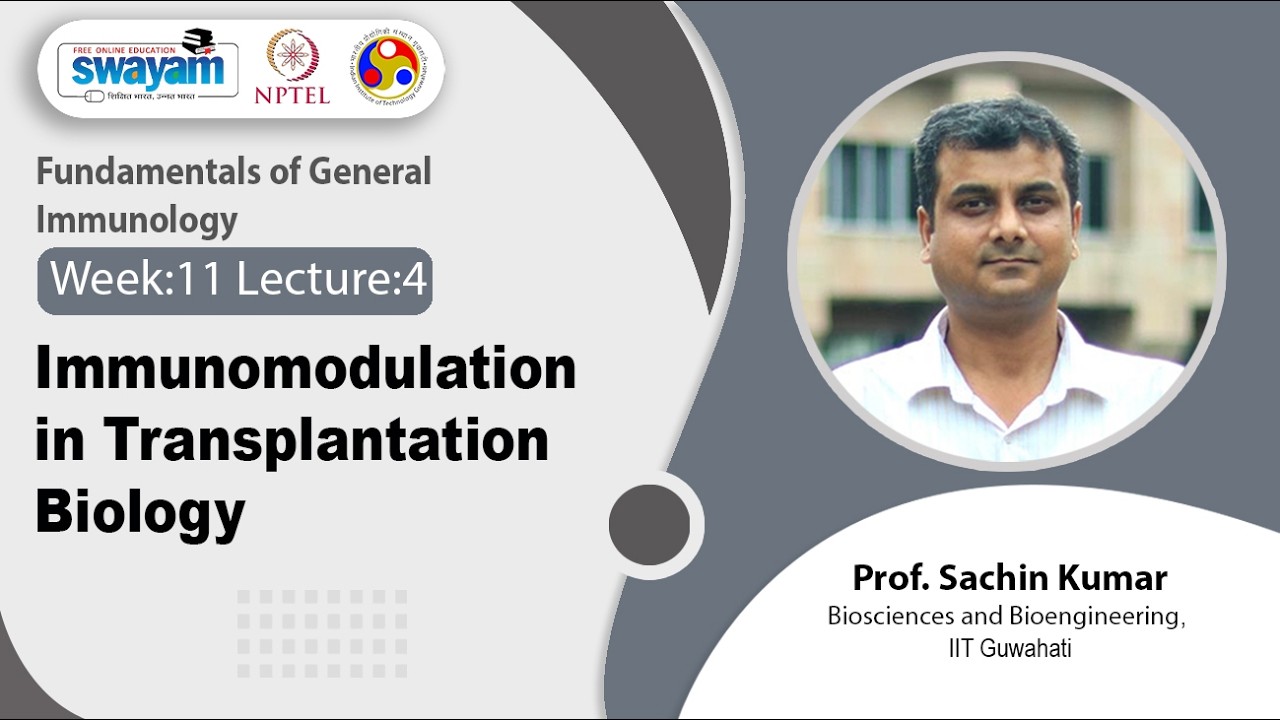
Lec 48: Immunomodulation in Transplantation Biology
Keywords
Summary
172 words
Critical Evaluation
Value of the Information & Strength of the Argument
The lecture provides a comprehensive and logically structured overview of transplantation immunology, effectively connecting molecular mechanisms to clinical applications. The argumentation is clear, starting with the mixed lymphocyte reaction as a model, then transitioning to blood group antigens (ABO, Lewis, Rh), and finally therapeutic procedures such as stem cell transplant and plasma therapy. Each topic is explained step by step, with emphasis on immune recognition and its consequences. Although the content is not novel, it is valuable for learners seeking a solid foundation. The professor uses simple language and analogies, making complex concepts accessible. The reasoning is sound, but the lecture would benefit from citing primary literature to strengthen its academic rigor.
Scientific Rigor, Source Quality, Title Accuracy
The lecture is scientifically rigorous in its presentation of established immunology principles, but it does not cite any specific research papers or external sources. The information appears accurate, though some simplifications are inherent in a 28-minute overview. The title accurately reflects the content, and the lecturer’s credentials (IIT Guwahati) lend credibility. No external sources are mentioned, so the quality relies on the instructor’s expertise. The content is consistent with standard immunology textbooks, but the lack of references reduces its utility for advanced learners seeking original studies. The title aptly summarizes the focus on immunomodulation in transplantation biology.
224 words
Title / Content Match
The title accurately reflects the content, focusing on immunomodulation in transplantation biology, and the lecture also covers blood group antigens and associated clinical procedures. The title is fully appropriate.
Quality & Reliability
8/10
Lecture by a professor from IIT Guwahati, part of the NPTEL course 'Fundamentals of General Immunology'. Content is scientifically accurate and well-structured, but no external citations are provided. The lecture covers established knowledge in transplantation biology and blood group immunology with clear explanations.
Key Moments
Markers derived by PSI from the transcript: the creator did not define chapters.
- Introduction to transplantation biology and the mixed lymphocyte reaction
- Detailed explanation of mixed lymphocyte reaction and T-cell activation
- ABO blood group system: antigens, antibodies, and donor compatibility
- Lewis antigen system: origin and its role in blood grouping
- Rh factor and erythroblastosis fetalis in pregnancy
- Autologous hematopoietic stem cell transplantation: procedure and applications
- Convalescent plasma therapy and passive immunization during COVID-19
- Summary of graft types and key concepts in transplantation biology
Cited Sources
- NPTEL Course: Fundamentals of General Immunology — Official course page with lecture details and syllabus
- Complete Playlist for the Course — YouTube playlist containing all lectures from the course
Contribution & Novelties
This lecture offers a consolidated and accessible synthesis of transplantation biology, bridging basic immunology concepts with clinical applications. While not introducing new research, it serves as a valuable educational resource that contextualizes mixed lymphocyte reactions, blood group systems, and therapeutic transplants. The clear explanations and clinical examples (e.g., Rh incompatibility, stem cell therapy) help learners grasp complex mechanisms.
Pour aller plus loin :
- Major Histocompatibility Complex — Core molecules governing T-cell recognition in transplantation.
- Graft-versus-host disease — A key complication discussed, where donor immune cells attack the host.
- ABO blood group system — Detailed genetics and clinical significance of the major blood grouping.
- Rh factor — Molecular basis of Rh antigens and implications for pregnancy.
- Hematopoietic stem cell transplantation — Further reading on autologous and allogeneic transplants.
- Convalescent plasma therapy — Use of passive antibodies in infectious disease treatment.
139 words
Radar Profile
The radar profile shows a balanced performance with notably high scores in quality and reliability (8 each), reflecting accurate scientific content and a trustworthy instructor. Quantity of information (7) indicates a decent breadth, while technical depth (6) suggests a moderate level suitable for introductory learners. Overall, the lecture is a dependable educational resource.