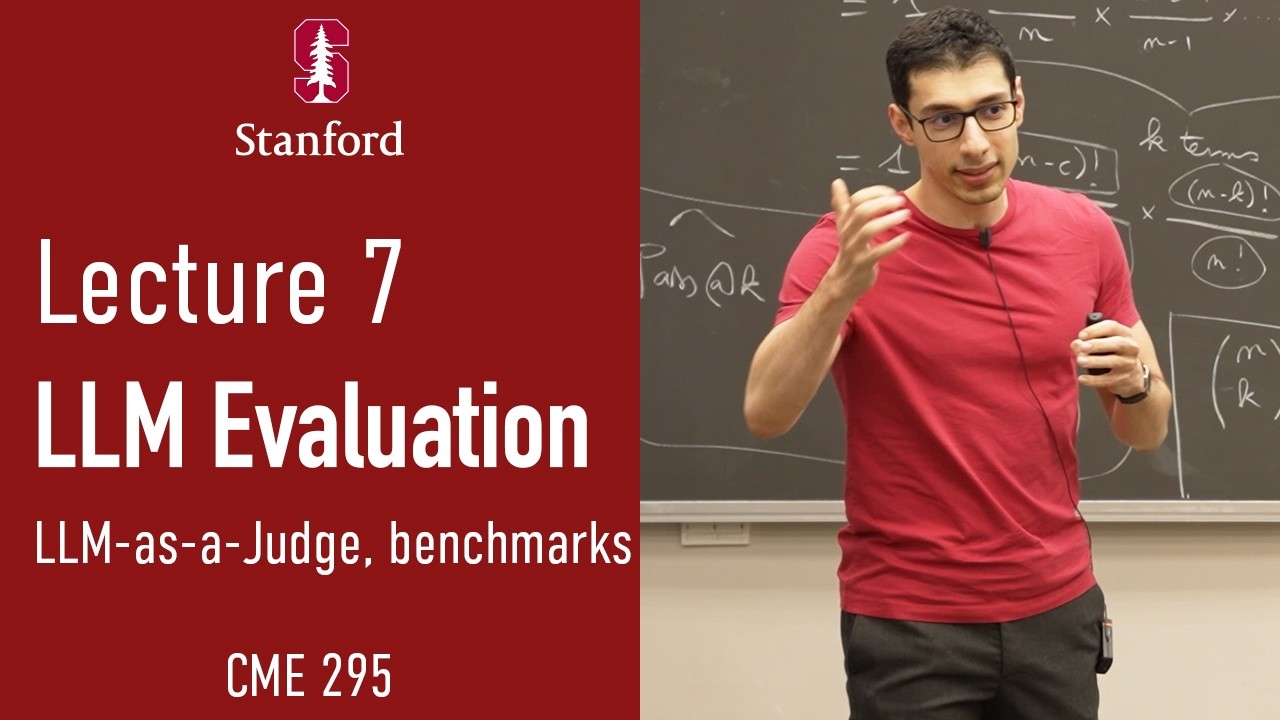
Stanford CME295 Transformers & LLMs | Autumn 2026 | Lecture 7 - LLM Evaluation
Title history
- Stanford CME295 Transformers & LLMs | Autumn 2026 | Lecture 7 - LLM Evaluation — observed on 20261121-0055 UTC (YouTube)
Keywords
Summary
178 words
Critical Evaluation
Value of the Information & Strength of the Argument
The value of this lecture lies in its systematic and pedagogical approach to LLM evaluation, covering both foundational metrics and recent developments like LLM-as-a-judge. The instructors provide clear mathematical derivations (e.g., Pass@k) and practical examples, making the content accessible yet rigorous. The argumentation is solid, as each method is introduced with its motivation and limitations, and the progression from human ratings to automated metrics logically builds toward LLM-based evaluation. The discussion of biases and the emphasis on prompt design for LLM judges add practical depth. However, some sections are brief (e.g., BLEU, METEOR) and could benefit from more illustrative examples or comparisons, but overall the lecture is well-structured and informative.
Scientific Rigor, Source Quality, Title Accuracy
The lecture is rigorous, with a clear academic context from Stanford University. The instructors are adjunct professors, and the content aligns with established literature in LLM evaluation. The sources mentioned in the video description include links to the course syllabus and playlist, which provide additional resources. The title accurately reflects the content: it is indeed Lecture 7 focusing on LLM evaluation. The chapter markers precisely segment the talk, aiding navigation. The scientific rigor is high, as the lecture uses formal definitions, formulas, and references to standard metrics (e.g., Cohen’s kappa, BLEU) and recent research like LLM-as-a-judge. The title-content match is excellent.
226 words
Title / Content Match
Title accurately describes the lecture content on LLM evaluation.
Quality & Reliability
9/10
Lecture from Stanford University's CME295 course, taught by adjunct professors, covering evaluation metrics with mathematical derivations and examples. High reliability due to academic context and detailed technical content.
Chapters
Cited Sources
- CME295 Syllabus — Course syllabus for reference
- Stanford Graduate Programs — Information about Stanford graduate programs
- Playlist for Course — Playlist of lectures
Contribution & Novelties
This lecture provides a structured and up-to-date overview of LLM evaluation techniques, bridging classical metrics with modern practices. Its contribution lies in clearly explaining the derivation of Pass@k, highlighting biases in LLM-as-a-judge, and introducing the concept of benchmaxxing and Pareto frontiers for model selection—topics not commonly covered in introductory materials. The lecture also emphasizes practical nuances like prompt hillclimbing and structured outputs, adding actionable insights.
Pour aller plus loin :
- Cohen’s kappa on Wikipedia — For a deeper understanding of inter-rater agreement statistics.
- Evaluating Large Language Models Trained on Code (Pass@k) — The paper that popularized the Pass@k metric for code generation.
- Judging LLM-as-a-judge with MT-Bench and Chatbot Arena — A key study on the reliability and biases of using LLMs as judges.
123 words
Radar Profile
The radar profile shows high scores across all dimensions, indicating a well-rounded and technically rich lecture with strong reliability and information density. The slightly lower score in 'niveau_technique' (8) reflects that while the content is advanced, some parts are introductory. Overall, the lecture excels in providing substantial quantitative and qualitative information.