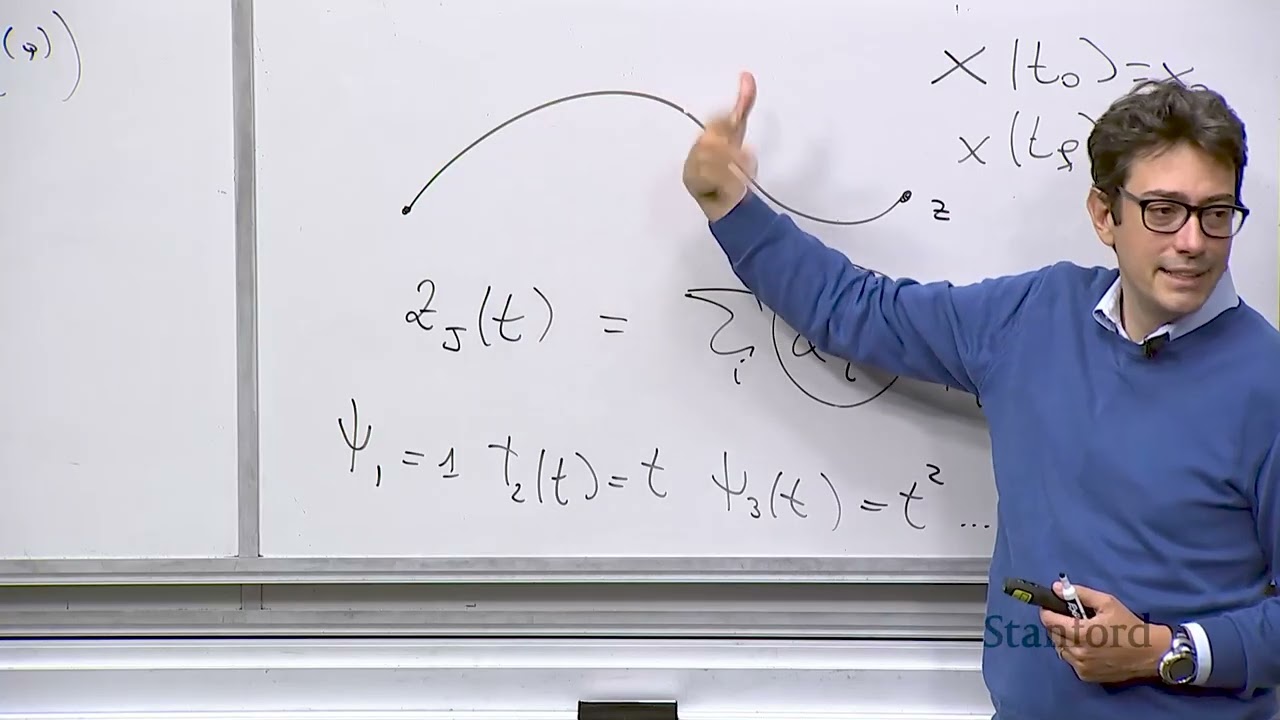
Stanford AA274A Principles of Robotic Autonomy | Autumn 2019 | Trajectory Tracking
Keywords
Summary
154 words
Critical Evaluation
Value of the Information & Strength of the Argument
The lecture provides substantial value by bridging theoretical concepts with practical implementation. It clearly explains the purpose of time scaling in trajectory optimization, demonstrating how to adjust speed profiles to meet input constraints. The argumentation is solid: each concept is introduced with intuition, followed by mathematical formalism, and then contextualized with examples from robotics. The instructor efficiently ties together previous topics, creating a coherent narrative that reinforces the learning objectives. The use of a problem set to apply these methods underscores the practical relevance. However, the lecture assumes prior knowledge of differential flatness and trajectory optimization, which may limit accessibility for those new to the subject. Nevertheless, within its scope, the argumentation is logically sound and well-supported by references to standard techniques.
Scientific Rigor, Source Quality, Title Accuracy
The scientific rigor is high, as the lecture is part of an official Stanford graduate course and delivered by a professor with extensive research experience in autonomous systems. The sources cited include the course’s companion textbook (Principles of Robot Autonomy) and official course materials, which are reliable and directly relevant. The title accurately reflects the content, focusing on trajectory tracking as the main theme while also covering necessary prerequisites like time scaling and closed-loop control. The lecture does not introduce novel research but synthesizes established methods, which is appropriate for a course. There is a clear alignment between the title and the delivered material, with no indication of misinformation or bias.
248 words
Title / Content Match
The title accurately reflects the content: the lecture focuses on trajectory tracking and includes related topics like time scaling and closed-loop control.
Quality & Reliability
9/10
Lecture by a renowned professor from Stanford University, based on established course materials, with open resources and peer-reviewed background.
Key Moments
Markers derived by PSI from the transcript: the creator did not define chapters.
- Introduction and recap of previous lecture on trajectory optimization and differential flatness
- Review of differential flatness concept and its application to compute open-loop trajectories
- Introduction to time scaling to account for input bound constraints in the flat output space
- Detailed explanation of time scaling mathematics and examples with a unicycle model
- Transition to trajectory tracking: need for closed-loop controllers and robustness
- Description of a simple geometric pursuit controller and its rationale
- Further elaboration on trajectory tracking and closed-loop control, linking to problem set
- Summary of the overall approach and integration of topics
Cited Sources
- Stanford Graduate Education — General information about Stanford's graduate programs, provided in the video description.
- Principles of Robot Autonomy — Companion textbook for the course, freely available online, referenced as a resource.
- PoRA-I Course Syllabus — Official course schedule and syllabus, provided for up-to-date information.
- AA274A Full Playlist — YouTube playlist of all lectures in the course, useful for context.
Concurring Sources
- Principles of Robot Autonomy — Official textbook for the course, aligns with the lecture content.
Contribution & Novelties
The lecture offers a clear pedagogical explanation of how to incorporate input constraints into differentially flat trajectory planning using time scaling. It elaborates on the separation of geometric path and time schedule, a concept that is crucial for practical implementation. The integration with trajectory tracking controllers provides a complete picture of the two-step design approach. While the methods are established, the lecture’s clarity and examples provide educational value.
Pour aller plus loin :
- Differential flatness — Key concept for trajectory planning; explains the theory behind simplifying motion planning.
- Time scaling — General method used to adjust trajectory speed profiles while preserving path geometry.
- Trajectory tracking — Overview of trajectory optimization and control, relevant to the lecture’s content.
- Principles of Robot Autonomy — Companion textbook for deeper study.
127 words
Radar Profile
The radar profile shows high scores across all dimensions, with the strongest points in technical level and reliability. The lecture is information-dense and technically rigorous, reflecting its graduate-level nature. The balance between quantity and quality is commendable, though the depth may be challenging for beginners.