µP, Momentum & Weight Decay Predictions | Stanford CS312 Quiz Review with Tatsunori Hashimoto
Keywords
Summary
303 words
Critical Evaluation
Value of the Information & Strength of the Argument
The informational value here is high for anyone working on hyperparameter transfer, because the video does not merely state answers: it exposes the reasoning paths that let a practitioner shortcut a costly sweep. The most transferable items are the empirical rules of thumb — that the learning rate times weight decay product is the invariant to track, that deviating from it costs roughly 0.01 × (log of the deviation ratio)², that momentum is nearly free to omit at small batch sizes but expensive at large ones, and that at large batch sizes the optimal peak learning rate saturates while the optimal weight decay keeps growing. These are stated with enough precision to be used heuristically and, importantly, with an explicit caveat that the quadratic rule is a rough order-of-magnitude device rather than a law.
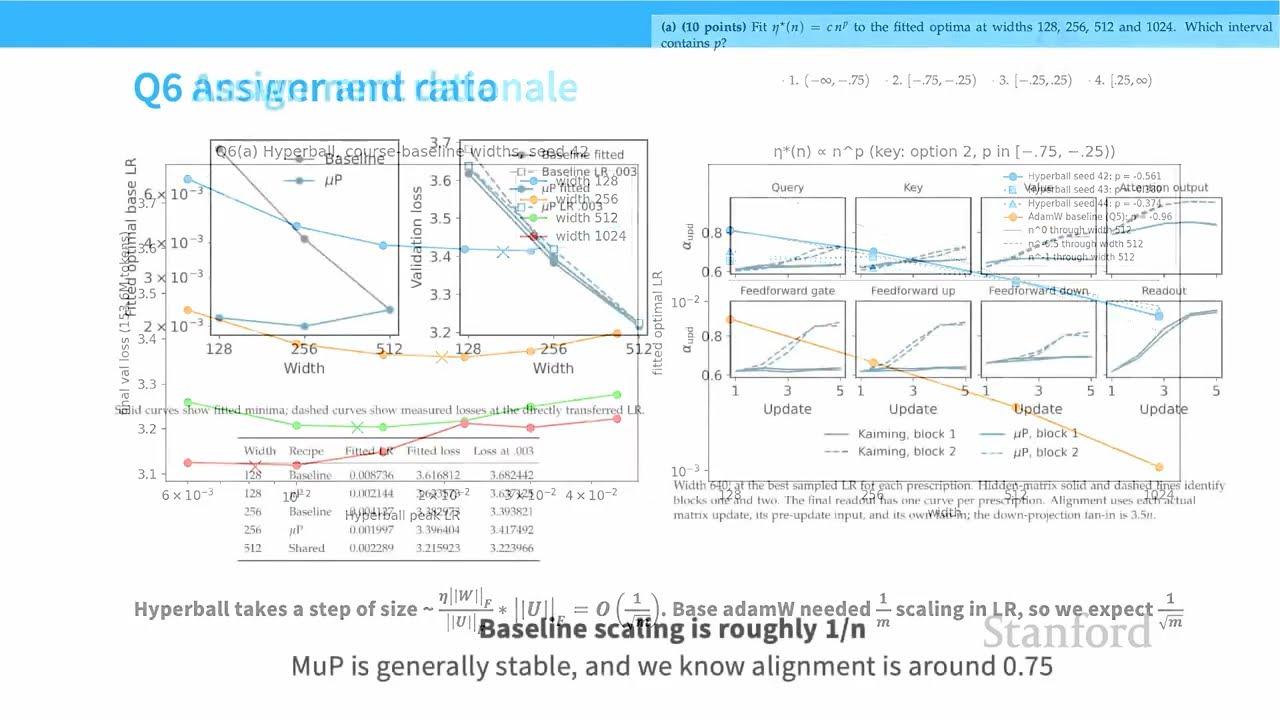
The argumentation is didactic and generally well-structured: each answer is motivated by a mechanism (linear versus square-root accumulation of residual contributions for aligned versus random blocks; Frobenius-norm normalisation in Hyperball implying a 1/√width step size; the noisy quadratic model bounding peak learning rate) before being checked against a plot. Where the reasoning is genuinely inductive, the speaker says so — the Hyperball exponent is bracketed from seeded runs, and one transfer-penalty question is admitted to have been hard to guess even for him. The main weakness is that the empirical anchors are shown as images from a private play test, with no numbers, seeds, error bars or code, so a viewer cannot distinguish a robust regularity from a quirk of one experimental configuration. Several answers are also acknowledged to be ‘off-by-one’ tolerant, which is honest but signals that the quiz measures coarse directional understanding rather than precise quantitative prediction. The value is therefore best described as expert-guided intuition-building, strong on mechanism and heuristics, weaker on demonstrated reproducibility of the specific coefficients.
Scientific Rigor, Source Quality, Title Accuracy
Scientifically, the lecture is internally coherent and mechanistically grounded, and the professor repeatedly separates what follows from theory (scaling of aligned versus random contributions, 1/width versus flat learning-rate scaling, noisy-quadratic-model predictions) from what is read off a plot. The weak point is sourcing: no paper, preprint or dataset is cited anywhere in the talk, and the only external references offered are links to the course website and the lecture playlist. The evidence consists of course-internal experiments and an ‘internal play test’ of an assignment, presented as slides without reported hyperparameters, seeds, uncertainty quantification or statistical tests; one exchange in the room even notes that a difference of about 0.06 sits uncomfortably close to a 0.05 threshold, which highlights the absence of formal significance treatment. The numerical rule of thumb (0.01 × log-ratio squared) is presented as surprisingly accurate but is explicitly an empirical fit to a single assignment’s landscape, not a validated law.
The relationship between title and content is faithful: the video delivers exactly the advertised quiz review on µP, momentum and weight-decay predictions, with the chapter markers mapping cleanly onto the questions discussed. The one caveat is that the title could suggest a research talk on these phenomena, whereas the format is a pedagogical answer-key walkthrough anchored in assignment data, which affects how much independent evidential weight a viewer should place on the numbers. A brief, unbranded promotional/logistics sequence appears at the very end, announcing tutorials and a survey request; it does not affect the scientific assessment.
569 words
Title / Content Match
The title matches the content closely: the video walks through quiz questions on µP vs CompleteP depth scaling, momentum at small and large batch sizes, and learning-rate/weight-decay prediction rules. Slight compression: it is a quiz review, not a systematic treatment of those topics.
Quality & Reliability
7/10
The content is delivered by a Stanford assistant professor and is grounded in concrete optimization experiments (loss landscapes over learning-rate × weight-decay grids, momentum sweeps, width sweeps), and the reasoning is explicit and checkable. However, the supporting evidence comes from a private course 'play test' whose raw data, seeds and code are not shown or linked, no external literature is cited, and the speaker himself concedes that several quiz answers are ambiguous and were partly guessed during play-testing. Reliability is therefore high as course pedagogy, moderate as independently verifiable science.
Chapters
- Optimization quiz review: reasoning it out
- Q1: Shared blocks, depth µP vs CompleteP
- Q1b: Alignment and which loss is lowest
- Q2: Cosine decay and LR times weight decay
- Q2b: Quadratic penalty rule of thumb
- Q3: Extrapolating Hyperball scaling trends
- Q4: Momentum sweep at batch 8 vs 256
- Q5: Almost µP and learning rate transfer
- Q6: Hyperball learning rate scaling in width
- Q7: Large batch: scale weight decay, not LR
- Tutorials and bonus question logistics
Cited Sources
- CS312: Deep Learning Alchemy — course website — Course site for the class whose assignment plots, quizzes and play-test data underpin every answer discussed in the video.
- Stanford Online — deep learning courses — Link given in the description for browsing Stanford's online deep learning course offering.
- CS312 full lecture playlist (YouTube) — Playlist containing the complete CS312 lecture series, including the lectures referenced throughout the quiz review.
Concurring Sources
- Tensor Programs V: Tuning Large Neural Networks via Zero-Shot Hyperparameter Transfer — Independent literature consistent with the video's claims that standard parameterization requires learning rates scaling as roughly 1/width while µP keeps them width-invariant, and that hyperparameters can be transferred across width.
- Decoupled Weight Decay Regularization (AdamW) — Supports treating weight decay as an independent, separately tunable quantity, which underlies the LR × WD diagonal and the recommendation to scale weight decay for large batches.
- SGDR: Stochastic Gradient Descent with Warm Restarts — Provides the cosine annealing-to-zero schedule used in the second quiz question's sweep.
Contribution & Novelties
The original contribution is pedagogical rather than empirical: the video packages a set of reasoning shortcuts that let a practitioner predict optimization outcomes without re-running sweeps — the learning-rate × weight-decay invariant with its approximately quadratic off-diagonal penalty, the batch-size-dependent cost of removing momentum, Hyperball’s implicit 1/√width step size sitting between Adam’s 1/width and µP’s flat scaling, and the recommendation to scale weight decay rather than peak learning rate at large batch sizes. It also reports a specific contrast between depth-µP and CompleteP for shared parameter blocks, with an explicit mechanism (perfect alignment implies linear accumulation and hence 1/L scaling). These are framed as quiz answers checked against an internal play test, so the novelty lies in the articulated heuristics and their compact formulation, not in new experimental results.
For further reading:
- Tensor Programs V: Tuning Large Neural Networks via Zero-Shot Hyperparameter Transfer — The µP paper underlying the width-invariant learning-rate transfer and the flat-versus-1/width scaling contrast used in several questions.
- Decoupled Weight Decay Regularization — Establishes weight decay as a hyperparameter separable from the learning rate, the premise of treating the LR × WD product as the invariant to track and of scaling weight decay at large batch sizes.
- SGDR: Stochastic Gradient Descent with Warm Restarts — Origin of the cosine decay-to-zero schedule used in the learning-rate/weight-decay grid question.
- Noisy quadratic model of batch-size scaling — The analytical argument invoked to explain why optimal peak learning rate bends while optimal weight decay keeps rising with batch size; cited by name only, as the specific reference is not given in the video.
- CompleteP and alignment-aware parameterization — The alternative to depth-µP discussed for the shared-block setting; named without a confirmed reference.
281 words
Radar Profile
The profile is sharply skewed toward technical depth and information density, reflecting a fast-paced, mechanism-first walkthrough of optimization experiments. Reliability and quality sit a notch below maximum because the supporting evidence is course-internal and unquantified, while accessibility is low by design. This is a profile of specialised graduate-level pedagogy rather than of a general-audience explainer.