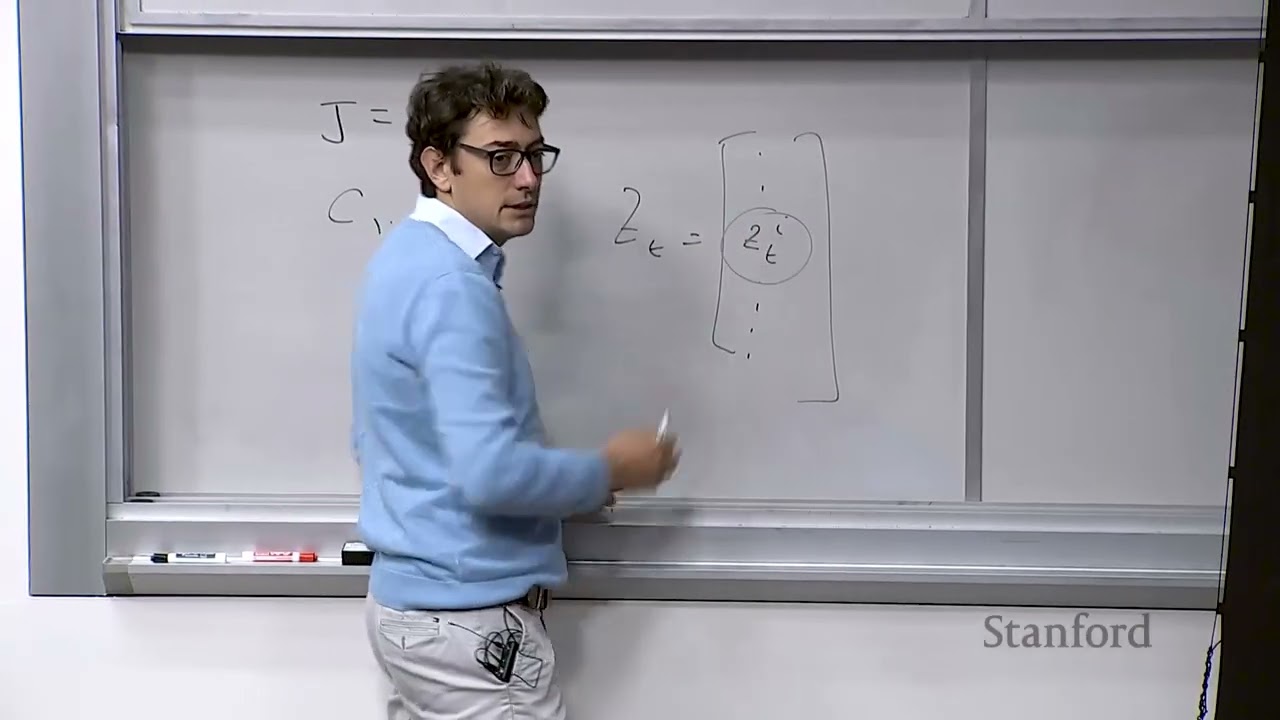
Stanford AA274A Principles of Robotic Autonomy | Autumn 2019 | EKF SLAM
Title history
- Stanford AA274A Principles of Robotic Autonomy | Autumn 2019 | EKF SLAM — observed on 20261026-1737 UTC (YouTube)
Keywords
Summary
149 words
Critical Evaluation
Value of the Information & Strength of the Argument
The value of this lecture lies in its clear, step-by-step explanation of sophisticated probabilistic robotics algorithms. The argumentation is rigorous, resting on well-known theoretical foundations of Kalman filtering and probability theory. The lecturer carefully motivates each step, transitioning from known methods to the challenges of unknown correspondences, and justifies approximations such as linearization in EKF. He also addresses student questions, clarifying subtle points like the interpretation of Mahalanobis distance and the implications of committing to erroneous associations. The argumentation is solid, rooted in standard literature and supported by references to the companion textbook and course materials. The lecturer’s expertise is evident, providing a coherent and mathematically sound presentation that enhances understanding of both the theoretical and practical aspects of EKF SLAM.
Scientific Rigor, Source Quality, Title Accuracy
The lecture exhibits high scientific rigor, with careful mathematical exposition and correct use of probabilistic tools. The source quality is exceptional: it is an official Stanford Online lecture, and the description links to the companion textbook ‘Principles of Robot Autonomy’ and the official course website, which serve as authoritative references. The title precisely matches the content, as the entire lecture is dedicated to EKF SLAM. No contradictions or unsubstantiated claims were noted. The presentation draws on well-established methods (EKF, particle filters) and clearly indicates the course context and speaker credentials. Consequently, the sources and title demonstrate strong reliability and alignment with the content.
239 words
Title / Content Match
The title accurately reflects the lecture content: a deep dive into EKF (Extended Kalman Filter) based SLAM, part of a graduate robotics course.
Quality & Reliability
9/10
The lecture is delivered by a Stanford professor and robotics expert, with a rigorous mathematical presentation of EKF SLAM and associated techniques. Content aligns with published course materials and textbook, ensuring high reliability. Minor deductions for the lack of peer-review or independent verification in a lecture format.
Key Moments
Markers derived by PSI from the transcript: the creator did not define chapters.
- Introduction to the lecture and recap of localization problem with known correspondences.
- Discussion on estimating unknown correspondence variables via maximum likelihood, and challenges of exponential assignments.
- Derivation of Gaussian representation for measurement likelihood and the use of linearization in EKF.
- Explanation of Mahalanobis distance for data association and its probabilistic interpretation.
- Introduction to Monte Carlo localization using particle filters for non-parametric belief approximation.
- Summary of the lecture and advice on robustness enhancements; wrap-up.
Cited Sources
- Stanford Graduate Education — Referenced as a resource for Stanford's graduate programs.
- Principles of Robot Autonomy (companion textbook) — Recommended as the companion textbook for the course.
- PoRA-I Course Syllabus — Link to the latest course schedule and syllabus.
- Full playlist of AA274A lectures — Playlist containing all lectures of the course.
Concurring Sources
- Principles of Robot Autonomy (textbook) — The textbook likely covers EKF SLAM and particle filtering in depth, corroborating lecture content.
- Course schedule and syllabus (PoRA-I) — Confirms the lecture's position in the course and alignment with curriculum.
Contribution & Novelties
The lecture provides a comprehensive educational walkthrough of EKF-based SLAM, focusing on the critical issue of unknown data association. Its original contribution lies in the clarity with which it explains the mathematical derivations and practical steps for implementing the algorithm, alongside a comparison with particle filter localization. The lecture also integrates student questions to clarify common misconceptions, enhancing its pedagogical value.
Pour aller plus loin :
- Simultaneous localization and mapping (SLAM) - Wikipedia — Provides an overview of SLAM variants and applications.
- Extended Kalman filter - Wikipedia — Details the EKF algorithm used throughout the lecture.
- Particle filter - Wikipedia — Explains the particle filter approach introduced for Monte Carlo localization.
- Mahalanobis distance - Wikipedia — Offers a formal definition and properties of this distance metric used for data association.
130 words
Radar Profile
The radar profile shows very high scores across all dimensions, with the highest on technical level (10) and consistent high scores for information quantity, quality, and reliability. This indicates a technically dense and authoritative lecture, suitable for advanced learners. The relatively high quality and reliability scores reflect the academic credibility of the source and the rigor of the presentation.