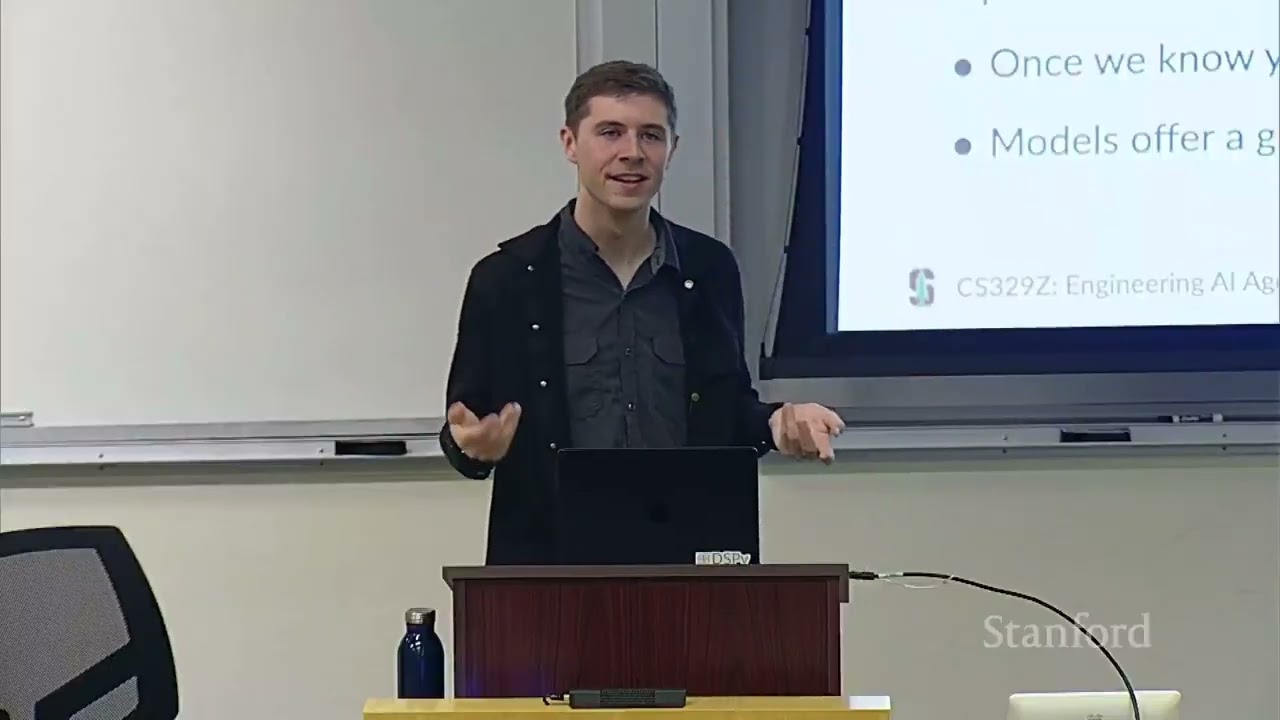
Optimizing AI Agents: Prompts vs. Weights (GEPA, GRPO) | Stanford CS329Z Lecture 9 with Michael Ryan
Title history
- Optimizing AI Agents: Prompts vs. Weights (GEPA, GRPO) | Stanford CS329Z Lecture 9 with Michael Ryan — observed on 20261117-2211 UTC (YouTube)
Keywords
Summary
140 words
Critical Evaluation
Value of the Information & Strength of the Argument
The lecture provides a comprehensive overview of optimization techniques for AI systems, with clear explanations and a structured framework. The arguments are well-supported by references to existing research and practical examples. The speaker’s expertise is evident, and he effectively illustrates the trade-offs between context and weight optimization. The presentation is logically organized, progressing from basic concepts to advanced methods, and includes interactive polls and Q&A to engage the audience. The depth of coverage is appropriate for a graduate-level course, making it valuable for both students and practitioners.
Scientific Rigor, Source Quality, Title Accuracy
The lecture references several key papers and methods, including OPRO, GRPO, and GEPA, with proper attribution. The content is based on established research and the speaker’s own contributions to DSPy and prompt optimization. The title accurately reflects the content, and the lecture is part of a Stanford course, which adds to its credibility. The use of examples and demonstrations enhances the pedagogical value. Overall, the sources are reliable, and the presentation adheres to academic standards.
177 words
Title / Content Match
The title precisely describes the lecture's focus on comparing prompt and weight optimization, mentioning specific algorithms (GEPA, GRPO) and the Stanford course context.
Quality & Reliability
9/10
The lecture is delivered by a Stanford CS PhD student and researcher actively contributing to prompt optimization, referencing established papers and methods, and is part of a graduate course at Stanford, ensuring a high level of expertise and reliability.
Key Moments
Markers derived by PSI from the transcript: the creator did not define chapters.
- Introduction and announcements, including a story about using Codex to convert slides.
- Poll on best prompt for PaLM 2L, revealing 'take a deep breath' as best.
- Conditions for optimization: data, system, and metrics; benefits like reliability and cost reduction.
- Coverage of few-shot optimization, including the 'Fantastically Ordered Prompts' paper and global/local entropy.
- Discussion of bootstrap reasoning through rejection sampling and its application in DSPy.
- Introduction to OPRO and reflective optimization, showing how LLMs generate new prompts based on past scores.
Cited Sources
- CS329Z Course Website — Course materials and additional resources for the lecture series.
- Stanford Online Agentic AI — Link to browse Stanford's online courses in Agentic AI.
- CS329Z Full Playlist — Complete playlist of CS329Z lectures on YouTube.
Contribution & Novelties
This lecture offers an original synthesis of optimization strategies for AI agents, bridging context optimization (prompts) and weight optimization (fine-tuning). It introduces several modern algorithms and their trade-offs, underscored by the speaker’s own research in prompt optimization. The practical guidance based on evaluation setups is particularly valuable for practitioners deploying AI systems.
Pour aller plus loin :
- Large Language Models as Optimizers (OPRO) — Paper introducing OPRO, which uses LLMs to generate new prompts based on past performance.
- DeepSeekMath: Pushing the Limits of Mathematical Reasoning in Open Language Models (GRPO) — Source of the GRPO algorithm, a reinforcement learning method discussed in the lecture.
- TextGrad — A method for prompt optimization via text gradients, covered conceptually in the lecture, without a verified URL.
- GEPA — Gradient-free evolutionary prompt optimization, presented as a recent algorithm, without a verified URL.
138 words
Radar Profile
The radar profile shows uniformly high scores across all dimensions, reflecting a balanced and comprehensive lecture. Information quantity and quality are top-notch, technical depth is high, and reliability is assured by the Stanford affiliation and expert speaker.