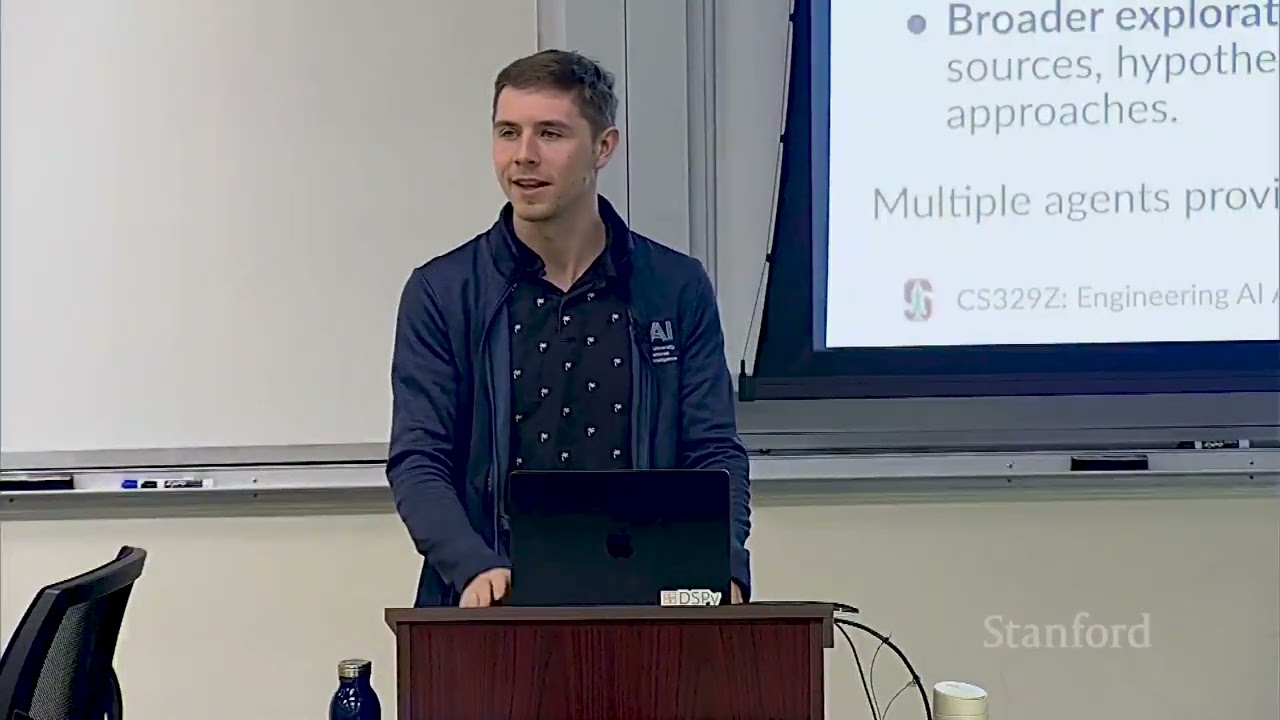
Multi-Agent Systems: When More Agents Help or Hurt | Stanford CS329Z Lecture 8 with Michael Ryan
Title history
- Multi-Agent Systems: When More Agents Help or Hurt | Stanford CS329Z Lecture 8 with Michael Ryan — observed on 20261117-0333 UTC (YouTube)
Keywords
Summary
201 words
Critical Evaluation
Value of the Information & Strength of the Argument
The lecture provides substantial value by synthesizing current knowledge on multi-agent systems, including practical guidance on when to use them and which patterns to adopt. Michael Ryan supports his arguments with references to academic research (e.g., Google’s ‘Towards the science of scaling agent systems’) and industry practices (Anthropic’s blog on agent swarms), balancing theoretical concepts with concrete examples like task ledgers and git worktrees. The argumentation is clear: he acknowledges the hype, presents both benefits and drawbacks, and recommends an evidence-based approach—start with a single agent, measure, then add complexity. The discussion of failure modes (information loss, error propagation) and the note that multi-agent systems are often more expensive adds critical nuance. However, some claims rely on anecdotal evidence or single studies, and the speaker occasionally glosses over technical details (e.g., the exact parameters in the Google paper). Overall, the reasoning is sound and well-structured, though a deeper treatment of specific research findings would strengthen the argument.
Scientific Rigor, Source Quality, Title Accuracy
The lecture demonstrates strong rigor by referencing academic papers, industry reports, and protocols. Specific sources mentioned include Google’s ‘Towards the science of scaling agent systems’ and Anthropic’s blog on multi-agent swarms, though their URLs were not provided in the description. The course website and playlist links are given, providing access to lecture materials. The title accurately captures the content, which is a survey of multi-agent system design with focus on when they are beneficial. However, the lecture relies heavily on the speaker’s own interpretation and a limited number of examples, and some claims (e.g., about OpenAI’s agent swarms) are presented as headlines without deeper verification. Nevertheless, the overall scientific quality is high, appropriate for a university graduate course.
290 words
Title / Content Match
The title accurately reflects the lecture: it focuses on multi-agent systems, explores when they are beneficial or detrimental, and includes orchestration and communication patterns.
Quality & Reliability
8/10
Lecture from Stanford CS329Z, a graduate course, presented by a CS PhD student with active research in AI agents. Content is well-structured, cites academic and industry work (Google paper, Anthropic blog), and provides balanced discussion of benefits and drawbacks. Score 8/10 due to reliance on some anecdotal examples and lack of detailed citations for all claims.
Key Moments
Markers derived by PSI from the transcript: the creator did not define chapters.
- Introduction and announcements about upcoming guest lecture on Terminal Bench.
- News headlines about agent swarms and motivation for multi-agent systems.
- Learning objectives and lecture overview.
- Comparison of single vs multi-agent systems, benefits and drawbacks.
- Orchestration patterns: independent, centralized, decentralized swarm, and hybrid.
- Communication patterns: handoffs, message boards, and Agent2Agent protocol.
- Coordination patterns and failure modes of multi-agent systems.
Cited Sources
- CS329Z Course Website — Course website for CS329Z: Engineering AI Agents, mentioned in description.
- Browse Stanford Online courses in Agentic AI — Link to browse Stanford online courses, provided in description.
- CS329Z Full Playlist — YouTube playlist for the full CS329Z lecture series.
Contribution & Novelties
This lecture provides a comprehensive and balanced overview of multi-agent systems, emphasizing that they are not universally better than single-agent systems. It introduces a clear taxonomy of orchestration patterns and discusses communication and coordination mechanisms, including emerging industry protocols like Google’s Agent2Agent. The original contribution lies in synthesizing academic findings and industry examples into a practical framework for engineers, with an explicit recommendation to start with a single-agent baseline and only add agents when measurable gains are observed. This is valuable for practitioners navigating the hype around agent swarms.
Pour aller plus loin :
- Multi-agent system — Foundational concept and literature on MAS.
- Orchestration (computing) — Relevant to orchestration patterns in distributed systems.
- Agent2Agent (A2A) protocol — Mentioned in the lecture; an open protocol for agent interoperability, but no specific URL provided here.
133 words
Radar Profile
The radar profile shows high scores across all dimensions (quantité, qualité, niveau technique, fiabilité), indicating a well-rounded and reliable lecture with substantial technical depth and solid sourcing. The slight dip in fiabilité relative to quantity reflects the reliance on some anecdotal evidence and lack of deep citation for every claim, but overall the lecture is highly informative and trustworthy.