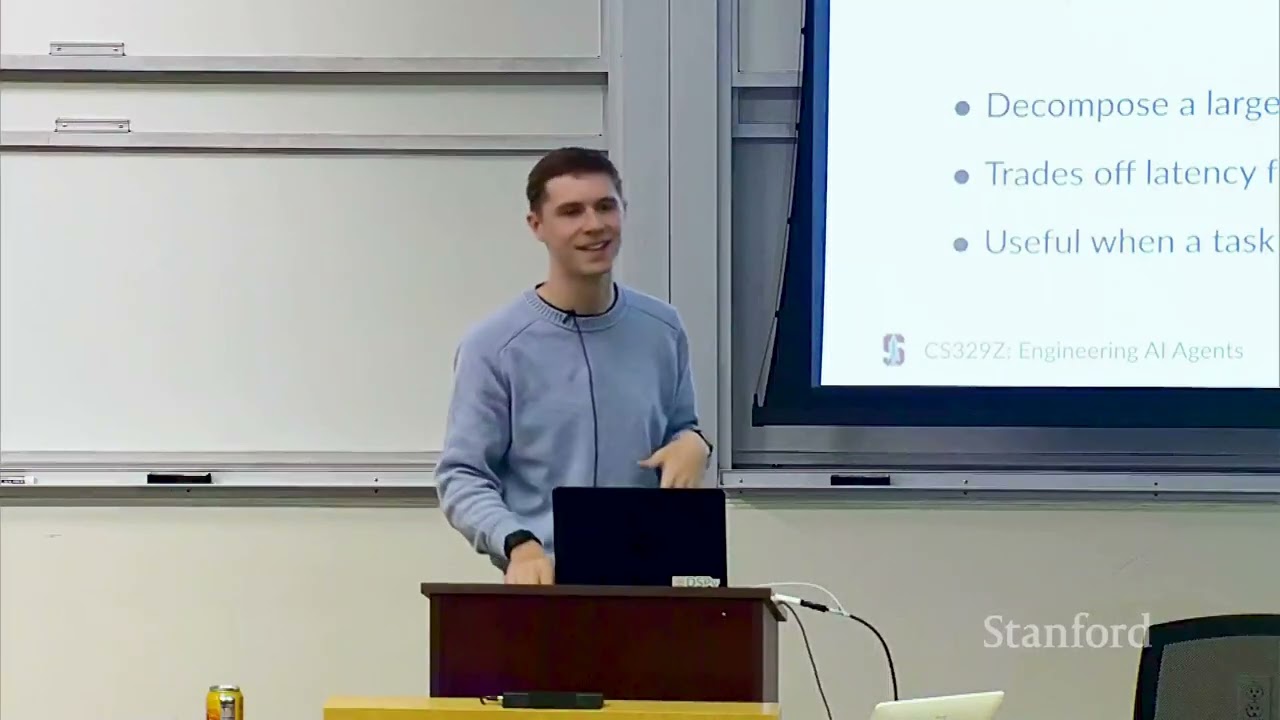
AI Agent Design Patterns: ReAct, CodeAct & More | Stanford CS329Z Lecture 6 with Michael Ryan
Title history
- AI Agent Design Patterns: ReAct, CodeAct & More | Stanford CS329Z Lecture 6 with Michael Ryan — observed on 20261114-2108 UTC (YouTube)
Keywords
Summary
164 words
Critical Evaluation
Value of the Information & Strength of the Argument
The lecture succeeds in providing a well-structured and practically relevant framework for agent design. It clearly explains the rationale behind each workflow pattern, including latency-accuracy trade-offs, cost considerations, and criteria for when each pattern is most appropriate. The use of the Storm system as a composed example effectively illustrates how multiple patterns can integrate in a real application. The argumentation is sound, with references to Anthropic’s taxonomy and academic papers, and the speaker openly acknowledges the need for customization and the ‘half-baked’ nature of patterns. The inclusion of a live Q&A enhances the value by addressing audience concerns about scalability and benchmarking, showing critical engagement with the material.
Scientific Rigor, Source Quality, Title Accuracy
The content is based on credible sources: Anthropic’s ‘Building Effective Agents’ post and research papers such as the Storm system. As a lecture in Stanford’s official CS329Z course, it maintains high academic rigor. The speaker, a CS PhD student, demonstrates deep familiarity with the subject. The title accurately reflects the lecture’s scope, covering both workflow and agent design patterns. The presentation is organized, with clear learning objectives and a logical progression from foundational concepts to advanced patterns. The description provides direct links to the course and related resources, further supporting the video’s credibility.
216 words
Title / Content Match
Title accurately reflects content: the lecture covers AI agent design patterns including ReAct, CodeAct, and workflow patterns, matching the engineering focus described.
Quality & Reliability
9/10
Lecture delivered by a Stanford CS PhD student within an official graduate course (CS329Z). Content is grounded in established design patterns and research, with clear structure and Q&A. Minor caveat: single source (lecture) and some patterns are generic.
Key Moments
Markers derived by PSI from the transcript: the creator did not define chapters.
- Introduction and lecture overview on agent design patterns
- Review of workflows vs agents: control flow and predictability spectrum
- Workflow design pattern 1: Prompt chaining with examples and trade-offs
- Workflow design pattern 2: Routing using LLMs as switch statements
- Workflow design pattern 3: Parallelization (sectioning and voting)
- Workflow design pattern 4: Orchestrator-workers with dynamic subtask delegation
- Workflow design pattern 5: Evaluator-optimizer loop for iterative improvement
- Composition example: Storm system for automatic Wikipedia article generation
- Q&A on Storm, multi-agent benchmarking, and loop termination
- Agent design patterns: ReAct, Reflexion, CodeAct, ReWOO (based on lecture overview)
Cited Sources
- CS329Z Course Website — Official course page with resources
- Agentic AI Online Program — Stanford's self-paced online course
- Stanford Agentic AI Courses — Link to browse Stanford online courses in Agentic AI
- Full CS329Z Playlist — Complete lecture series playlist
Contribution & Novelties
The lecture provides a structured taxonomy of agent design patterns, synthesizing Anthropic’s workflow patterns with reasoning-acting patterns like ReAct and context management techniques. It offers practical guidance on when to use each pattern and emphasizes the need to adapt them to specific use cases. The inclusion of a real-world example (Storm) illustrates how these patterns can be composed, making the content directly applicable.
Pour aller plus loin :
- Anthropic: Building Effective Agents — Source of the five workflow patterns discussed.
- ReAct: Synergizing Reasoning and Acting in Language Models — The ReAct pattern for interleaving reasoning and tool use.
- Reflexion: Language Agents with Verbal Reinforcement Learning — The Reflexion pattern using verbal feedback and self-reflection.
- CodeAct: Executable Code Actions Elicit Better LLM Agents — The CodeAct pattern using executable code as tool actions.
132 words
Radar Profile
The profile shows a well-balanced lecture with high quantity and quality of information, a solid technical level, and strong overall reliability. The only slight dip is in technical depth (8), reflecting its nature as a broad overview rather than a deep dive into a single topic.