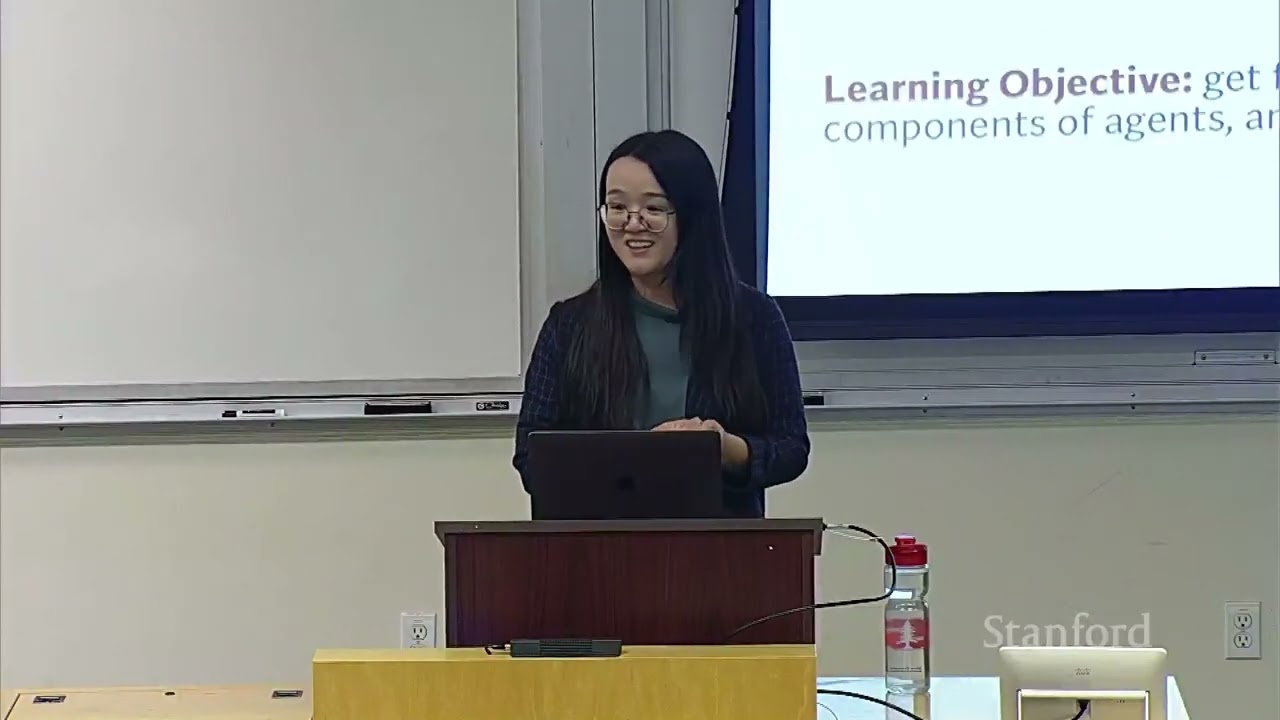
What Are AI Agents? Agentic Systems Explained | Stanford CS329Z Lecture 1 with Diyi Yang
Title history
- What Are AI Agents? Agentic Systems Explained | Stanford CS329Z Lecture 1 with Diyi Yang — observed on 20261110-2124 UTC (YouTube)
- Stanford CS329Z Introduction — What Are Agentic Systems? — observed on 20261109-2119 UTC (YouTube)
Keywords
Summary
142 words
Critical Evaluation
Value of the Information & Strength of the Argument
The lecture provides a comprehensive and well-structured overview of AI agents, offering both historical context and a clear conceptual framework. The argumentation is solid, relying on established research such as ReAct, chain-of-thought prompting, and tool use. The speaker effectively demonstrates why reasoning, memory, and tools are essential for agent performance, using concrete examples and diagrams. The discussion on model capability improvements and agent benchmarks is supported by data trends, and the lecturer critically addresses the reliability-efficiency trade-off. The course encourages hands-on learning and emphasizes the importance of evaluation, making it a valuable resource for understanding modern agentic systems.
Scientific Rigor, Source Quality, Title Accuracy
The lecture is rigorous, referencing seminal works and presenting a balanced view of the field. The speaker is a Stanford professor with recognized expertise, ensuring high scientific credibility. Sources cited include the actor model, ReAct, AutoGPT, Toolformer, and Model Context Protocol, though specific paper references are not linked in the video description. The description provides links to the course website and related resources, which are authoritative. The title accurately matches the content, and the lecture stays focused on explaining agents and agentic systems. The structure is clear, with logical progression from history to components to challenges.
209 words
Title / Content Match
The title accurately reflects the content: it explains what AI agents are and introduces agentic systems. The lecture is the first in a Stanford course, matching the description.
Quality & Reliability
9/10
The lecture is delivered by a Stanford professor, covers well-established research, and provides accurate descriptions of agent architectures. It includes historical context and references to fundamental works.
Chapters
- Welcome & instructor introductions
- Course overview & logistics
- A short history of AI agents
- ReAct, BabyAGI & AutoGPT: the agent boom
- Q&A: Will model capabilities saturate?
- Anatomy of an LLM agent
- Planning & reasoning: CoT, ReAct, Reflexion
- Q&A: ReAct vs. chain of thought
- Multi-agent debate & orchestration
- Agent memory: episodic, semantic, procedural
- Tool use: Toolformer & Gorilla
- Compound AI systems: workflows vs. agents
- Tool calls & Model Context Protocol (MCP)
- Key challenges: reliability, safety & privacy
Cited Sources
- CS329Z Course Website — Main course website with slides, homeworks, and lecture materials.
- Stanford Online Courses in Agentic AI — Link to Stanford's online offerings related to Agentic AI.
- CS329Z Full Playlist — YouTube playlist containing all lectures of the CS329Z course.
Contribution & Novelties
66 words
Radar Profile
The radar profile is fairly balanced, with slightly higher scores in information quality and reliability, reflecting the academic rigor and depth of the lecture. The technical level is high but appropriate for a graduate audience, and the quantity of information is substantial.