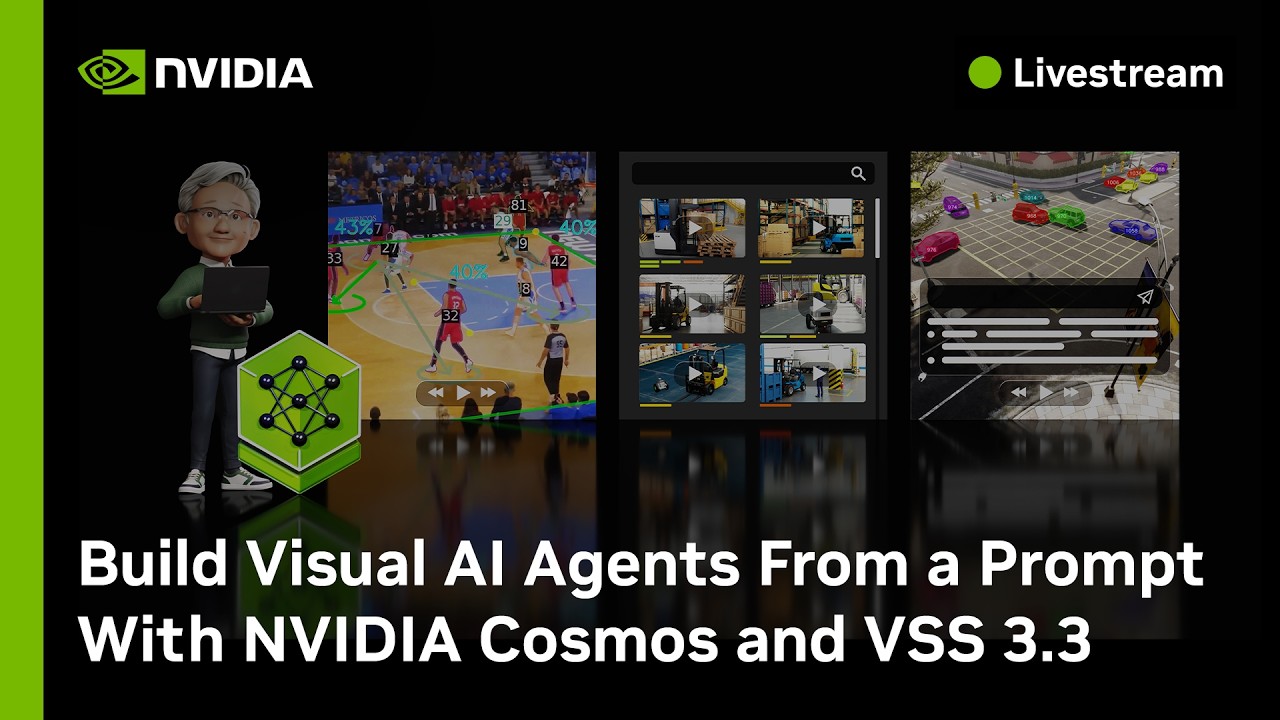
Build Visual AI Agents From a Prompt With NVIDIA Cosmos and VSS 3.3
Keywords
Summary
178 words
Critical Evaluation
Value of the Information & Strength of the Argument
The video delivers substantial practical value in demonstrating a complete workflow for building visual AI agents rapidly. It effectively illustrates the integration of multiple components—video indexing, real-time monitoring, and specialized measurement—within a single application, using a realistic industrial use case. The argumentation is primarily demonstrative, relying on live action rather than rigorous scientific analysis. While the claimed improvements (e.g., 60% latency reduction, 40% more concurrent streams) are presented without detailed methodology or benchmark conditions, they align with NVIDIA’s engineering expertise. The demo provides step-by-step guidance that is actionable for developers seeking to implement similar systems. However, the absence of critical examination or discussion of limitations (e.g., dependency on GPU resources, potential edge cases) reduces the scholarly depth.
Scientific Rigor, Source Quality, Title Accuracy
The video is published by the official NVIDIA Developer channel, and the information aligns with NVIDIA’s technical documentation and announcements. Sources provided in the description include the VSS 3.3 Technical Blog, VSS Skills, VSS Build, and Brev Launchable, which are directly related to the content. The title matches the content precisely, reflecting the demonstration of prompt-based agent construction using Cosmos and VSS. However, the presentation is promotional in nature, lacking external independent references or critical evaluation. The demo is convincing but serves as a showcase rather than a peer-reviewed study. The public comments (not provided) would be useful for understanding community reception, but their absence prevents further analysis.
240 words
Title / Content Match
The title accurately reflects the content: the video demonstrates building visual AI agents from a prompt using NVIDIA Cosmos and VSS 3.3.
Quality & Reliability
8/10
Official NVIDIA live stream presenting a technical demo of visual AI agent development. Content is credible and well-structured, but promotional in tone and lacks independent validation of claimed performance metrics.
Key Moments
Markers derived by PSI from the transcript: the creator did not define chapters.
- Introduction by host Draat Senna, presenting the agenda and the team (Adam Ryson, Hassan Mustafa).
- Adam Ryson explains the VSS blueprint and new features in version 3.3, including Adaptive Efficient Video Sampling (EVS) and streaming NIM support.
- Hassan starts the live demo: building a visual AI agent for an orange juice factory from a natural-language prompt using codex and the Build Vision AI skill.
- Demonstration of video search: querying 'show me liquid leaking from bottles' and obtaining verified clips from recorded footage.
- Setting up real-time alerts: configuring a monitoring rule for overflow during filling and reviewing detected incidents in the UI.
- Extending the application with a measurement component for bottle fill levels using segmentation masks and VSS integration, including chat-based comparisons.
- Discussion on deployment costs and scalability options (e.g., edge vs. data center), followed by closing remarks.
Cited Sources
- VSS 3.3 Tech Blog — Official NVIDIA blog detailing features and improvements in VSS 3.3.
- VSS Skills — Repository of pre-built skills for VSS, used in the demo for search and alert capabilities.
- VSS Build — NVIDIA tooling for building and customizing VSS applications.
- Brev Launchable — Platform used to deploy and manage the application infrastructure.
Concurring Sources
- VSS 3.3 Tech Blog — Confirms the features mentioned in the video (EVS, streaming NIM) and their performance claims.
- VSS Skills — Provides the pre-built skills that are used in the demo, supporting the workflow's accessibility.
Contribution & Novelties
The video presents a novel, practical demonstration of building visual AI agents from natural-language prompts using NVIDIA’s VSS blueprint and Cosmos model. It showcases a full workflow—from prompt to deployment—and highlights new features (Adaptive EVS, streaming NIM) that reduce latency and cost. The demo illustrates the integration of search, alerting, and custom measurement capabilities in a real-world scenario, offering a reusable template for developers. The ‘pour aller plus loin’ section provides foundational concepts for deeper exploration.
Pour aller plus loin :
- Computer vision — Core technology enabling visual understanding and analysis.
- Large language model — Underpins the conversational query interface in the demo.
- NVIDIA VSS Blueprint — Official open-source repository for video search and summarization, likely compatible with the shown workflow.
- Efficient video sampling — Related concept in video processing, though adaptive EVS is specific to NVIDIA.
137 words
Radar Profile
The radar profile shows strong scores across all dimensions, with quantity and quality of information particularly high (9 and 8), reflecting the demo's depth and practical content. Technical level is also high (8), while reliability is slightly lower (8) due to the promotional nature, but still solid. The overall profile indicates a well-rounded, informative tutorial.