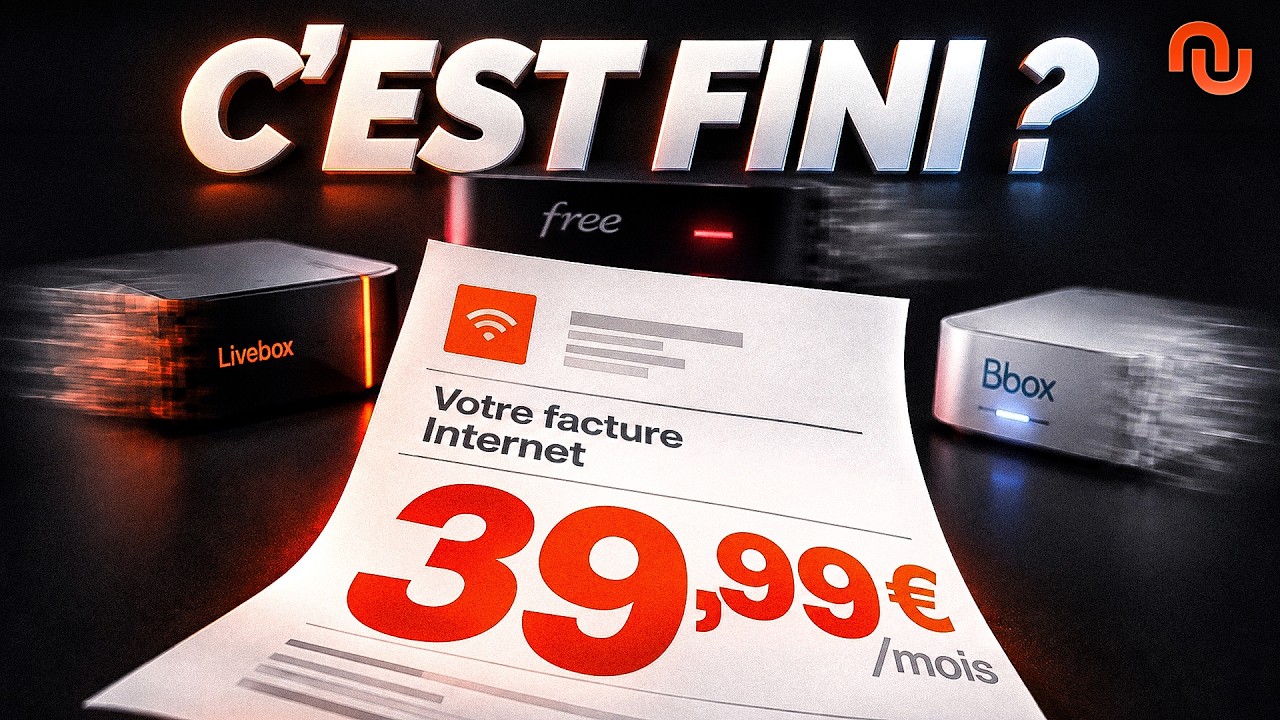
Les box TV, c'est fini : ce qui va arriver à votre Livebox, Freebox et Bbox (et vos abonnements)
TV boxes are over: what's coming for your Livebox, Freebox and Bbox (and your subscriptions)
Title history
- Les box TV, c'est fini : ce qui va arriver à votre Livebox, Freebox et Bbox (et vos abonnements) — observed on 20261031-2315 UTC (YouTube)
- M5 Ultra vs 2 DGX Sparks… The Number You're Not Looking At — observed on 20261010-0113 UTC (YouTube)
Keywords
Summary
162 words
Critical Evaluation
Value of the Information & Strength of the Argument
The video provides valuable insights into the French telecom market, combining historical context, current statistics, and strategic analysis of operator behaviors. The argumentation is well-structured: it starts with a surprising statistic, explains the historical significance of TV boxes, details the recent transition to apps, gives concrete examples (Samsung TVs, Freebox Ultra without decoder), and then interprets the move towards high-end accessories. The reasoning is coherent and supported by evidence such as product announcements and market data. However, some future predictions (like the Super Freebox) are based on rumors and are presented as such, which is acceptable. The exploration of the operators’ motivation to monetize ‘brain time’ and move away from low-margin hardware is convincing.
Scientific Rigor, Source Quality, Title Accuracy
The video demonstrates scientific rigor by grounding its analysis in verifiable facts: specific statistics, well-documented product launches, and references to industry trends. The quality of sources is reasonable; the video mentions an article on Numerama (the channel’s own website) and uses official announcements. There is no direct citation of external academic or regulatory sources, which could be seen as a limitation. The title accurately reflects the content, though it overstates the definitive nature of the transformation (‘c’est fini’) while the video itself acknowledges the still-high adoption rate. The commentary section is mostly factual and avoids exaggeration, with presenter opinions clearly labeled as such. Overall, the claims are consistent with general knowledge about the French telecom sector.
245 words
Title / Content Match
The title promises an explanation of the fate of TV boxes and subscriptions, which the video delivers comprehensively, though the imperative tone is slightly exaggerated.
Quality & Reliability
8/10
The video presents a well-researched analysis using specific statistics (83.7% of French households still using operator TV boxes), historical context (Freebox Revolution, etc.), and market observations. It cites trends from the US and mentions industry partnerships (Bang & Olufsen, Devialet). The claims are consistent with public knowledge about the French telecom market, though some predictions are speculative.
Chapters
Cited Sources
- Numerama — The channel's main website where the associated article is published.
- Numerama+ — Premium subscription offering additional content.
- Numerama Twitch — Live streaming channel of Numerama.
- Numerama YouTube playlists — Collection of playlists from the channel.
External References
Contribution & Novelties
This video contributes by synthesizing the current state of the French TV box market and articulating the strategic pivot by operators toward software and premium hardware. It highlights the unique French situation (83.7% penetration) compared to the US, and connects product announcements (Orange Home Cinema, Free’s rumored Super Freebox) to broader trends in cord-cutting and platform aggregation. The explanation of ’time of brain’ monetization provides a clear rationale for operator behavior.
Pour aller plus loin :
- Cord-cutting — Relevant for understanding the broader global trend of abandoning traditional TV subscriptions.
- Android TV — The platform being adopted by operators like Orange for their new decoders.
- Smart TV — The ecosystem where operator apps are increasingly delivered, replacing dedicated hardware.
- Freebox — Historical background on the pioneering French TV box offered by Free.
- Over-the-top media service — Context for the shift from operator-managed hardware to internet-delivered content.
146 words
Radar Profile
The radar profile shows high scores in information quantity, quality, and global reliability, with a slightly lower technical level due to the accessible approach. This indicates a balanced, well-supported news review suitable for a general audience.
💬 Balanced: On the 30 comments analysed, the sentiment is mostly positive with many viewers expressing that they no longer watch linear TV, but a few corrected technical inaccuracies about ADSL vs. 56k modems, and one criticized the title as promising more than delivered.