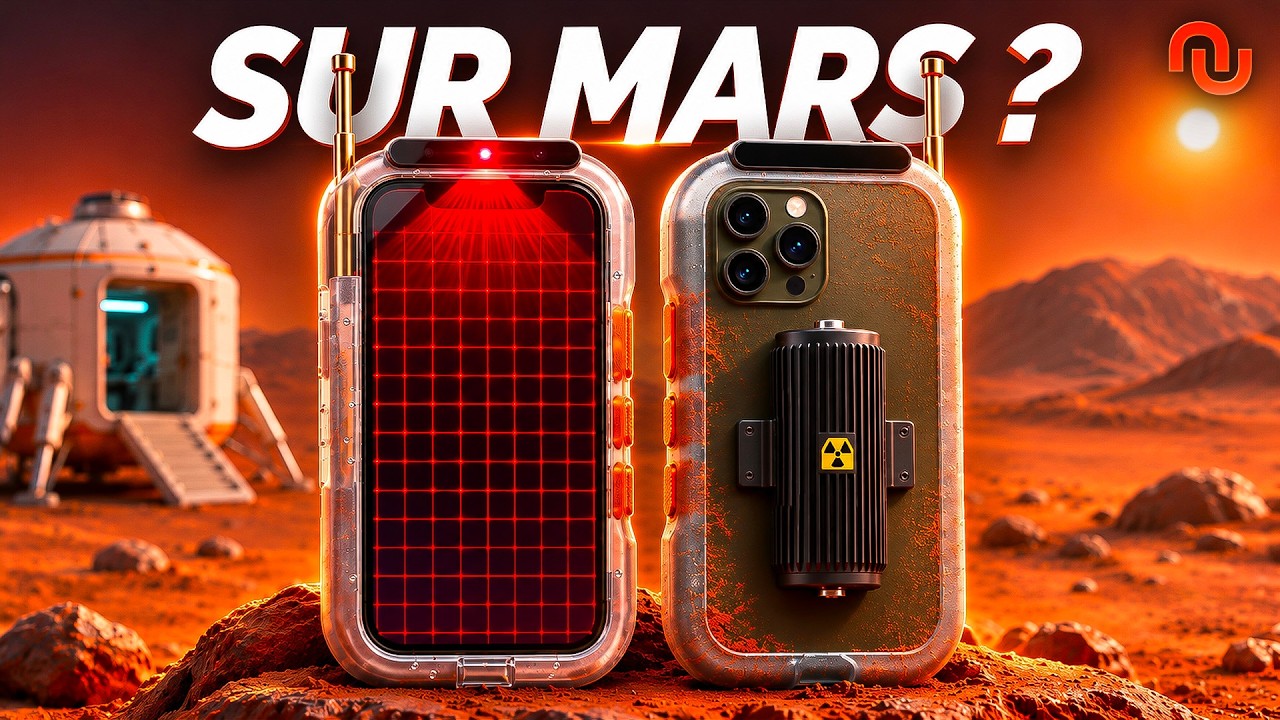
On a créé un smartphone pour survivre sur Mars
We created a smartphone to survive on Mars
Keywords
Summary
295 words
Critical Evaluation
Value of the Information & Strength of the Argument
The informational value lies in the way abstract planetary science is converted into concrete design constraints. Each of the six sections carries at least one verifiable number or named precedent — 30,000 infrared dots for face mapping, 3 to 22 minutes of one-way light travel, 0.64 millisievert per day at the surface, a factor of roughly one hundred in atmospheric density, 0 to 35 °C as the certified operating range of a consumer phone, -60 °C average and -125 °C at the winter pole, a 45 kg generator on Perseverance — and each number is immediately attached to a design decision. The argumentation is cumulative rather than list-like: solving the cold problem with active heating creates an energy demand, which is then resolved by the nuclear source, and that source is explicitly noted to also supply heat, closing the loop. The strongest reasoning moment is the rejection of the intuitive lead shield: the narrator explains that heavy-metal impacts spawn secondary particle cascades, so low-atomic-mass, hydrogen-rich materials such as polyethylene or water perform better, an argument that runs against lay intuition and is stated with its own caveat. The weakest links are the deliberately hand-waved ones — ‘we miniaturised it a bit, AI is great, we can do anything’ — acknowledged as jokes, and the estimated final weight of ‘a few kilos’ paired with a Mars-gravity justification that is more rhetorical than computed. Overall the value is pedagogical: it teaches the physics of Mars through the constraints it imposes on a familiar object, and it is honest about the speculative, illustrative status of the end product.
Scientific Rigor, Source Quality, Title Accuracy
Scientifically, the video is careful with orders of magnitude and mostly correct on the numbers it cites: the light-time range, the solar conjunction blackout every 26 months, the Curiosity surface dose, the atmospheric thinness, the absence of a global magnetic field, the 2018 Opportunity loss, the 38% gravity figure and the Pu-238 thermoelectric architecture are all consistent with published mission data and planetary science. The processor claim is accurate in spirit (the RAD750 traces its lineage to the PowerPC 750 used in the late-1990s iMac G3), and the shielding discussion reflects genuine radiation-physics reasoning rather than folklore. Source quality, however, is indirect: no paper, agency document or dataset is named beyond instruments and missions, so a viewer cannot check the figures without independent searching, and the accompanying written article is only pointed to through the channel’s homepage rather than a specific link. One statement stands out as unsupported — an electrodynamic dust-removal screen described as ’tested by NASA on the Moon in 2025’ — and should be treated as unverified pending a traceable reference. Transparency is otherwise good: the partnership is announced at the start and again at the end, the AI-generated nature of all Mars and VFX footage is stated explicitly, and the video includes a roughly one-minute sponsored segment near the beginning plus recurring promotional returns to the partner platform. The visual demonstration of the generation workflow is itself a useful methodological disclosure, showing prompt-writing, rendering and iterative review rather than presenting synthetic footage as documentary. On title and content: the match is good, with the caveat that ‘we built’ means ‘we specified in detail’, not fabricated.
549 words
Title / Content Match
The title promises a smartphone built to survive Mars, and the video delivers a step-by-step conceptual redesign addressing six real Martian constraints; nothing physical is actually manufactured, which the narration makes clear, so the promise is only mildly overstated.
Quality & Reliability
7/10
The technical claims are, for the most part, quantitatively correct and traceable to real space hardware: light-time to Earth of 3–22 minutes, ~0.64 mSv/day measured by the Curiosity RAD instrument, the RAD750 processor derived from the PowerPC 750, aerogel insulation, plutonium-238 radioisotope generators on Curiosity and Perseverance, the loss of Opportunity in the 2018 planet-wide dust storm, Mars gravity at 38% of Earth's, an atmosphere roughly 100 times thinner than Earth's. The reasoning about shielding is also sound (hydrogen-rich materials outperform lead because heavy-metal impacts generate secondary particle showers). Deductions: no primary literature or agency documents are cited, only mission and instrument names; one claim is hard to substantiate (an electrodynamic dust shield 'tested by NASA on the Moon in 2025'); and the whole device remains a conceptual exercise whose visuals were AI-generated, though this is disclosed clearly and repeatedly. The video is a paid partnership, announced openly at the start.
Chapters
Cited Sources
- Numerama — accompanying article and channel site — The channel points viewers to its site for written coverage of the topics discussed; no article-specific URL is given in the description.
- NASA Delay Tolerant Networking (DTN) — Named in the video as the existing protocol designed for store-and-forward communication across interplanetary delays; no document is linked.
- Curiosity RAD instrument — surface radiation measurement (~0.64 mSv/day) — Cited as the source of the daily radiation dose figure used to size the shielding argument.
- RAD750 radiation-hardened processor (Perseverance / PowerPC 750 lineage) — Invoked as the reference point for a radiation-tolerant chip running at ~200 MHz.
- Multi-Mission Radioisotope Thermoelectric Generator (Pu-238) on Curiosity and Perseverance — Presented as the energy solution immune to dust storms and night, with a stated mass of 45 kg for the flight unit.
- Opportunity rover and the 2018 planet-wide dust storm — Used as the cautionary case for why solar power cannot be relied upon on Mars.
- Apollo lunar dust damage to spacesuits — Cited as precedent for the abrasiveness of anhydrous, electrostatically charged regolith dust.
Concurring Sources
- Delay-tolerant networking — Wikipedia — Confirms that a store-and-forward bundle protocol exists and was developed precisely for deep-space links with long and intermittent delays.
- RAD750 — Wikipedia — Corroborates the radiation-hardened processor lineage and its ~200 MHz class, consistent with the video's claim.
- Radioisotope thermoelectric generator — Wikipedia — Supports the description of Pu-238 decay heat conversion and the use of such units on Curiosity and Perseverance.
- Health threat from cosmic rays — Wikipedia — Provides context for surface dose rates and for secondary-particle production in heavy shielding, matching the video's anti-lead argument.
Dissenting Sources
- Claim of an electrodynamic dust shield tested by NASA on the Moon in 2025 — No document, mission or instrument is named to support this, and the dating and venue could not be matched to a traceable reference; electrostatic dust-removal concepts are real and have been studied in lab and orbital settings, but the specific 'tested on the Moon in 2025' formulation should be treated as unverified.
External References
Contribution & Novelties
The original contribution is formal more than factual: the video turns a familiar consumer object into a probe for planetary science, and it pairs that with a candid, step-by-step disclosure of an AI-assisted visual-effects pipeline. Rather than presenting synthetic imagery as documentary footage, it shows the take-off-the-shelf studio shot, the natural-language instruction, the model’s choice of tool and prompt, and the frame-by-frame review loop that precedes a final shot. The engineering framing is also effective as pedagogy: each Martian hazard is introduced as a measured quantity, then resolved with a technology that already exists on a rover, the ISS or in a NASA lab, which makes the conclusion — that nearly nothing was invented — an argument rather than a slogan. Its limitation is that the synthesis is never stress-tested: mass, power budget, thermal cycling and cost are estimated only in passing, so the artefact remains a design fiction illustrated with considerable craft.
Pour aller plus loin :
- Delay-tolerant networking — Background on the store-and-forward architecture the video proposes for messaging across a 3–22 minute light lag.
- RAD750 — Details on the radiation-hardened PowerPC processor used on Mars rovers, invoked as the reliability-over-performance trade-off.
- Radioisotope thermoelectric generator — How Pu-238 decay heat becomes electricity, the basis for the video’s ’nuclear battery’ upgrade.
- Health threat from cosmic rays — Context for the surface dose figures and for why hydrogen-rich shielding beats lead.
- Aerogel — The ultralight insulator used to jacket the phone against -60 °C and lower.
- Electrodynamic dust shield — the electrostatic travelling-wave concept proposed for the screen; treated in the video as flight-demonstrated, but no traceable reference is provided.
270 words
Radar Profile
The profile is broad rather than deep: information quantity and quality sit in the upper-middle range thanks to a dense supply of named missions, instruments and figures, while technical level stays moderate because each constraint is explained from first principles rather than modelled. Reliability is lifted by the accuracy of the cited numbers and by explicit disclosure of the partnership and of the AI-generated imagery, and held back by the absence of checkable primary references and by a fully conceptual end product.