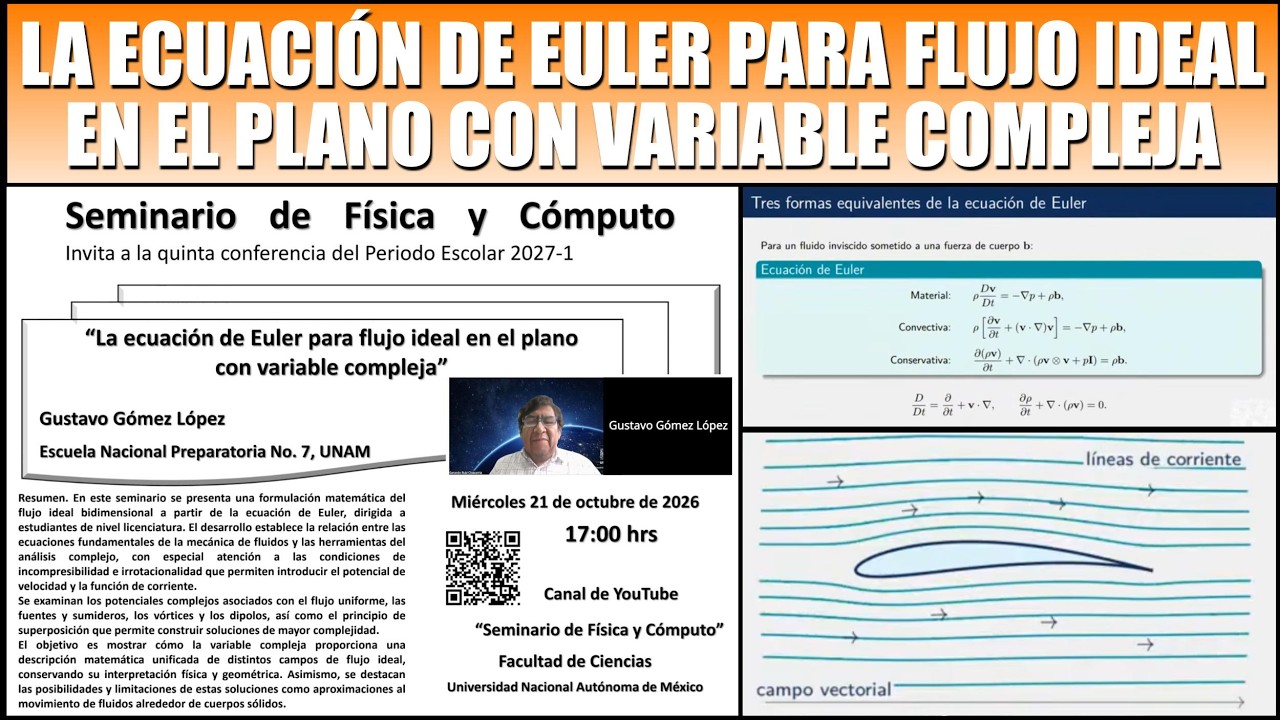
La ecuación de Euler para flujo ideal en el plano con variable compleja (Gustavo Gómez López)
Euler's Equation for Ideal Flow in the Plane with Complex Variables (Gustavo Gómez López)
Title history
- La ecuación de Euler para flujo ideal en el plano con variable compleja (Gustavo Gómez López) — observed on 20261025-1935 UTC (YouTube)
Keywords
Summary
226 words
Critical Evaluation
Value of the Information & Strength of the Argument
The value of this talk lies in its clear, systematic progression from fundamental principles to practical applications, making advanced fluid dynamics accessible. The argumentation is logically coherent: it starts with the physics, introduces the necessary complex analysis, and builds flows by superposition, culminating in airfoil design. The speaker carefully explains each step, using diagrams and equations, and connects the mathematical formalism to physical interpretations (streamlines, velocity field, pressure). The discussion of the model’s limitations (omission of viscous effects, boundary layers, d’Alembert’s paradox) adds critical depth. The presentation is intellectually honest about the idealizations used, and the final application to airfoils demonstrates the explanatory power of the theory. Overall, the argumentation is solid and persuasive.
Scientific Rigor, Source Quality, Title Accuracy
The title perfectly matches the content: the talk indeed covers Euler’s equation for ideal flow in the plane, solved via complex variables. Rigor: the speaker follows a standard mathematical development, referencing known results from complex analysis and fluid mechanics without introducing new or unverified claims. However, the description provides only a link to a playlist of related seminars, not specific citations to textbooks or papers. The talk mentions ‘referencias’ at the end, but they are not visible in the transcript. Thus, the sourcing is indirect and the viewer would need to rely on standard literature to confirm details. The absence of explicit citations is a minor weakness, but the content itself is consistent with established knowledge. The talk includes a brief note on the Cauchy-Riemann equations and Laplace’s equation, and the use of the Joukowski transform is presented correctly. No contradictory information from external sources is known, and the presentation is methodologically sound.
282 words
Title / Content Match
The title precisely reflects the content: the presentation focuses on Euler's equation for ideal (inviscid, incompressible, irrotational) flow in the plane, treated using complex variable methods, including elementary flows, flow around a cylinder, and airfoil profiles.
Quality & Reliability
8/10
The talk is a well-structured university seminar by a physics professor from UNAM. It presents standard theoretical fluid dynamics material (Euler equations, potential flow, complex variables) accurately, with clear derivations and physical interpretations. No original research is claimed, but the content is consistent with established textbooks. The absence of explicit citations in the description slightly limits independent verification, but the mathematical and physical exposition appears reliable.
Key Moments
Markers derived by PSI from the transcript: the creator did not define chapters.
- Introduction to ideal flow and Euler's equation: dissipative forces neglected, pressure as only surface force.
- Derivation of potential flow: irrotationality leads to scalar potential and Laplace's equation.
- Introduction to complex variable methods: holomorphic functions, Cauchy-Riemann equations, and complex potential.
- Presentation of elementary flows: uniform flow, source, vortex, and dipole with their complex potentials.
- Flow around a cylinder obtained by superposition of uniform flow and dipole, including velocity and pressure distribution.
- Introduction to conformal mapping and Joukowski transform to derive airfoil profiles from cylinder flow, with discussion of lift and Kutta condition.
Cited Sources
- Seminario de Física y Cómputo - related videos playlist — The playlist from the seminar series where this talk was presented, containing other related lectures.
Concurring Sources
- Seminario de Física y Cómputo - related videos playlist — The playlist of related seminar talks from the same channel, which likely covers similar physics topics and serves as a corroborating resource for the subject matter.
Contribution & Novelties
The talk’s contribution is primarily pedagogical: it offers a coherent, self-contained introduction to ideal fluid flow using complex analysis, bridging mathematical methods and physical intuition. It does not present new research but synthesizes known material in an accessible manner, particularly for students. The step-by-step construction from elementary flows to airfoil profiles illustrates the power of superposition and conformal mapping.
Pour aller plus loin :
- Euler equations (fluid dynamics) — Provides the general governing equations for inviscid flow, complementing the talk’s focus on incompressible potential flow.
- Potential flow — Gives an overview of the concept of irrotational, incompressible flow and its applications, directly related to the core of the presentation.
- Joukowski transform — Describes the conformal mapping used to generate airfoil sections from a cylinder, a key topic in the latter part of the talk.
- Cauchy–Riemann equations — The mathematical foundation for complex potentials, essential for understanding the representation of flow fields in the complex plane.
155 words
Radar Profile
The radar profile shows a balanced score across quantitative information, qualitative content, technical level, and reliability, all around 8/10. This indicates a solidly informative and technically sound presentation, with a slight emphasis on pedagogical clarity rather than groundbreaking novelty.