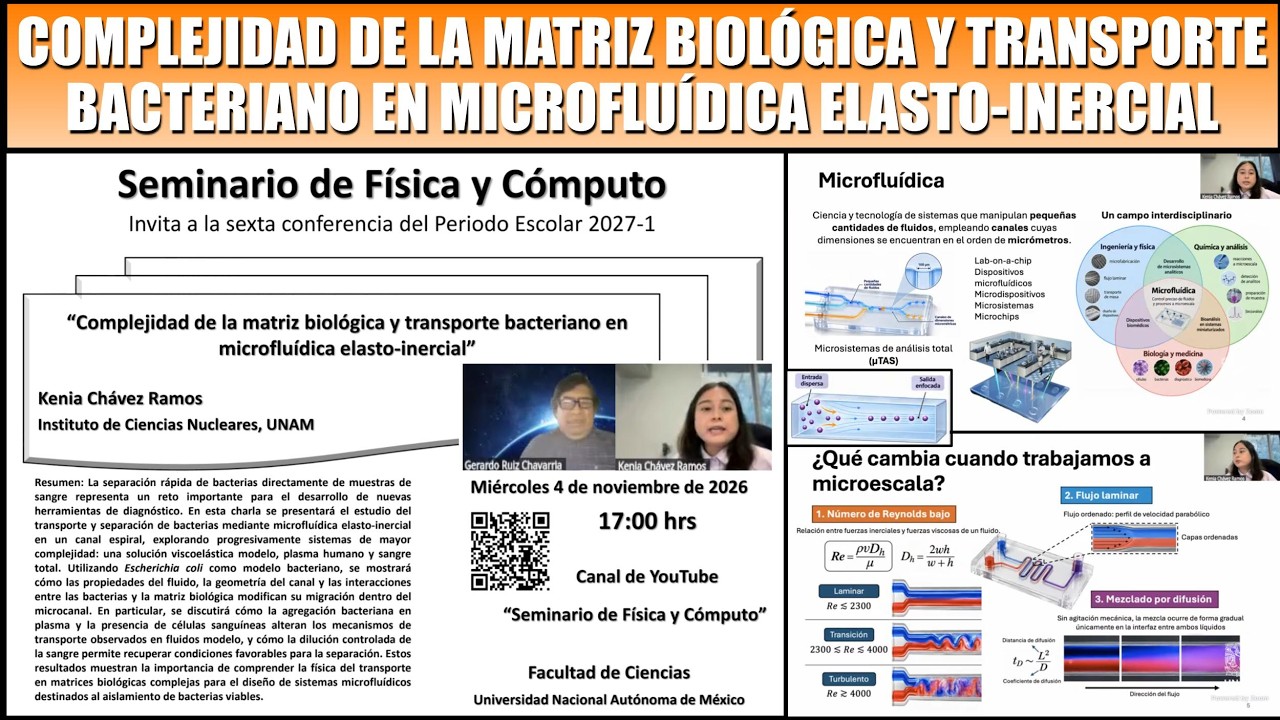
Complejidad de la matriz biológica y transporte bacteriano en microfluídica elasto-inercial (Kenia)
Complexity of Biological Matrix and Bacterial Transport in Elasto-Inertial Microfluidics (Kenia)
Title history
- Complejidad de la matriz biológica y transporte bacteriano en microfluídica elasto-inercial (Kenia) — observed on 20261109-0800 UTC (YouTube)
Keywords
Summary
154 words
Critical Evaluation
Value of the Information & Strength of the Argument
The presentation provides substantial value by connecting clinical needs with an engineering solution. The argumentation is well-structured: it starts with the clinical problem of sepsis, justifies the need for rapid bacterial separation, and logically leads to the microfluidic approach. The speaker clearly explains the underlying physics, using diagrams and analogies to make complex concepts accessible. The methodology is presented in a reproducible manner, detailing device fabrication and experimental design. The argument is persuasive, as it identifies a clear gap (slow conventional diagnostics) and proposes a technical solution, though direct quantitative results or validation data are not shown in this talk, which somewhat weakens the empirical grounding.
Scientific Rigor, Source Quality, Title Accuracy
The scientific rigor is high, as the speaker is a researcher with a strong background in chemistry and microfluidics, and the content is consistent with established principles in microfluidics and sepsis research. However, no specific sources or citations are mentioned during the talk, which limits the ability to verify claims directly. The title is accurate in describing the content: the talk indeed covers the complexity of the biological matrix and bacterial transport in elasto-inertial microfluidics. The link to a seminar playlist provides context but does not include direct references. Overall, the information is reliable, but the lack of explicit citations reduces the score slightly.
225 words
Title / Content Match
The title accurately reflects the content: the talk discusses the complexity of biological samples and bacterial transport using elasto-inertial microfluidics.
Quality & Reliability
8/10
The presentation is based on peer-reviewed research by a researcher at UNAM, with clear explanation of methods and underlying physics. However, no direct citations are provided in the video, and the talk is a single perspective.
Key Moments
Markers derived by PSI from the transcript: the creator did not define chapters.
- Introduction and context of sepsis: global statistics, mortality, and urgency of timely diagnosis.
- Limitations of conventional blood culture methods for bacterial detection.
- Introduction to microfluidics: laminar flow, Reynolds number, and advantages of miniaturization.
- Explanation of inertial and elasto-inertial microfluidics: forces, focusing positions, and size-based separation.
- Methodology: device fabrication using 3D printing and PDMS replica molding, and experimental design.
- Discussion of challenges in separating bacteria from complex blood samples and potential for sepsis diagnostics.
Cited Sources
- Seminario de Física y Cómputo playlist — Playlist of related seminar videos mentioned in the description.
Concurring Sources
- WHO Sepsis Fact Sheet — Provides global statistics on sepsis, supporting the importance of timely diagnosis.
- Microfluidics - Wikipedia — General background on microfluidics, aligning with the principles discussed.
Contribution & Novelties
The talk introduces a novel application of elasto-inertial microfluidics for bacterial separation from blood, addressing the complexity of biological matrices. It provides a comprehensive explanation of the underlying physics and presents a practical device design. The approach offers a label-free, high-throughput alternative to conventional diagnostics.
Pour aller plus loin :
- Microfluidics – Overview of microfluidics principles and applications.
- Lab-on-a-chip – Integration of laboratory processes on a chip.
- Sepsis – WHO fact sheet on sepsis, relevant to the clinical context.
79 words
Radar Profile
The radar profile shows balanced scores across all dimensions, indicating a technically robust and comprehensive presentation with high information quality and reliability.