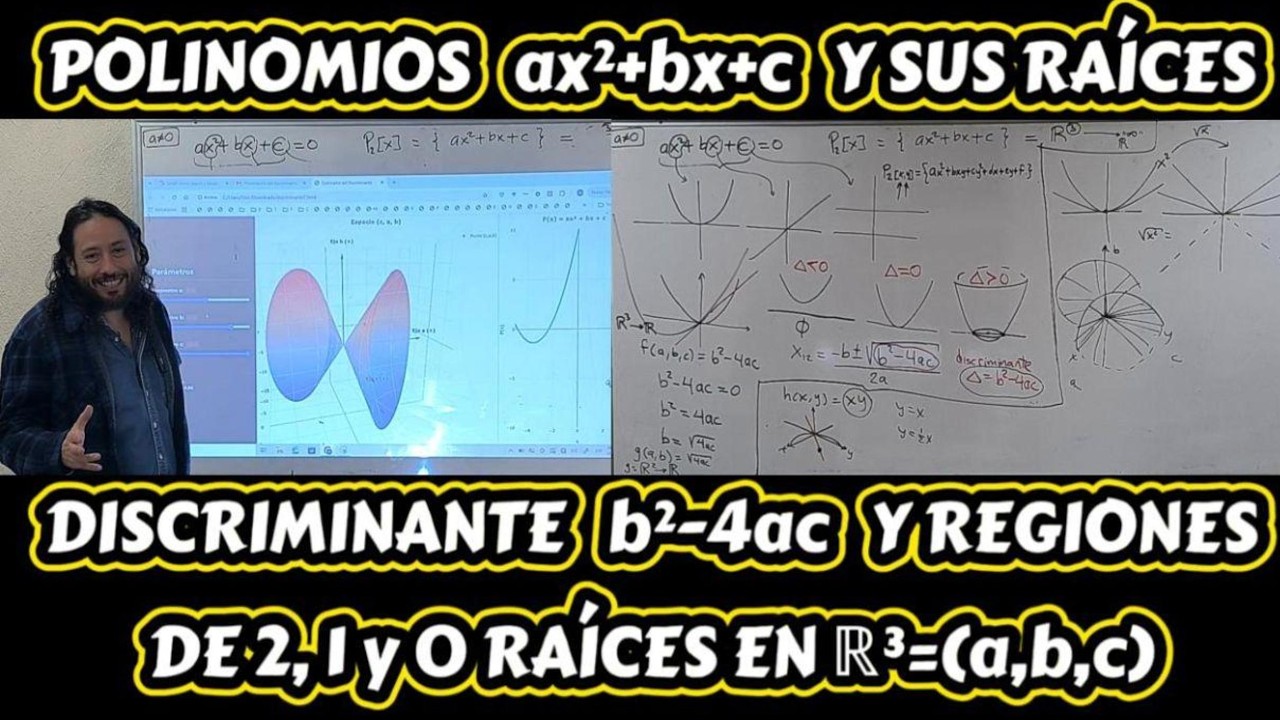
Polinomios ax²+bx+c y sus raíces Discriminante b²-4ac y regiones de 2, 1 y 0 raíces en ℝ³=(a,b,c
Polynomials ax²+bx+c and their roots Discriminant b²-4ac and regions of 2, 1 and 0 roots in ℝ³=(a,b,c
Keywords
Summary
214 words
Critical Evaluation
Value of the Information & Strength of the Argument
The video provides significant educational value by offering a fresh geometric perspective on a classical algebraic topic. It effectively bridges algebraic manipulation (the discriminant) with geometric intuition (the shape of the parameter space), enhancing conceptual understanding. The argumentation is systematic: the lecturer carefully derives the surface equation b²=4ac by algebraic rearrangement, then builds intuition by first analyzing simpler functions like xy and its square root, generalizing to the cone. The reasoning is solid, with explicit justifications for each step, such as why the absolute value appears when taking square roots. The use of a live tool (GeoGebra) to explore the parameter space reinforces the arguments with visual evidence, making the logical chain compelling and accessible.
Scientific Rigor, Source Quality, Title Accuracy
The scientific rigor is high; all mathematical statements are correctly derived and consistent with standard algebraic theory. The professor distinguishes between real and complex roots and correctly notes the fundamental theorem of algebra for complex numbers. No external sources are cited explicitly, but the content relies on well-established mathematical knowledge, presented without error. The title is perfectly aligned with the content: it announces exactly what the video demonstrates—the discriminant and its role in partitioning the parameter space into regions of 2, 1, and 0 real roots. The title is informative and precise, neither overstating nor understating the material.
228 words
Title / Content Match
Title accurately summarizes the content: the discriminant b²-4ac and its role in determining zero, one, or two real roots, visualized as regions in the 3D parameter space (a,b,c).
Quality & Reliability
9/10
Mathematically rigorous presentation with clear logical explanations and visualizations; no unsupported claims.
Key Moments
Markers derived by PSI from the transcript: the creator did not define chapters.
- Introduction: course context, motivation for studying quadratic polynomials, and relation to conic sections.
- Recap: graphing quadratics as parabolas, interpretation of equation as intersection of graphs, and the role of coefficients.
- Discussion of the three cases of roots based on discriminant sign, linking to the quadratic formula.
- Introduction of the discriminant b²-4ac and its algebraic role; explanation of why negative discriminant yields no real roots.
- Derivation of b²=4ac as the boundary surface; perspective shift to parameter space (a,b,c) in R³.
- Geometric construction of the cone: analyzing xy and its square root, building the double cone, and interpreting regions.
- Analogies to conic sections: the root set as a circle for a one-dimensional observer, foreshadowing classification of conics.
- Conclusion: summary of the cone interpretation and transition to conic sections in two variables.
Contribution & Novelties
The lecture offers a novel pedagogical approach by visualizing the discriminant condition as a cone in the parameter space (a,b,c), thereby making the algebraic regions of root count intuitively graspable. This is not new mathematical content but a fresh didactic method that can help students internalize the concept and prepare for higher-dimensional geometry.
Pour aller plus loin :
- Discriminant (Wikipedia) — The general concept of discriminants for polynomials and its geometric meaning.
- Quadratic equation (Wikipedia) — Detailed treatment of the formula and the discriminant’s role.
- Conic section (Wikipedia) — Directly related to the final analogy, discussing classification of conics via invariants.
101 words
Radar Profile
The profile shows high scores in quality, reliability, and technical level, with a slightly lower but still strong score in quantity of information, reflecting the lecture's depth and accuracy. The relatively low quantity score likely stems from the single-topic focus and the slow, stepwise explanation style, which may compress the breadth of content covered.