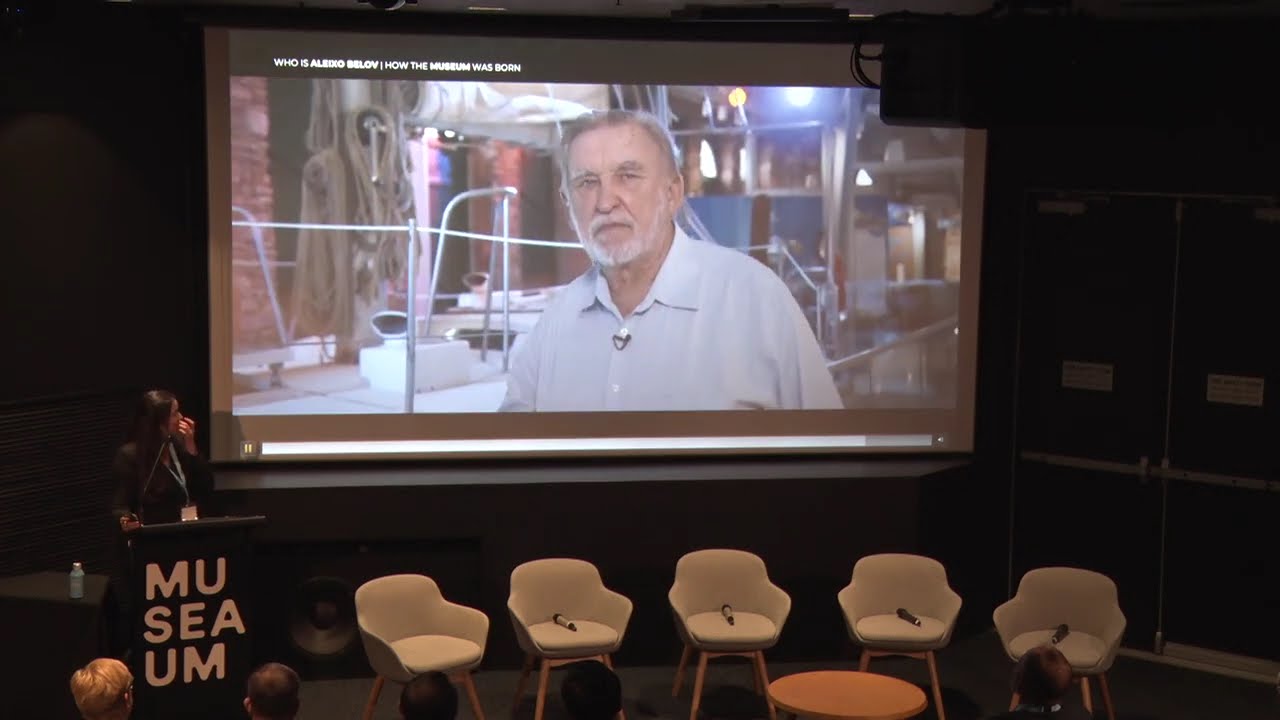
ICMM Congress 2026: Courageous Leadership Plenary Session
Title history
- ICMM Congress 2026: Courageous Leadership Plenary Session — observed on 20261029-1710 UTC (YouTube)
Keywords
Summary
154 words
Critical Evaluation
Value of the Information & Strength of the Argument
The value of the information lies in the practical, experience-based insights shared by practitioners who have led significant institutional changes. Each speaker provides concrete examples: Larissa Nabuco details financial growth metrics and the shift from a museum-only model to a foundation with multiple activities; Ulla Teräs illustrates how redefining the ship Sigyn as an urban asset rather than a preservation problem altered strategic thinking; Feng Zhao demonstrates how real-time shipping data and VR experiences enhance audience engagement. The arguments are presented with clarity and are grounded in real cases, though they rely on self-reported success and lack comparative or externally verified evidence. The panel format offers a diversity of global perspectives, which strengthens the collective insight, but individual claims are not critically examined within the session.
Scientific Rigor, Source Quality, Title Accuracy
The scientific rigor is moderate. The speakers cite internal institutional data and acknowledge uncertainties, but they do not reference peer-reviewed literature or external evaluations. Sources are primarily their own experiences and organizational reports, which are appropriate for a conference presentation but not for a systematic review. The title accurately describes the session’s focus on leadership, and the content matches this, with each speaker addressing how they confronted challenges and implemented changes. No public comments are provided to analyze, so no community feedback is assessed.
225 words
Title / Content Match
The title accurately reflects the content: a plenary session on courageous leadership within maritime museums, featuring four speakers who each address leadership challenges and institutional transformation.
Quality & Reliability
7/10
The presentations draw on real institutional experiences and data, but they are largely anecdotal and not systematically referenced to external sources. The credibility stems from the speakers' authoritative positions, yet there is limited verifiable evidence presented.
Key Moments
Markers derived by PSI from the transcript: the creator did not define chapters.
- Opening and introduction by chair Richard Kendall
- Larissa Nabuco presents transformation of Aleixo Belov Sea Museum
- Ulla Teräs discusses Forum Marinum's ecosystem approach
- Feng Zhao outlines China Maritime Museum's sustainability strategies
- Dmytro Kobaliia speaks on resilience and heritage in Ukraine
- End of talks, beginning of panel discussion
Concurring Sources
- ICMM Congress 2026 official website — The session is part of the official congress program; no direct URL provided.
Contribution & Novelties
The session contributes original perspectives on museum leadership by sharing distinct national and institutional contexts. Larissa Nabuco’s focus on diversifying revenue streams and expanding the institution’s scope beyond a physical museum is a concrete model for sustainability. Ulla Teräs’s systems-thinking approach, treating the museum as an actor in urban development, offers a novel lens for strategic planning. Feng Zhao’s integration of live shipping data and digital interactivity illustrates innovative audience engagement. The novelty lies in the cross-cultural comparison and the emphasis on courageous, experimental leadership rather than on technical innovation alone.
Pour aller plus loin :
- Maritime museum — Provides background on the type of institution discussed.
- Ocean literacy — Concept central to several speakers’ educational missions.
- Museum management — Overview of practices and challenges relevant to the session.
- Digital transformation in museums — Related to Feng Zhao’s use of VR and data visualization.
144 words
Radar Profile
The radar chart indicates high quantity of information (8) and good quality (7), with moderate technical level (5) and robust reliability (7). The profile suggests a content-rich, experience-based session rather than a highly technical or deeply data-driven one, fitting an expert panel focused on practical leadership insights.