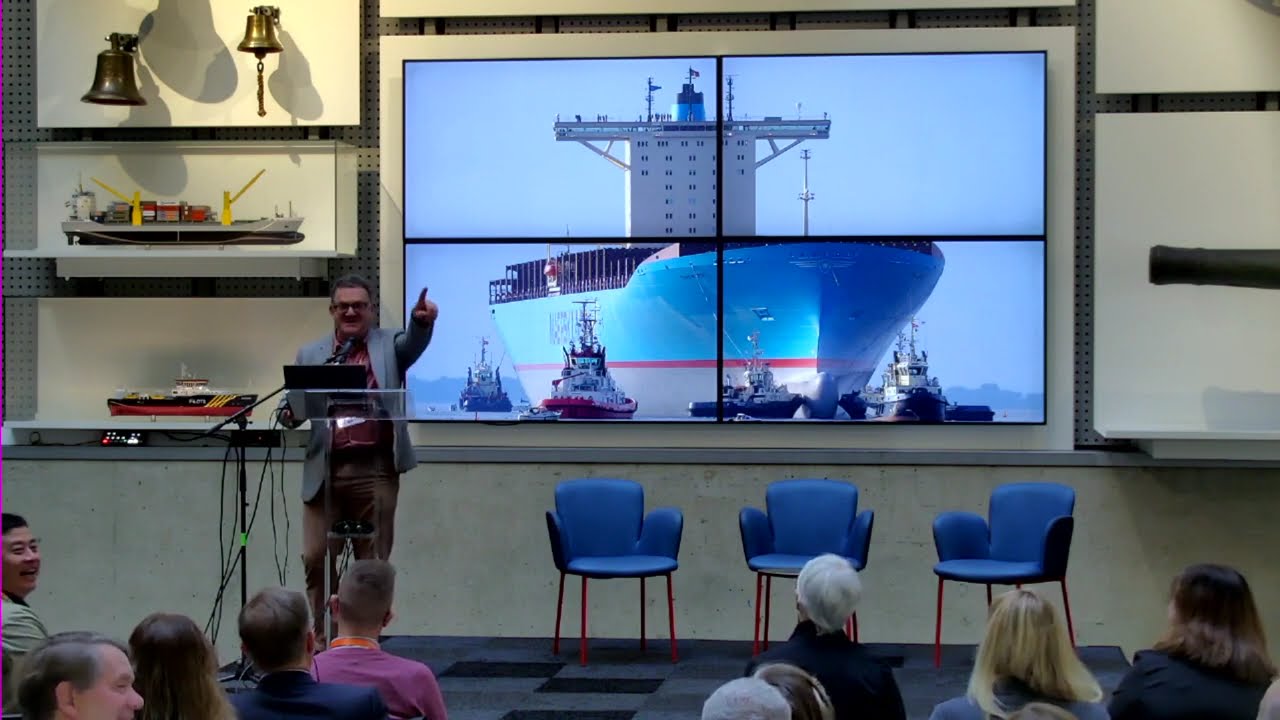
ICMM Congress 2024: Museum Ships and Maritime Heritage Plenary Session
Keywords
Summary
209 words
Critical Evaluation
Value of the Information & Strength of the Argument
The session offers substantial value by combining practical experience with a critical, forward-looking perspective. Matthew Tanner’s argument is built on a clear diagnosis: the field suffers from over-capitalization and under-sustainability, driven by emotion rather than rational planning. He uses concrete examples (HMS Implacable, Medway Queen, SS Great Britain) and data (fleet numbers, at-risk registers) to support his claim that the pioneering era of ship preservation is over and that a new equilibrium is needed. His call for ICMM to redefine its purpose and help members make strategic choices is well-argued. Raymond Ashley’s argument is more conceptual, proposing a framework for World Heritage recognition. He draws parallels with other heritage sites and systematically lists the qualities that make ships eligible, such as their status as works of naval architecture and their role in global trade. His argument is persuasive but remains a proposal; he acknowledges the lack of ships on the list and the challenges of nomination. Both speakers are coherent and consistent, though the transcript cuts off before Ashley’s conclusion, leaving his final points incomplete.
Scientific Rigor, Source Quality, Title Accuracy
The speakers demonstrate strong rigor by citing specific sources: Campbell McMurray’s 1994 paper, Norman Brouwer’s 1999 international register, Colin White’s work, and Neil Yanish’s 1982 paper. They reference institutional data from the UK National Historic Fleet, the National Register of Historic Places, and UNESCO World Heritage lists (1,199 sites, 933 cultural, 227 natural). The title accurately reflects the content, which is a plenary session on museum ships and maritime heritage. The session is a professional conference talk, not a peer-reviewed study, but the arguments are well-supported by evidence and experience. No advertising sequence is present. The transcript is incomplete, which slightly limits the assessment of the full argumentation.
298 words
Title / Content Match
The title accurately reflects the content: a plenary session on museum ships and maritime heritage with two speakers addressing preservation challenges and World Heritage recognition. The title is descriptive and matches the session's scope.
Quality & Reliability
7/10
The session features two recognized professionals in maritime heritage: Matthew Tanner, a leading figure in historic ship preservation, and Raymond Ashley, president and CEO of the Maritime Museum of San Diego. Their arguments are grounded in professional experience, institutional data (UK National Historic Fleet, National Register of Historic Places, UNESCO World Heritage lists), and published literature. However, the talk is an opinion piece rather than a peer-reviewed study, and some claims are anecdotal or rely on personal observation. The transcript is incomplete (ends mid-sentence), which limits full assessment.
Key Moments
Markers derived by PSI from the transcript: the creator did not define chapters.
- Introduction by Vincent Lipanovich, session moderator.
- Matthew Tanner begins his talk on ship preservation, referencing Campbell McMurray's 'Road to Hell' paper.
- Tanner discusses the decline of the UK National Historic Fleet from 5,050 to 200 vessels.
- Tanner critiques the emotional drivers of preservation and the myth of HMS Implacable.
- Tanner introduces the concept of 'zombie ships' and the impact of lottery funding.
- Tanner discusses replica ships and the Medway Queen as an example of lost authenticity.
- Tanner calls on ICMM to redefine its purpose and help members make strategic choices.
- Raymond Ashley begins his talk on historic ships and World Heritage.
- Ashley contrasts the destruction of Bamiyan Buddhas and Palmyra with the neglect of ships.
- Ashley explains the UNESCO World Heritage nomination process and lists criteria.
Cited Sources
- Campbell McMurray, 'Ship Preservation: A Road to Hell Paved with Good Intentions' (1994) — Referenced by Matthew Tanner as the foundational critique of ship preservation.
- Norman Brouwer, 'International Register of Historic Ships' (1999) — Cited by Tanner to show the number of preserved vessels worldwide.
- Colin White, paper on 'too many preserved ships' — Mentioned by Tanner as another key critique.
- Neil Yanish, paper (1982) — Cited by Tanner as an early voice on preservation issues.
- UK National Historic Fleet register — Source of data on fleet numbers and at-risk vessels.
- UNESCO World Heritage Convention (1972) — Referenced by Raymond Ashley as the framework for World Heritage Sites.
- National Register of Historic Places (USA) — Mentioned in relation to the Falls of Clyde and USS Olympia.
Concurring Sources
- UNESCO World Heritage Convention — Supports Ashley's argument that ships could be eligible for World Heritage status.
- National Historic Ships UK — Provides data on the UK fleet, corroborating Tanner's figures.
Contribution & Novelties
The session provides a critical and forward-looking perspective on maritime heritage, combining a diagnosis of current preservation failures with a proposal for international recognition. Matthew Tanner’s concept of ‘zombie ships’ and his call for ICMM to redefine its purpose offer a new strategic direction for maritime museums. Raymond Ashley’s argument for recognizing historic ships as World Heritage Sites is a novel and ambitious proposal that challenges the current UNESCO framework. Together, they highlight the need for sustainability, rigor, and a long-term cultural vision in maritime preservation.
Pour aller plus loin :
- UNESCO World Heritage Convention — The official framework for World Heritage Sites, relevant to Ashley’s proposal.
- National Historic Ships UK — The UK register of historic vessels, referenced by Tanner.
- ICOM Definition of a Museum — The museum definition discussed by Tanner, relevant to redefining maritime museums’ purpose.
139 words
Radar Profile
The radar profile shows a strong emphasis on information quality and reliability, with moderate scores in quantity and technical level. The session is rich in expert opinion and historical context but lacks quantitative depth or technical detail. The overall profile reflects a well-argued, professionally grounded discussion rather than a data-heavy technical presentation.