MGV 3702 Genética de Populações - Aula6
MGV 3702 Population Genetics - Class 6
Keywords
Summary
192 words
Critical Evaluation
Value of the Information & Strength of the Argument
The lecture provides a solid, mathematically rigorous exposition of inbreeding theory. It builds from first principles, starting with the probabilistic definition and then moving to Wright’s correlation-based approach. The derivation of the effect of inbreeding on genotype frequencies is clear and well-argued. The connection between inbreeding and relationship coefficients is elegantly demonstrated. The argumentation is logical and step-by-step, making complex concepts accessible. The use of examples, such as the ABO blood group and small town marriages, helps illustrate abstract ideas. The lecture also highlights practical implications for plant and animal breeding, showing the relevance of the theory. Overall, the value of the information is high for students of population genetics, as it provides a foundational understanding of inbreeding and its quantification.
Scientific Rigor, Source Quality, Title Accuracy
The lecture is scientifically rigorous, relying on established theory from Sewall Wright (1951). However, it does not cite specific papers or sources beyond mentioning Wright’s name. The derivations are correct and follow standard population genetics textbooks. The title accurately reflects the content, as it focuses on inbreeding and variance of gene frequency. The lecture does not include any advertising sequences. No comments were provided for analysis.
202 words
Title / Content Match
The title accurately reflects the content: a class on population genetics focusing on inbreeding and variance of gene frequency.
Quality & Reliability
7/10
The content is a university-level lecture on population genetics, specifically on inbreeding and its quantification. It relies on established theory (Wright, 1951) and derives standard formulas. The presentation is coherent and mathematically sound, though it lacks citations to primary literature or external sources. The absence of peer review or source verification limits the score to 7.
Key Moments
Markers derived by PSI from the transcript: the creator did not define chapters.
- Introduction to inbreeding: definition as probability of identity by descent.
- Wright's (1951) definition: inbreeding as correlation between uniting gametes.
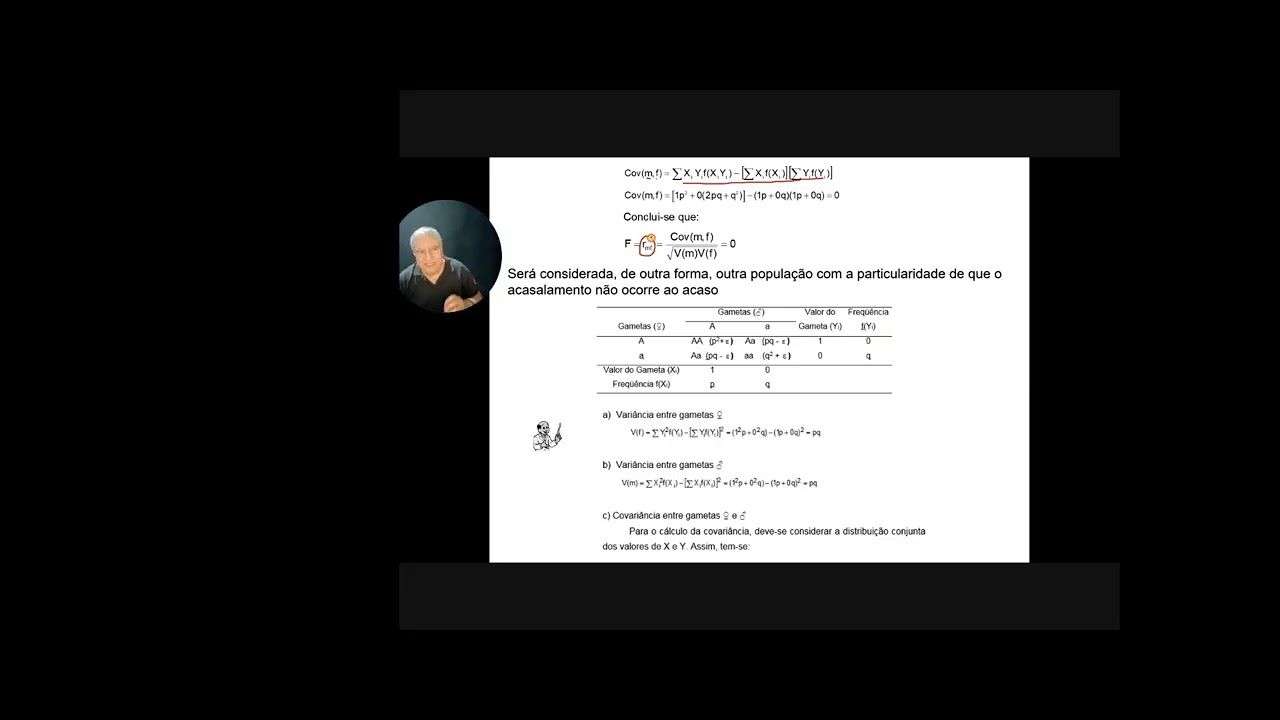
- Derivation of variance and covariance of gametic values in random mating.
- Introduction of non-random mating and the effect of inbreeding (E).
- Effect of inbreeding on genotype frequencies: increase in homozygotes by Fpq.
- Coefficient of relationship: probability of identity by descent between two individuals.
- Relationship between inbreeding and relationship coefficients.
- Inbreeding in populations derived from self-fertilization: derivation of Ft = 1 - (1/2)^t.
- Practical implications and caution in applying formulas.
Contribution & Novelties
The lecture does not present new research but provides a comprehensive tutorial on classical population genetics concepts. It synthesizes Wright’s theory and standard derivations in a clear, pedagogical manner. The original aspect is the detailed step-by-step explanation of the correlation between gametes and its link to inbreeding, which is often glossed over in textbooks.
Pour aller plus loin :
- Inbreeding — Wikipedia article providing an overview of inbreeding, its causes, and consequences.
- Coefficient of relationship — Wikipedia article explaining the coefficient of relationship and its calculation.
- Sewall Wright — Wikipedia article on Sewall Wright, who developed the correlation-based definition of inbreeding.
101 words
Radar Profile
The radar profile shows high scores in quantity of information, technical level, and overall reliability, reflecting the lecture's depth and accuracy. The quality of information is slightly lower due to the lack of cited sources, but the content remains robust. The profile indicates a strong educational resource for advanced students.