MGV 3702 - Genética de Populações :Aula7
MGV 3702 - Population Genetics: Lesson 7
Title history
- MGV 3702 - Genética de Populações :Aula7 — observed on 20261025-1532 UTC (YouTube)
Keywords
Summary
176 words
Critical Evaluation
Value of the Information & Strength of the Argument
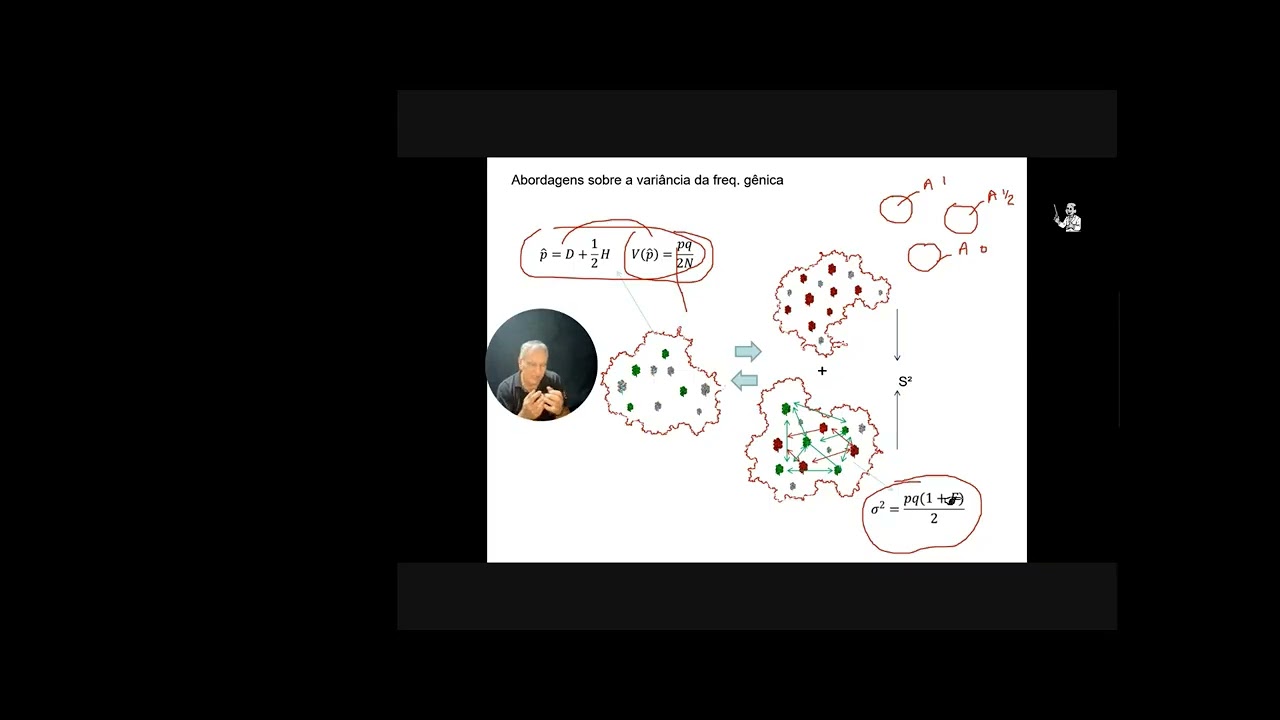
The video provides a solid conceptual and mathematical explanation of a subtle but central topic in population genetics. The instructor systematically distinguishes two interpretations of ‘variance of gene frequency’: the variance of the allelic frequency estimate and the variance attributable to subdivision or inbreeding. He shows how the same variance can be derived from different theoretical bases, leading to different insights. The argumentation is logical and rigorous, with step-by-step derivations and clear explanations of the biological meaning. The use of concrete examples, such as selfing and pooling populations, helps make abstract concepts tangible. The lecturer also connects the topics to practical applications in plant breeding, highlighting how variance drives selection strategies. However, the absence of citations leaves some claims unsupported, though the mathematical reasoning is transparent and internally consistent.
Scientific Rigor, Source Quality, Title Accuracy
The scientific rigour is high: the mathematical derivations are correct and the biological interpretations are standard in the field. The lecturer demonstrates a deep understanding of the subject and effectively links population genetics to quantitative genetics. No external references are cited, but the content aligns with established textbooks and theory. The title ‘MGV 3702 - Genética de Populações: Aula7’ accurately reflects the educational context and content. The presentation is coherent, and the limited use of visual aids is compensated by verbal clarity. From the available transcript, there are no inaccuracies or logical inconsistencies. The absence of audience comments prevents any analysis of public perception, but the pedagogical approach appears sound.
254 words
Title / Content Match
Le titre correspond parfaitement au contenu : il s'agit bien de la septième leçon de génétique des populations du cours MGV 3702.
Quality & Reliability
8/10
The lecture presents a rigorous mathematical treatment of gene frequency variance, endogamy, and evolutionary forces, consistent with standard population genetics theory, although no external sources are cited.
Key Moments
Markers derived by PSI from the transcript: the creator did not define chapters.
- Introduction to the lecture on variance of gene frequency and recap of population genetic parameters.
- Derivation of the variance of allelic frequency using the binomial distribution.
- Alternative derivation using an indicator variable; link to inbreeding and relatedness.
- Discussion of the Wahlund effect: variance arising from pooling populations with different allele frequencies.
- Consequences of self-fertilization on genotypic and allelic frequencies, and on variance.
- Transition to forces altering gene frequency: migration and mutation.
Concurring Sources
- Population genetics - Wikipedia — General theoretical foundation of the concepts discussed.
- Wahlund effect - Wikipedia — Specifically addresses the variance due to population subdivision.
- Genetic drift - Wikipedia — Relevant to the stochastic variation in gene frequencies.
- Hardy-Weinberg principle - Wikipedia — Reference equilibrium model used in the derivations.
Contribution & Novelties
The primary contribution of this lecture is its explicit pedagogical clarification of two distinct concepts of ‘variance of gene frequency’ and their interconnections with inbreeding, drift, and population structure. It offers a deeper mathematical insight into how variance formulations relate to different biological scenarios, which is often only implicit in textbooks. The lecturer also bridges the gap to quantitative genetics, showing how these variances underpin additive variance and heritability.
Pour aller plus loin :
- Population genetics — Provides a broad overview of the field, including gene frequency dynamics.
- Wahlund effect — Directly related to the increase of homozygosity when subpopulations are pooled.
- Genetic drift — Explains the stochastic changes in allele frequencies and the variation among populations.
- Hardy-Weinberg principle — Baseline model for allele and genotype frequencies in the absence of evolutionary forces.
133 words
Radar Profile
Le profil radar montre une excellente qualité d'information et un niveau technique très élevé, indiquant que la vidéo est dense et spécialisée. La quantité d'information est élevée mais la fiabilité demeure bonne, bien que l'absence de sources externes limite la vérification externe.