MGV3702 Genética de Populações: Aula12
MGV3702 Population Genetics: Class 12
Title history
- MGV3702 Genética de Populações: Aula12 — observed on 20261112-2356 UTC (YouTube)
Keywords
Summary
117 words
Critical Evaluation
Value of the Information & Strength of the Argument
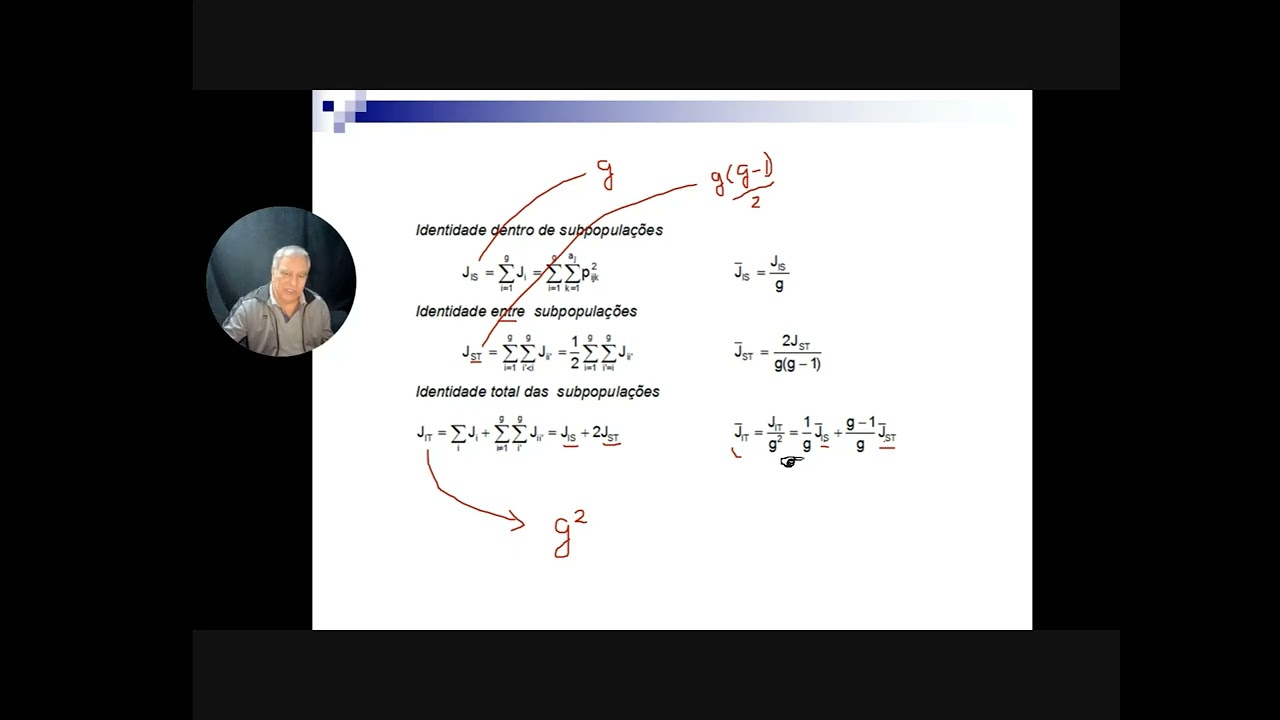
The value of the information is high for students seeking a thorough understanding of Nei’s genetic differentiation statistics. The instructor builds the argument carefully, starting from foundational definitions of identity and heterozygosity, then deriving diversity and GST step by step. He explicitly clarifies common misconceptions, such as the difference between diversity and heterozygosity, and emphasizes the importance of contextualizing definitions. The presentation is logically coherent, with numerical examples that make abstract concepts tangible. However, the lecture relies solely on verbal explanation and blackboard-style illustration, lacking visual aids or references, which may limit its accessibility for self-study.
Scientific Rigor, Source Quality, Title Accuracy
The scientific rigor is sound: the content is based on classic literature (Nei 1973, Nei 1972), and the instructor demonstrates a deep grasp of the material. He carefully distinguishes between Nei’s 1972 and 1973 approaches, which prevents confusion. However, no citations or references are provided in the video description, so viewers cannot easily consult primary sources. The title accurately reflects the content, as it is a lecture on population genetics. The presentation is internally consistent, and the instructor shows awareness of alternative methods (e.g., Wright’s F-statistics) without going into detail here.
202 words
Title / Content Match
The title clearly signals a university-level course in population genetics, which matches the instructional content on differentiation statistics.
Quality & Reliability
8/10
The lecture provides a detailed exposition of well-established population genetics methods (Nei's GST), built on clear conceptual definitions and worked examples. The presenter is presumably an instructor with deep domain knowledge, but no external references are provided in the description, limiting verifiability.
Key Moments
Markers derived by PSI from the transcript: the creator did not define chapters.
- Introduction to biometric approaches for studying population differentiation.
- Definition of genetic identity within and between populations, including matrix notation.
- Explanation of heterozygosity as the complement of identity, with calculations for within and between populations.
- Introduction of Nei's concept of genetic diversity and its relationship to heterozygosity.
- Derivation of the GST statistic, its interpretation, and a worked example showing low differentiation.
- Discussion on using GST matrices for clustering and ordination, and an alternative contingency-based approach.
Cited Sources
- Nei, M. (1973). Analysis of gene diversity in subdivided populations. PNAS, 70(12), 3321-3323. — The lecture's main method is based on this paper, defining diversity and GST.
- Nei, M. (1972). Genetic distance between populations. American Naturalist, 106, 283-292. — Mentioned as an alternative measure, with a different definition of differentiation.
- Wright, S. (1951). The genetical structure of populations. Annals of Eugenics, 15, 323-354. — Referenced later in the lecture (F-statistics) as a related framework.
Concurring Sources
- Nei, M. (1973). Analysis of gene diversity in subdivided populations. PNAS, 70(12), 3321-3323. — The mathematical foundation of the GST statistic.
- Wright, S. (1951). The genetical structure of populations. Annals of Eugenics, 15, 323-354. — Related F-statistics that also partition genetic variation within and among populations.
Contribution & Novelties
The lecture provides a clear pedagogical walkthrough of Nei’s GST statistic, bridging conceptual definitions with practical computation. It emphasizes the distinction between diversity and heterozygosity, which is often confusing. The instructor also demonstrates how to interpret GST matrices through clustering and projection methods, offering a comprehensive view of population differentiation analysis.
Pour aller plus loin :
- Fixation index (Wikipedia) — This provides context on related statistics like Wright’s Fst, useful for comparison.
- Genetic distance (Wikipedia) — Covers Nei’s distance measures, including the 1972 method.
- Population genetics (Wikipedia) — A broad overview of the field and key concepts.
97 words
Radar Profile
The radar profile shows a balanced high score across all dimensions, indicating a lecture that is rich in content, technically deep, and reliable, though not necessarily groundbreaking in novelty.