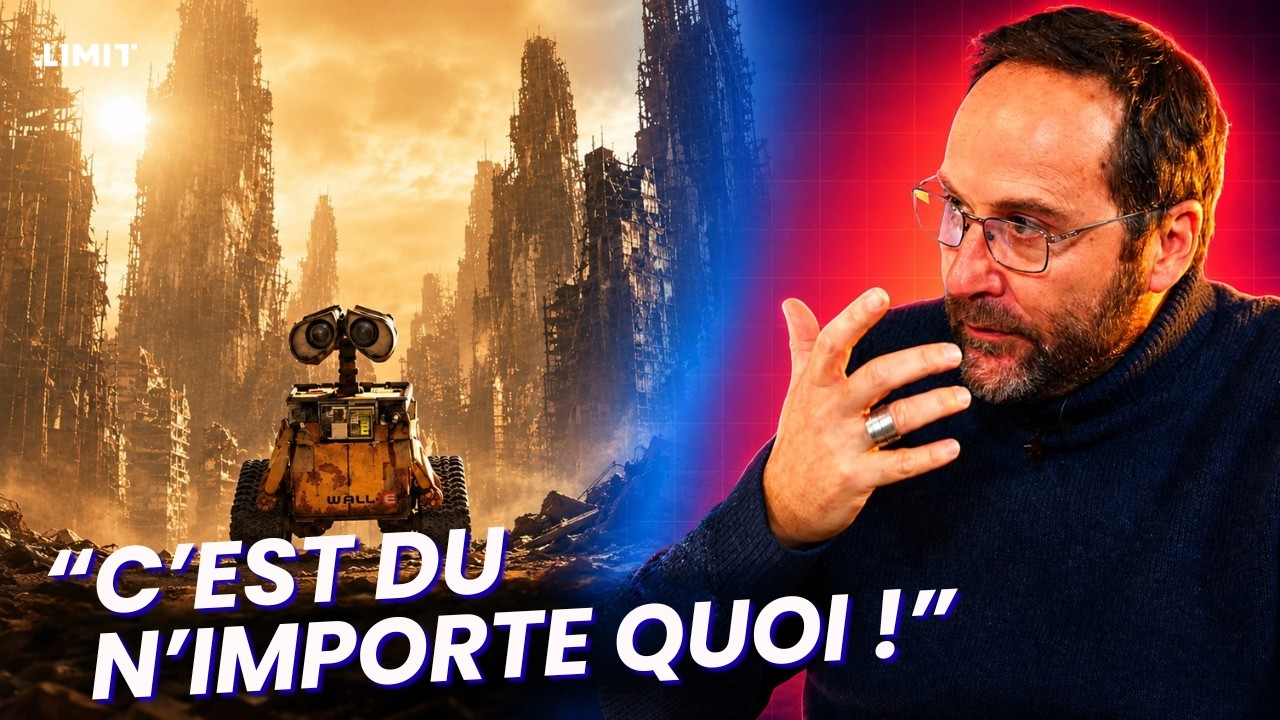
Un géographe analyse des films d’effondrement
A geographer analyzes collapse-themed films
Keywords
Summary
129 words
Critical Evaluation
Value of the Information & Strength of the Argument
The video offers a valuable perspective by connecting cinematic dystopias with contemporary urban reality. Faburel’s argumentation is solid in that it consistently traces how films perpetuate a vision of urban dominance and individual survival, rather than exploring cooperative or ecological solutions. He presents a clear thesis: the city is a totalizing institution that has become a religion of consumption and control. His reasoning is logical, though it relies on qualitative assertions rather than empirical data. The discussion is thought-provoking and challenges viewers to question mainstream narratives, adding intellectual depth to the analysis.
Scientific Rigor, Source Quality, Title Accuracy
The scientific rigor is moderate. Faburel’s expertise is evident, but he does not cite specific studies or datasets during the discussion. The description provides a link to his book, which likely contains more detailed arguments. The title accurately reflects the content, as it is indeed a geographer analyzing collapse films. The channel LIMIT is presented as an independent media, and the video includes a call for support, which is transparent. Overall, the source quality is acceptable given the format of an opinion-led discussion.
190 words
Title / Content Match
The title accurately reflects the content: a geographer analyzes films dealing with societal collapse, though the focus is more on urban and social critique than on literal collapse scenarios.
Quality & Reliability
7/10
The video features Guillaume Faburel, a geographer with legitimate expertise on urbanism and collapse, but the discussion is largely opinion-based and lacks explicit references to scientific studies. The arguments are coherent and grounded in urban theory, yet the absence of verifiable data or citations reduces the reliability score.
Chapters
Cited Sources
- Pour en finir avec les grandes villes (book by Guillaume Faburel) — Referenced in the description as the author's book for deeper exploration of urban collapse and post-urban alternatives.
- LIMIT media website — Official website of the channel, providing additional content and information.
- LIMIT Bluesky profile — Social media profile of the channel, included as a contact point.
Contribution & Novelties
The video’s original contribution lies in its critical analysis of mainstream films through a geographer’s lens, exposing how they reinforce urban-centric and individualistic narratives of collapse. It offers an alternative perspective rooted in eco-urbanism, advocating for small-scale, self-governing communities and a shift from megacities to post-urban lifestyles. The discussion also highlights the role of cinema in shaping collective imagination, urging viewers to question these cultural filters.
Pour aller plus loin :
- Collapsology — A study of the potential collapse of industrial civilization, relevant to the film themes discussed.
- Degrowth — An economic theory advocating for reduced consumption, aligning with Faburel’s emphasis on sobriety and localism.
- Urban sprawl — The expansion of urban areas, contrasting with the post-urban vision proposed by Faburel.
121 words
Radar Profile
The radar profile shows moderate scores across all dimensions, with slightly higher quality and reliability than quantity, indicating a focused but content-rich discussion. The low quantity score reflects the short duration, while the technique level is decent for a general audience, making the video accessible yet substantive.