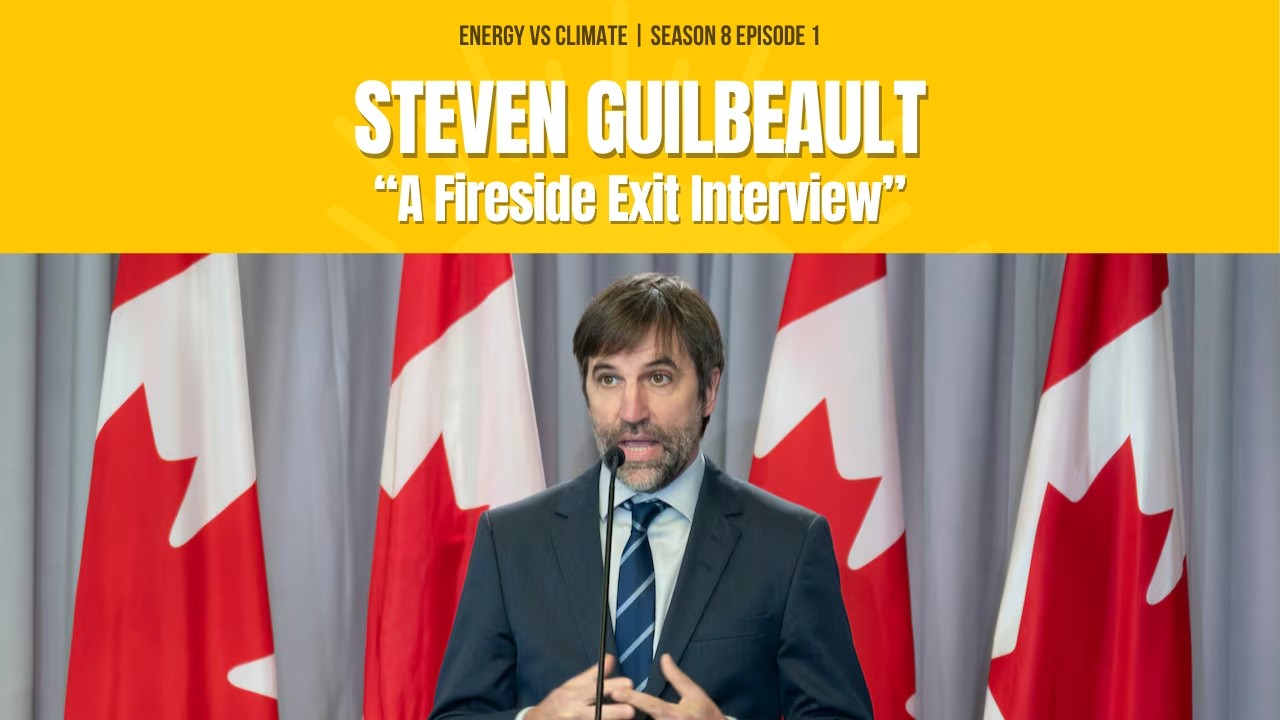
The Fireside Exit Interview: Quitting Cabinet Over a Pipeline | With Steven Guilbeault
Keywords
Summary
194 words
Critical Evaluation
Value of the Information & Strength of the Argument
The value of this interview lies in its unique insider perspective on high-level climate policy decisions in Canada. Guilbeault provides nuanced arguments, particularly his analysis of how the environmental movement’s shift from public mobilization to policy work may have weakened its political leverage. He articulates a clear moral framework for his resignation, emphasizing consistency and accountability to his constituents. The argumentation is thoughtful, though it reflects personal opinion rather than objective analysis. His claim that the climate backslide is not due to Trump is well-articulated, and he supports it by pointing to the continuation of climate architecture in Europe and Australia. The discussion of multilateralism is insightful, but lacks concrete evidence beyond anecdote. Overall, the interview offers valuable context for understanding Canadian climate politics, but it is not a scientific or data-driven analysis.
Scientific Rigor, Source Quality, Title Accuracy
The scientific rigor is moderate: the content is primarily anecdotal and opinion-based, with references to specific events (e.g., COP15, COP31) but no citation of scientific literature. Source quality is high in terms of the speaker’s expertise, but the podcast does not provide external references beyond the channel’s own links. The title accurately reflects the content, as the interview indeed focuses on the resignation over a pipeline and Guilbeault’s experiences. There is no significant mismatch between title and content. The video includes no commercial advertising sequence.
233 words
Title / Content Match
The title accurately reflects the content: a fireside chat focusing on Guilbeault's resignation over a pipeline deal and his broader reflections on climate policy.
Quality & Reliability
8/10
The interview features a highly experienced former environment minister with deep knowledge of Canadian climate policy and diplomacy. The discussion is candid and provides insider perspectives, but it is fundamentally a subjective account rather than a systematically sourced scientific assessment.
Chapters
Cited Sources
- Energy vs Climate official website — Podcast's main site for further episodes and information.
- Energy vs Climate LinkedIn page — Channel's professional social media presence.
- Energy vs Climate Bluesky profile — Social media channel for updates and discussions.
- Energy vs Climate donation page — Support page for the podcast.
- Bespoke Podcasts — Production company for the podcast.
Contribution & Novelties
The interview provides original insights into the internal dynamics of Canadian climate policy, particularly the reasoning behind a high-profile resignation on principle. It offers a former minister’s candid reflections on the challenges of balancing political realities with environmental commitments. The narrative that the environmental movement’s pivot from grassroots mobilization to policy work may have inadvertently weakened public pressure is a valuable perspective.
Pour aller plus loin :
- Kunming-Montreal Global Biodiversity Framework — This is the COP15 agreement that Guilbeault cites as his proudest achievement; provides context on the framework’s goals.
- Trans Mountain Pipeline — Essential to understanding the pipeline controversies discussed, including the original project and its expansions.
- United Nations Climate Change Conference (COP31) — The upcoming COP31 in Turkey, mentioned as a venue for continued multilateral climate negotiations.
129 words
Radar Profile
The profile shows strong scores in information quantity and quality, reflecting the depth of the interview, while technical level is moderate, appropriate for a general audience interested in policy. The moderate reliability score aligns with the subjective nature of the content.