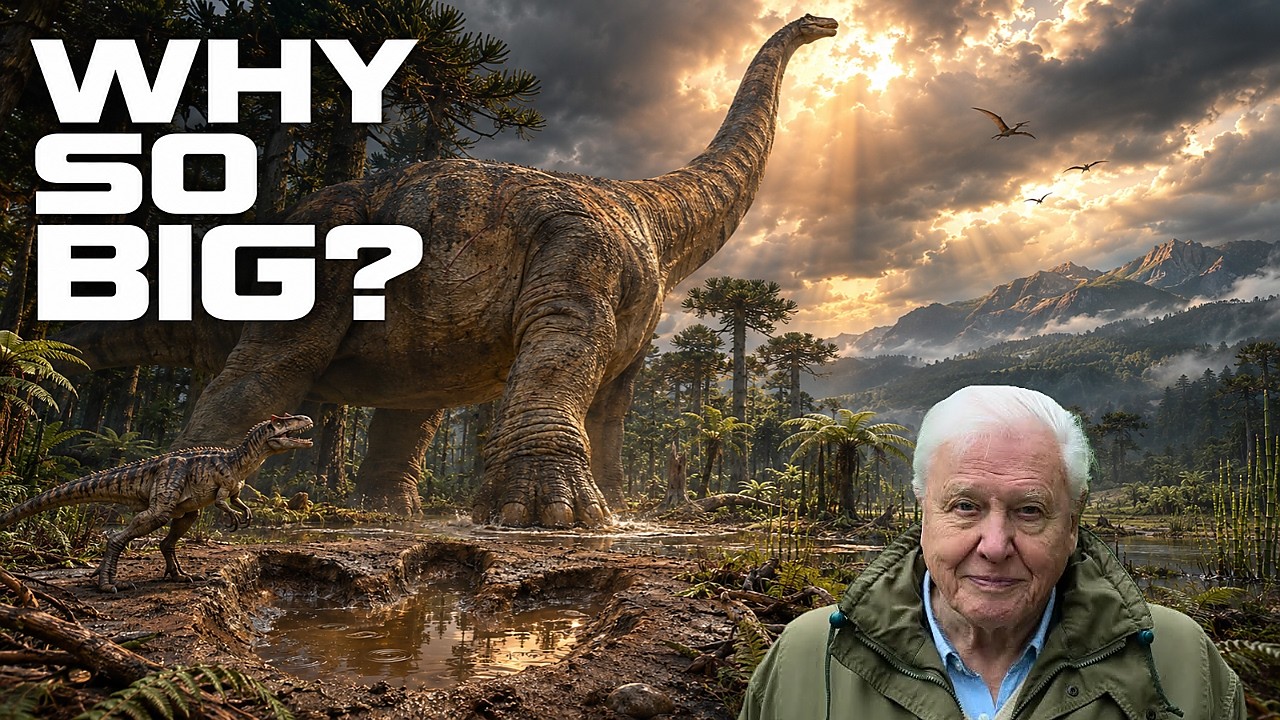
Sir David Attenborough: The Rise and Fall of Earth's Greatest Giants | Full Documentary
Title history
- Sir David Attenborough: The Rise and Fall of Earth's Greatest Giants | Full Documentary — observed on 20261110-2237 UTC (YouTube)
Keywords
Summary
149 words
Critical Evaluation
Value of the Information & Strength of the Argument
The value of the information lies in its comprehensive synthesis of multiple causal factors for gigantism, presenting a nuanced view that avoids single-cause explanations. It correctly distinguishes between the roles of oxygen, respiratory efficiency, body structure, and ecological context across different eras. The argumentation is structured logically, moving from general principles to specific examples, and supports claims with plausible biomechanical and ecological reasoning. The documentary effectively demonstrates how evolution responds to opportunities, using mass extinctions as turning points that open niches for new giants. However, it does not delve into counterarguments or recent scientific debates, and it lacks explicit citations, which slightly weakens its scholarly rigor.
Scientific Rigor, Source Quality, Title Accuracy
The documentary maintains a high degree of scientific accuracy in its descriptions of prehistoric animals and evolutionary mechanisms, consistent with current paleontological knowledge. It does not cite specific scientific papers or external sources, relying instead on general expert consensus. The title is appropriate, as the content indeed covers both the rise and fall of various giant species across geological periods. The narrative is well-organized and does not contain obvious errors or exaggerations. Without explicit references, the scientific rigor is based on the plausibility of the explanations rather than verifiable sources, but the overall presentation is reliable and educational.
219 words
Title / Content Match
The title accurately reflects the content: a comprehensive overview of how and why giant animals evolved and declined throughout Earth's history.
Quality & Reliability
8/10
The documentary presents scientifically plausible explanations for prehistoric gigantism, aligning with current paleontological understanding. It distinguishes between various causal factors and avoids over-simplification, though it does not cite specific studies or sources.
Key Moments
Markers derived by PSI from the transcript: the creator did not define chapters.
- Introduction to why gigantism occurred, setting up the question and overall theme.
- Discussion of Carboniferous period and high oxygen levels enabling giant insects like Meganeura and Arthropleura.
- Explanation of dinosaur gigantism, focusing on efficient respiratory systems and air-filled bones in sauropods.
- Coverage of marine reptiles and sharks, including ichthyosaurs, mosasaurs, and Megalodon, and the role of buoyancy.
- Transition to Ice Age mammals like mammoths and saber-toothed cats, and the role of mass extinctions in creating opportunities.
Contribution & Novelties
The documentary offers a holistic overview of gigantism across geological time, synthesizing multiple causal factors in a coherent narrative. Its originality lies in framing gigantism as an opportunistic response to ecological conditions rather than a linear trend, and in illustrating how different biological mechanisms (e.g., respiratory efficiency, reproduction, buoyancy) shaped size limits. It also emphasizes the cyclical nature of giant species’ rise and fall, linking extinction events to new adaptive radiations.
Pour aller plus loin :
- Gigantism (Wikipedia) — Overview of gigantism across taxa, including ecological and evolutionary causes.
- Cope’s rule (Wikipedia) — The tendency for lineages to increase in body size over time, relevant to the documentary’s discussion of size trends.
- Meganeura (Wikipedia) — Details on the giant dragonfly-like insect and its oxygen-driven size.
- Sauropoda (Wikipedia) — Information on the largest land animals and their unique respiratory and skeletal adaptations.
- Chicxulub impact (Wikipedia) — The asteroid impact linked to dinosaur extinction and subsequent mammal diversification.
156 words
Radar Profile
The radar profile shows high scores in quantity and quality of information, moderate technical depth, and strong reliability. This indicates a comprehensive, well-structured documentary that is accessible yet scientifically sound, with a balanced presentation of evidence.