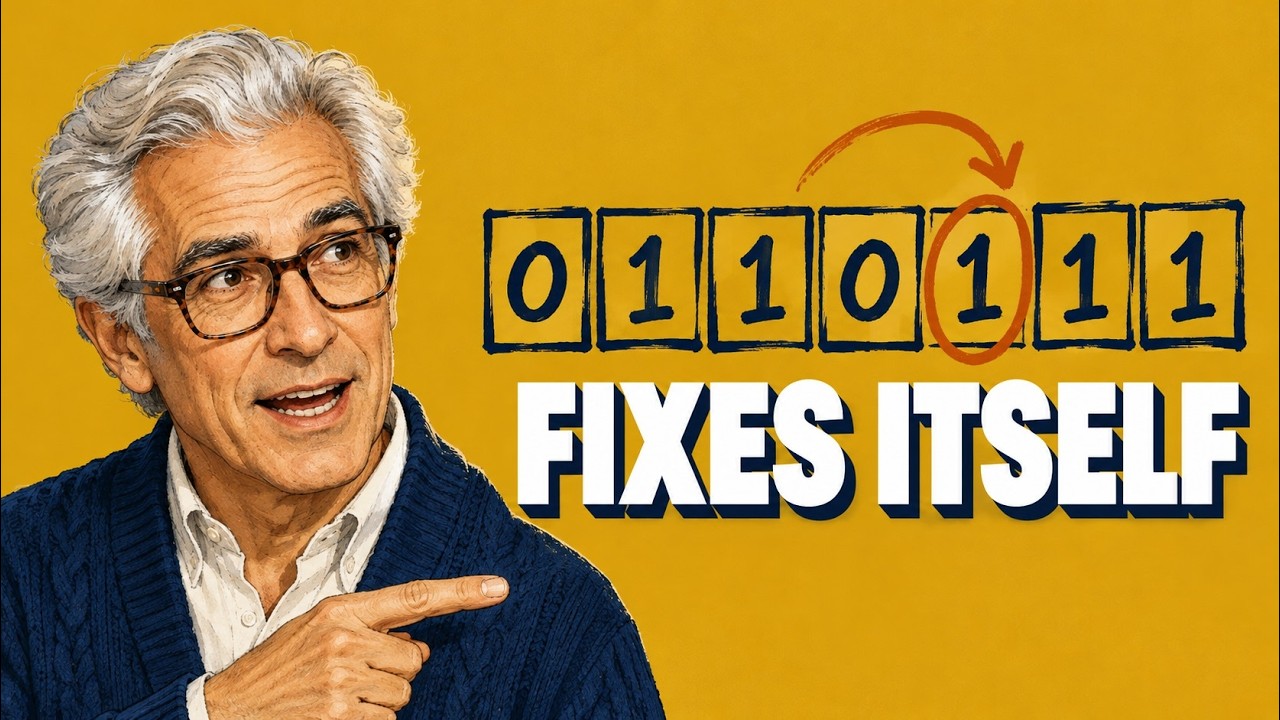
How Computers Fix Their Own Mistakes (Hamming Codes)
Title history
- How Computers Fix Their Own Mistakes (Hamming Codes) — observed on 20261031-2257 UTC (YouTube)
Keywords
Summary
139 words
Critical Evaluation
Value of the Information & Strength of the Argument
The video’s value lies in its clear, step-by-step exposition of a foundational concept in computer science. It builds the code from first principles, using counting and binary logic to derive the structure, which makes the material accessible to a broad audience. The argumentation is solid: every step is justified, and the presenter explicitly addresses common misunderstandings, such as why check bits are placed at specific positions. The historical narrative adds context without compromising technical accuracy. The video also demonstrates the practical relevance through ECC memory and space probes, reinforcing the importance of the subject.
Scientific Rigor, Source Quality, Title Accuracy
The scientific rigor is high: the video accurately presents the mathematical basis of Hamming codes, citing the original 1950 paper by Hamming and Shannon’s 1948 information theory work. The historical account is presented with appropriate caution, noting discrepancies in some details. The title fully matches the content, and the video’s structure with timestamps enhances its utility. The use of visual aids and examples supports comprehension, and the presenter’s claims align with established coding theory.
183 words
Title / Content Match
The title accurately reflects the content, as the video explains how Hamming codes enable error correction in computers.
Quality & Reliability
9/10
The video provides an accurate and thorough explanation of Hamming codes, supported by clear examples and references to the original works. The mathematical claims are correct and the historical context is presented with appropriate caveats regarding the exact chain of events.
Chapters
- How a flipped bit can hide in plain sight
- Repetition and parity bits: the costly fix and the cheap alarm
- Richard Hamming, the Bell Labs relay computer and lost weekend jobs
- Counting the situations: why 3 yes or no checks are enough
- Numbering positions in binary and building the 7-bit block
- Flipping a bit and reading its address from the checks
- The delayed 1950 paper and Shannon's 1948 information theory
- Double errors, SECDED and ECC memory
- Perfect codes, the Golay code and Voyager
- Putting it all together
Cited Sources
- Hamming, R. W. (1950). Error detecting and error correcting codes. Bell System Technical Journal. — The original paper introducing Hamming codes as referenced in the video.
- Shannon, C. E. (1948). A Mathematical Theory of Communication. — Shannon's paper that introduced information theory and included a Hamming code as an example.
- Golay code — Used by Voyager spacecraft as an extended Golay code, mentioned in the video.
Concurring Sources
- Hamming code - Wikipedia — Corroborates the technical details and properties of Hamming codes described in the video.
Contribution & Novelties
The original contribution of this video is its pedagogy: it explains a complex topic with exceptional clarity, using direct counting and binary address reasoning to make the concept intuitive. It fills a void for learners who seek a thorough understanding rather than just a formula.
Pour aller plus loin :
- Hamming code - Wikipedia — An overview of Hamming codes and their properties.
- Information theory - Wikipedia — The foundational context for error-correcting codes.
- Perfect code - Wikipedia — Explains why Hamming codes are perfect and lists known perfect codes.
- ECC memory - Wikipedia — Practical application of error correction in computer memory.
103 words
Radar Profile
The radar profile shows balanced scores across all four dimensions, with slightly lower technical level compared to quantity and quality, reflecting the video's accessibility while maintaining accuracy. The reliability score is high, indicating a trustworthy educational resource.