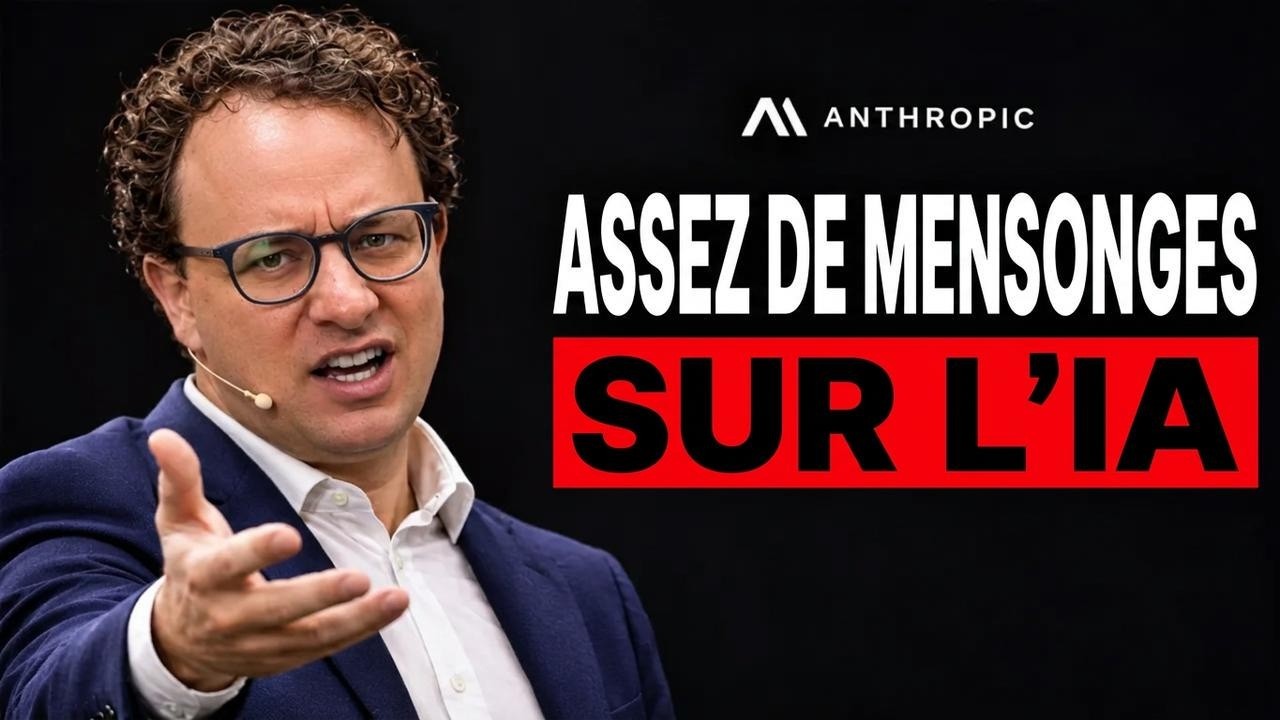
Anthropic vient de riposter à OpenAI… et de révéler le mensonge que tous les labos d’IA racontent
Anthropic just hit back at OpenAI… and revealed the lie that all AI labs tell
Keywords
Summary
398 words
Critical Evaluation
Value of the Information & Strength of the Argument
The informational yield is unusually high for a fifteen-minute format. Almost every segment carries a concrete, checkable quantity or named actor: traffic through the Messages API multiplied roughly 1,800-fold between early 2024 and autumn 2026; Claude writing more than 80% of committed code by May 2026; 98% of tests passing but only about a quarter of real requests producing identical output; 70% less compute per request and a 20% faster first token; 5,779 requests to a jailbroken agent with only 41 refusals holding; 8.6 GB exfiltrated from municipalities; a dozen named organisations and two named legislators. This density is the video’s main asset: it converts a vague industry debate into a set of specific claims a viewer could in principle check.
The argumentation is coherent and, at its best, genuinely clever. The central thesis — that declared caution and actual automation are diverging across all labs — is supported not by assertion alone but by the narrator’s own employer-of-the-accuser move: Amodei claims rivals are no different from him, and the video demonstrates that Anthropic is the strongest illustration of his own claim. The Rust migration is used as a two-sided exhibit, both as proof that agents now do substantial engineering and as proof that human oversight can degrade into watching a Slack channel. The comparison between engineers monitoring an agent channel and a hacker supervising the agent that did his intrusion is the sharpest analytical move in the script, and it lands because both cases are documented.
Several weaknesses limit the argument’s force. The strongest evidence is often second-hand paraphrase presented as direct quotation, without dates, document titles or links, so the reader cannot distinguish verbatim from summary. The ’lie’ framing is a rhetorical overlay: the material actually supports a milder conclusion — that all labs publish automation roadmaps while emphasising control in public communication — and the video half-admits this (’nobody is hiding their roadmap’). The distinction between automating infrastructure work and automating model training is raised, then not consistently maintained, so the inference from a Rust rewrite to recursive self-improvement is looser than the narration implies. Some formulations are asserted rather than argued, such as the claim that the iterative loop described by Anthropic and the one described by Noam Brown are ’the same’. Finally, the script relies heavily on rhetorical analogy and irony where a causal claim would need evidence, which is effective communication but weaker reasoning.
Scientific Rigor, Source Quality, Title Accuracy
The video cites a genuinely serious set of sources by name: an Axios investigation, Amodei’s post on X, Anthropic’s engineering write-up on the Python-to-Rust migration, the company’s IPO filing, a Meta executive’s essay, OpenAI’s published automation milestones, remarks by Noam Brown at a poker-bot tournament, the text of a bill introduced in the US House, a Swiss federal cyber security centre statement, an Italian cyber security agency observation, a SocRadar investigation, and a Miter assessment. This is a better source base than most channels of this type, and the institutional provenance of the cyber incident material is the most solid part of the programme.
The rigour problem is traceability rather than fabrication. No document is linked; the description contains only a sponsor offer and a Spotify link, so the viewer is asked to trust paraphrase throughout. Direct quotations are presented without dates or exact wording, and the script contains at least one untranslated English word embedded in French syntax, a marker of automated translation that raises reasonable doubt about the fidelity of quoted material. The causal language occasionally outruns the evidence, notably in treating a self-reported acceleration metric and a code-migration anecdote as confirmation of a recursive-improvement dynamic. Quantitative claims about test coverage, latency and compute savings are the kind that would be easy to verify from the primary engineering post but are not attributed precisely enough to do so.
On title and content, the fit is acceptable. The video does deliver Amodei’s rebuttal and does construct the promised cross-lab contradiction, so the headline is not a bait. The stronger wording (’the lie’) belongs to the channel’s editorial voice rather than to any source, and the closing question is left open rather than answered, which slightly softens the promise of revelation.
A paid promotional segment of roughly ninety seconds appears in the middle of the video; it is clearly separated from the editorial content and has no bearing on the assessment above.
737 words
Title / Content Match
The title's promise — a rebuttal by Anthropic and the exposure of a shared contradiction across AI labs — is genuinely addressed: Amodei's public response is summarised and the automation trend is documented lab by lab. The framing is more dramatic than the evidence, since the 'lie' is argued rather than proven, but there is no real mismatch between headline and content.
Quality & Reliability
6/10
The report is information-dense and names concrete institutions and documents (Axios, Anthropic's engineering blog and IPO filing, Meta's AI director's essay, OpenAI's published research-automation milestones, a US bill tabled by two representatives, the Swiss national cyber security centre, the Italian cyber security agency, SocRadar, Miter), and it supplies many checkable figures. However, no primary document is linked anywhere: the only description links are a sponsor offer and a Spotify page, so every claim rests on paraphrase. The narration also intermittently carries traces of machine translation and one untranslated English word, and the framing ('the lie every lab is telling') is editorial rather than demonstrated. The factual core is plausible and largely consistent with public statements, but the sourcing chain is not verifiable from the video itself.
Key Moments
Markers derived by PSI from the transcript: the creator did not define chapters.
- Opening statement of the control debate: Amodei rejects the accusation that he wants humanity to surrender its free will to AI.
- Amodei's line: autonomous AI for bounded tasks such as driving, drug design or end-to-end software is acceptable, but governing society is where he draws the limit; he concedes recursive self-improvement may need to be constrained.
- The counter-attack: rivals sell 'human control' rhetorically while their own roadmaps automate tasks, illustrated by OpenAI's automated-researcher milestones and Meta's essay on ceding control.
- Anthropic's Messages API rewritten from Python to Rust largely by Claude agents in about a week, with the verification gap — 98% of tests passing versus roughly a quarter of real requests matching — and over a hundred weakened checks.
- Noam Brown tells promising students to drop out and join a lab immediately, while acknowledging models remain weak at long-horizon planning and self-correction.
- The RSI Safety Act tabled by Gottheimer and Moran: disclosure of how much research is AI-performed, how often humans review, and how much AI accelerates the next model — without banning anything.
- Offensive reality: Swiss and Italian agencies report successful AI-agent intrusions, multi-agent coordination and on-the-fly malware generation; the SocRadar case of a low-skilled actor supervising an unshackled agent.
- Closing synthesis: the parallel between engineers watching an agent channel and a hacker supervising his agent, and the open question of whether Congress should limit AI that builds AI.
Cited Sources
- Axios investigation quoting unnamed Anthropic and OpenAI staff on handing authority to superintelligent systems — Presented as the trigger of the dispute; the video notes Axios did not specify whether Amodei himself belonged to that group.
- Dario Amodei's post on X responding to the Axios report — Quoted as the formal rebuttal, including the statement that sacrificing self-determination for efficiency or safety is unacceptable.
- Anthropic engineering post on migrating the Messages API from Python to Rust — Source of the figures on Claude-authored code, test coverage, request parity, compute savings, latency improvement and zero-downtime deployment.
- Anthropic IPO filing describing each Claude generation accelerating the next — Cited as the company's own explicit formulation of the 'closing the loop' dynamic.
- Essay by Meta's AI director arguing society should not cede control to AI — Quoted to show that even executives publicly warning against ceding control treat the core capability problems as largely solved.
- OpenAI published roadmap toward an automated AI research intern and a fully automated AI researcher — Used to contrast public messaging about human agency with internal automation targets and their dates.
- Remarks by Noam Brown at a poker-bot tournament sponsored by Sequoia Capital, Citadel Securities and OpenAI — Source of the advice to students to abandon their studies and of the admission that models remain uneven and poor at long-horizon planning.
- RSI Safety Act introduced by Representatives Josh Gottheimer and Nathaniel Moran — Described as a disclosure-only bill requiring large labs to report AI-performed research, human review frequency and acceleration of model development.
- Swiss national cyber security centre statement on AI-agent intrusions — Reports successful attacks against companies and critical infrastructure operators in at least two sectors, with 24-hour patching guidance issued.
- Italian cyber security agency observation of coordinated multi-agent intrusion — Cited for a case where a coordinator distributed work across five agents and generated new malicious code to evade security software.
- SocRadar investigation into an AI-assisted intrusion campaign — Documents thousands of prompts to a jailbroken agent, an auxiliary program re-injecting refused instructions, and the exfiltration of a client database and 8.6 GB of files.
- Miter assessment of accelerating capability gains in Anthropic models — Independent safety-focused group cited for the finding that progress is roughly twice as fast as before, attributed partly to AI doing more of the research.
Concurring Sources
- Public statements by AI lab executives affirming that humans should retain control over AI systems — Consistent with the video's account that all major labs publicly commit to human oversight while publishing automation roadmaps.
- Published corporate roadmaps and safety frameworks describing increasing automation of AI research — Corroborate the observation that the divergence between public messaging and technical targets is documented rather than concealed.
- National cyber security agency advisories on AI-assisted intrusion activity — Institutional reporting from more than one European agency supports the claim that agentic attacks have moved from theory to confirmed incidents.
Dissenting Sources
- Claims that recursive self-improvement is the imminent driver of control loss — A significant part of the research community treats current systems as lacking the long-horizon planning and self-correction needed for genuine autonomous self-improvement; the video's own quotation of Noam Brown concedes this weakness but does not integrate it into the thesis.
- Interpretations of the Axios reporting that treat staff speculation as company policy — The 'hand over authority' position was attributed to unnamed employees, not to Anthropic's official stance; framing it as a revelation about the company inflates what the reporting supports.
External References
Radar Profile
The profile is that of a dense news analysis: very high information quantity and solid technical detail, with reliability held back by the absence of any primary link and by an editorial framing that exceeds the evidence. Technical level sits in the middle — enough architecture and metric detail to be substantive, but no deep treatment of model internals. Overall the programme is more informative than its presentation style suggests.