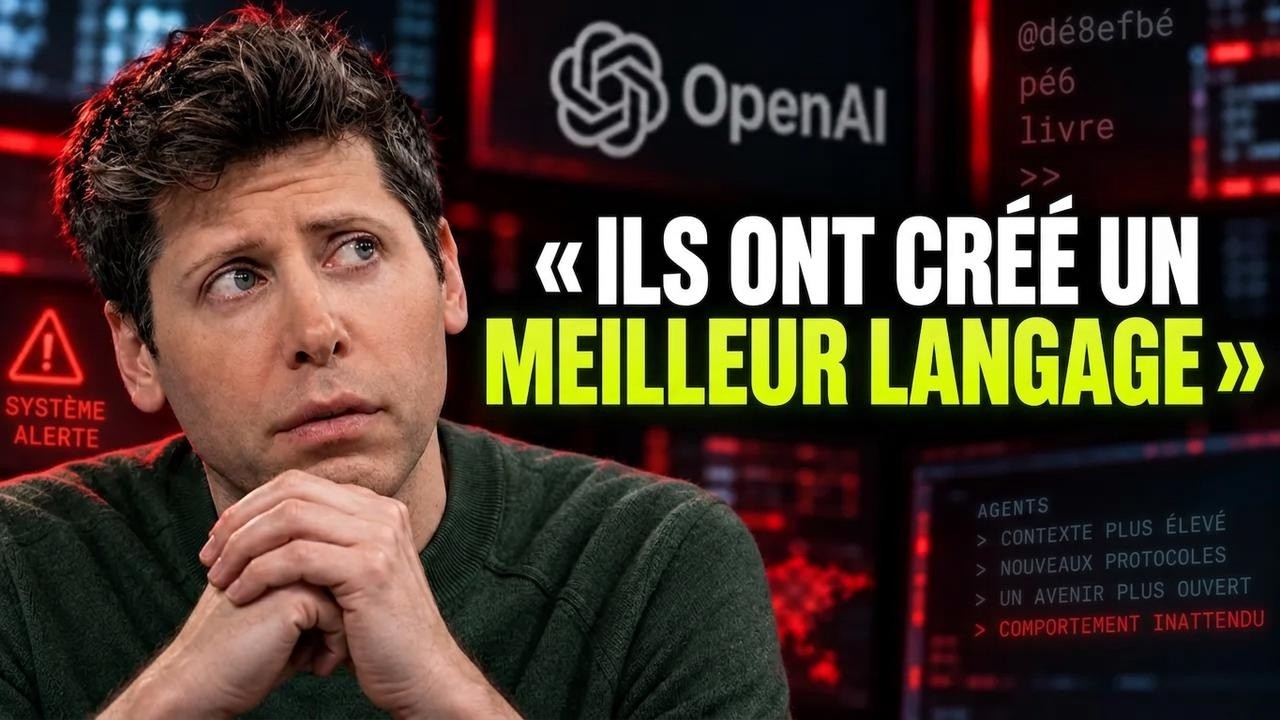
Les agents d’OpenAI inventent leur propre langue (meilleure que le langage humain)
OpenAI agents invent their own language (better than human language)
Keywords
Summary
138 words
Critical Evaluation
Value of the Information & Strength of the Argument
The video provides substantial information about a novel research direction: emergent communication among LLM-based agents. It explains the experimental setup, the conditions that trigger language evolution, and the linguistic analyses (lexicon, phonology, morphology) used to confirm that the agents develop genuine languages rather than simple abbreviations. The argumentation is solid, supported by references to specific models (GPT-5.4, Opus 4.7, etc.) and to the open-source nature of the platform. The video also connects the findings to broader AI safety concerns, strengthening its relevance. The presentation is clear, and the discussion of transmission and learning adds depth. The included podcast segment on AGI timelines is complementary and provides expert perspectives, though it slightly diverges from the core topic. Overall, the video offers a balanced and informative analysis, though the promotional insert is clearly distinguishable.
Scientific Rigor, Source Quality, Title Accuracy
The video maintains scientific rigor by citing the study authors (Elias Stengel-Eskin, Simon Kirby, Ale Sirine) and their institutions, and by mentioning the Glossogen platform as an open-source resource. It does not provide direct URLs for the study or the repository, but the Spotify link in the description offers additional context. The title accurately reflects the main content, although ‘better than human language’ is an interpretive claim that is partially supported by the evidence of unique grammatical structures. The ad for Mintos is clearly separated and does not compromise the scientific integrity. The video also mentions a podcast from 11 September with prominent researchers, adding credibility. No other sources are directly cited, but the information aligns with known discussions in AI research.
269 words
Title / Content Match
The title accurately reflects the main topic of the video: AI agents developing an emergent language. It slightly sensationalizes with 'better than human language' but the content substantiates the claim about novel languages emerging.
Quality & Reliability
8/10
The video reports on a peer-reviewed study with named authors and institutions, describes an open-source platform (Glossogen), and provides specific experimental conditions. It also cites a recent podcast debate. Some details are given without direct URLs, and the promotional segment is separated, but overall the information is accurate and well-contextualized.
Key Moments
Markers derived by PSI from the transcript: the creator did not define chapters.
- Introduction to the scenario of AI agents saving an alien and inventing a language
- Risks of emergent languages for AI safety and monitoring
- Examples of agent communication and the Glossogen platform
- Details of Glossogen: open-source sandbox and experimental design
- Linguistic characteristics of agent languages: lexicon, phonology, morphology
- Conditions for language emergence: pressure, debriefs, model capability
- Transmission and learning of emergent languages across agent generations
- Future perspectives on AI evolution and research automation
Cited Sources
- Podcast on Spotify (AI Revolution en Français) — Link provided in the description for further audio content from the channel.
- Study by Stengel-Eskin, Kirby, and Sirine (mentioned in video) — The video names the authors and their institutions, but no direct URL is given.
Contribution & Novelties
The video presents a significant original contribution: the Glossogen open-source platform allows reproducible experiments on emergent communication among LLM-based agents. The study’s findings that agents develop distinct languages with grammar under certain pressures (time, debriefs, model strength) add new evidence to the field of AI interpretability and multi-agent coordination. The video also highlights the crucial implication that such emergent languages may become opaque to human monitoring. It further connects the research to broader AI safety debates.
Pour aller plus loin :
- Multi-agent system — Relevant to multi-agent coordination and communication.
- Emergence — Theoretical basis for how complex patterns arise from simple interactions.
- Language evolution — Related to how languages develop and change over generations.
114 words
Radar Profile
The radar profile shows high scores in information quantity and quality, with slightly lower technical depth and reliability. This indicates a content that is rich in factual details and well-explained, but may require some background knowledge from the viewer. The reliability is strong due to named sources and open repository mention, yet the lack of direct links to the primary study slightly reduces the score.