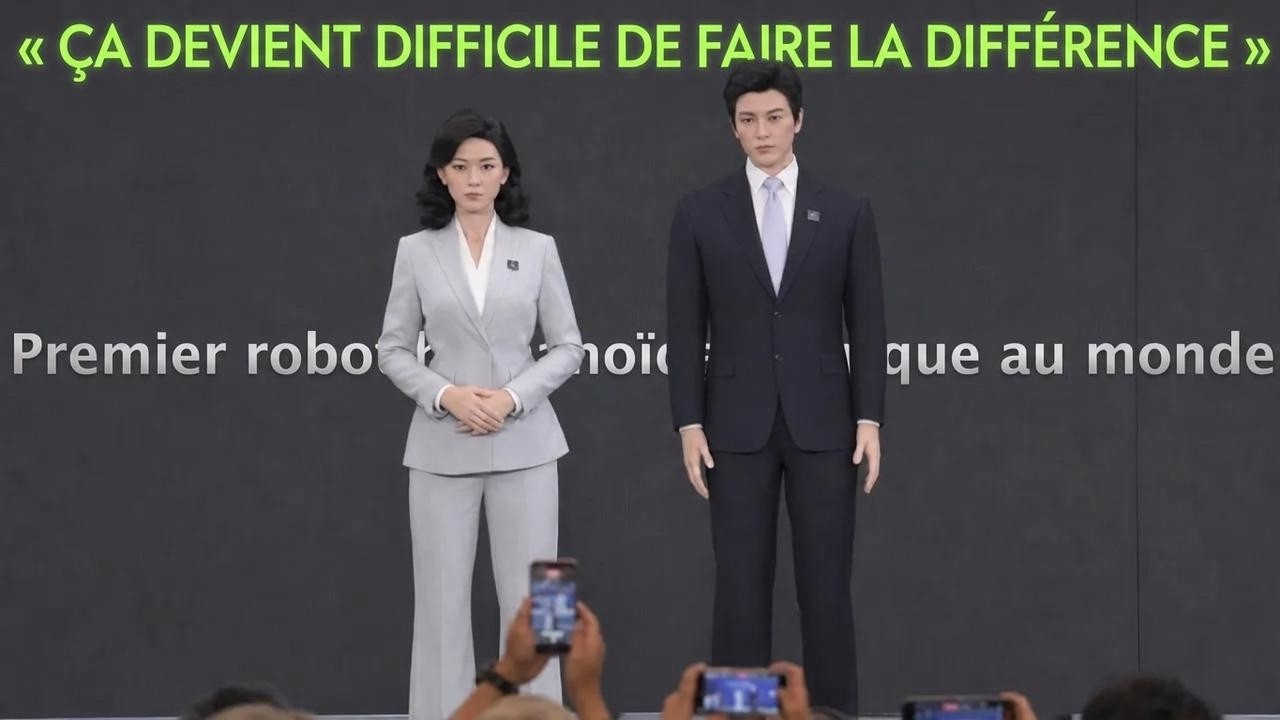
Les nouveaux robots bioniques chinois dotés d’IA ont l’air trop humains avec leur peau artificielle
The new Chinese bionic robots equipped with AI look too human with their artificial skin
Title history
- Les nouveaux robots bioniques chinois dotés d’IA ont l’air trop humains avec leur peau artificielle — observed on 20261110-0839 UTC (YouTube)
Keywords
Summary
128 words
Critical Evaluation
Value of the Information & Strength of the Argument
The video provides valuable overviews of several robot developments, offering details on technical concepts and practical implications. The argumentation is generally balanced, acknowledging limitations and potential issues such as the lack of rigorous error rate reporting and the reliance on state-controlled content libraries. However, the video tends to rely on promotional statements from companies without independent verification, and some claims are presented without supporting evidence.
Scientific Rigor, Source Quality, Title Accuracy
In terms of scientific rigor, the video is a news review rather than a primary source. It cites media reports and company announcements but does not provide direct links to academic papers or official data. The title accurately reflects the main theme but exaggerates by focusing on the ’too human’ aspect, which is subjective. The content matches the title’s promise, though it also covers additional topics, so there is a slight mismatch in scope.
154 words
Title / Content Match
The title highlights Chinese bionic robots with AI and artificial skin, which is the main focus of the first segment, though the video also covers other robot news; the sensationalized 'too human' aspect is somewhat exaggerated.
Quality & Reliability
5/10
The video provides a balanced overview of recent robotics developments, but it relies on unverified media reports and company claims without direct primary sources, limiting its reliability.
Key Moments
Markers derived by PSI from the transcript: the creator did not define chapters.
Cited Sources
- AI Revolution (Spotify podcast) — Podcast version of the video content, mentioned in the description.
Contribution & Novelties
The video aggregates recent developments and provides context, but its originality is limited as it compiles news from other sources. Its main contribution is the comparative analysis of different robot applications and the critical questioning of claims.
Pour aller plus loin :
- Humanoid robot — General overview of humanoid robots.
- Artificial skin — Biomedical and robotic applications of synthetic skin.
- Biomimetics — Engineering inspired by biological systems, relevant to the moth robot.
72 words
Radar Profile
The radar profile shows moderate scores across all dimensions, indicating a balanced but not particularly deep or highly reliable content.