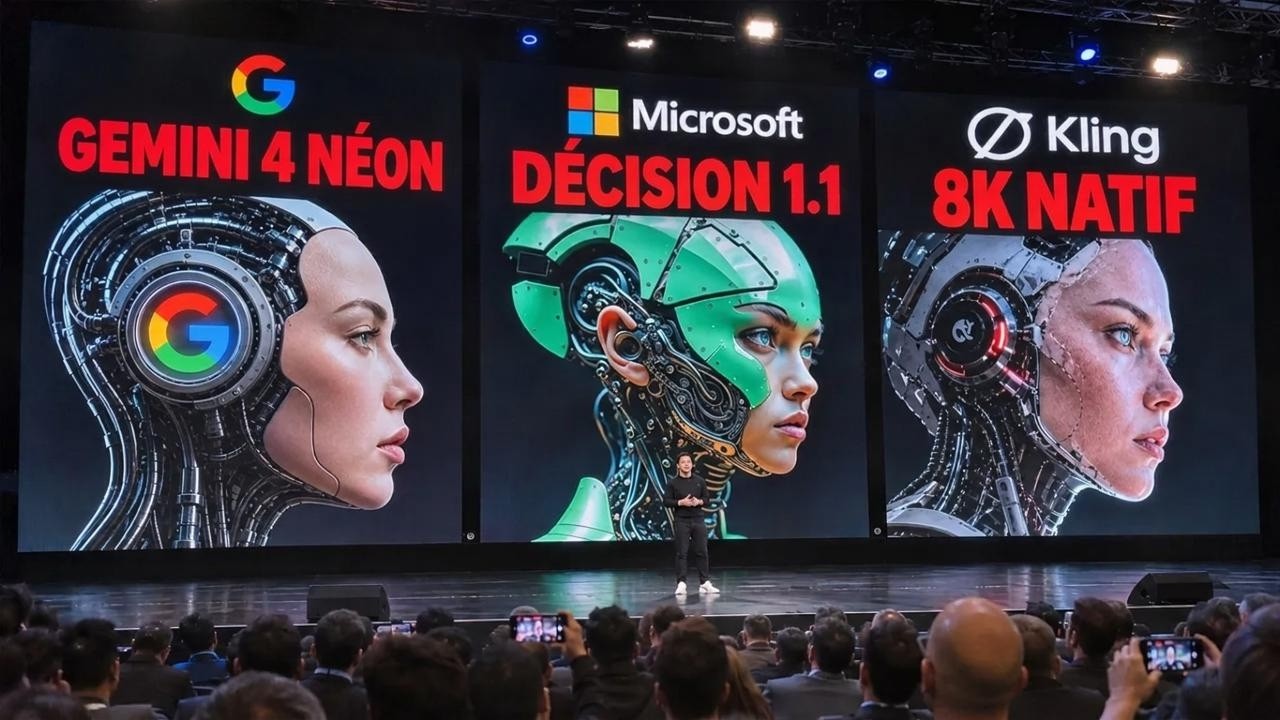
Google lance Gemini 4 Neon, Microsoft sort 3 modèles, nouveau RSI, Kling passe à la 8K...
Google launches Gemini 4 Neon, Microsoft releases 3 models, new RSI, Kling moves to 8K...
Title history
- Google lance Gemini 4 Neon, Microsoft sort 3 modèles, nouveau RSI, Kling passe à la 8K... — observed on 20261120-0930 UTC (YouTube)
Keywords
Summary
147 words
Critical Evaluation
Value of the Information & Strength of the Argument
The video offers substantial value by consolidating multiple AI developments into a concise format, with concrete numbers on model performance and pricing that allow for direct comparison. The argumentation is structured around key announcements, each supported by specific examples and benchmark results. However, the video relies heavily on the host’s narrative and does not provide primary sources or links to the studies mentioned, which limits the ability to independently verify claims. The tone is informative and relatively objective, though occasional subjective commentary appears, such as calling the Blender demonstration ‘dingues’ (crazy).
Scientific Rigor, Source Quality, Title Accuracy
The rigor is moderate: the video cites numerous specific figures (e.g., benchmark scores, token costs, parameter counts) and names research institutions (Google DeepMind, Microsoft Research, etc.), but it does not include direct references or URLs. The title accurately reflects the content, and the video’s structure follows a logical progression. The lack of formal citations reduces the scientific rigor; viewers cannot trace the claims to original papers or official announcements. Nevertheless, the information appears consistent with known trends in AI, and the channel seems to base its coverage on publicly available information.
197 words
Title / Content Match
The title accurately lists the main topics: Gemini 4 Neon, Microsoft models, SIM, and Kling 8K. The content matches the title closely, with additional items like HeyGen Avatar 6 also covered.
Quality & Reliability
6/10
The video provides specific benchmark numbers, model prices, and technical details, but lacks direct links to the studies or papers mentioned. Claims are presented without verifiable citations within the video, though the channel appears to be a dedicated AI news source with consistent output.
Key Moments
Markers derived by PSI from the transcript: the creator did not define chapters.
- Introduction to the major announcements of the week
- Gemini 4 Neon: performance benchmarks and demonstrations
- SIM (Self-Improvement Memory) explained
- Opus builds a neural network without training
- Microsoft Decision and its Ignite models
- Kling Image 4.0 goes native 8K
- HeyGen Avatar 6: realistic talking avatars
Cited Sources
- AI Revolution en Français - Podcast — Link to the Spotify version of this video, mentioned in the description as an alternative to watch or listen.
Contribution & Novelties
This video provides a timely and comprehensive roundup of recent AI releases, with a focus on Gemini 4 Neon’s competitive advantages and the novel SIM system for recursive self-improvement. It also covers Microsoft’s research on interpretable neural networks and its cost-effective Decision model, alongside updates from Kling and HeyGen. The video adds value by synthesizing information from multiple sources and offering practical context (e.g., real-world demos, pricing comparisons).
Pour aller plus loin :
- Recursive self-improvement — directly relevant to the SIM system and AI self-improvement concepts discussed.
- Transformer (deep learning architecture) — foundational to the models mentioned (Gemini, Claude, GPT) and the interpretable network construction in Microsoft’s research.
- Large language model — context for the LLM-based approaches and benchmarks referenced throughout the video.
123 words
Radar Profile
The radar profile shows high scores in quantity and technical level, moderate in quality and reliability, indicating a content-rich video that might lack in-depth sourcing. The balance suggests a news-oriented format suited for keeping up with AI developments, but not for deep technical verification.